


CUBE AMS
Cube AMS 2026: Lightweight full-suspension performance for XC and trail
The CUBE AMS series represents the ultimate in mountain bike innovation and performance. These bikes are the result of intensive research and development, with a focus on speed, efficiency and an unparalleled riding experience.
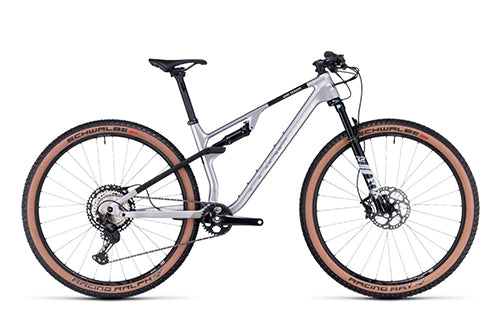
CUBE AMS
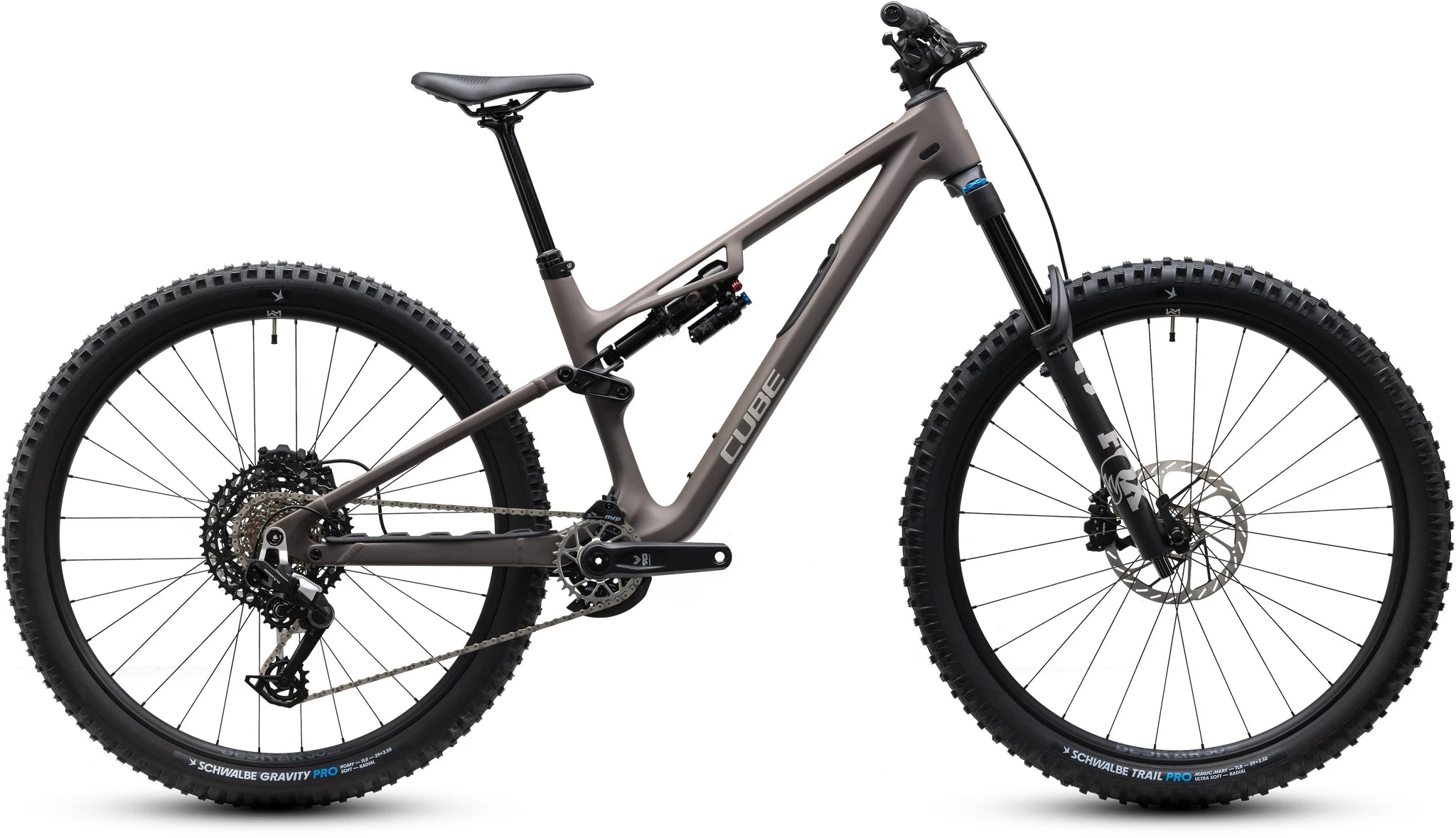
CUBE Stereo HPC
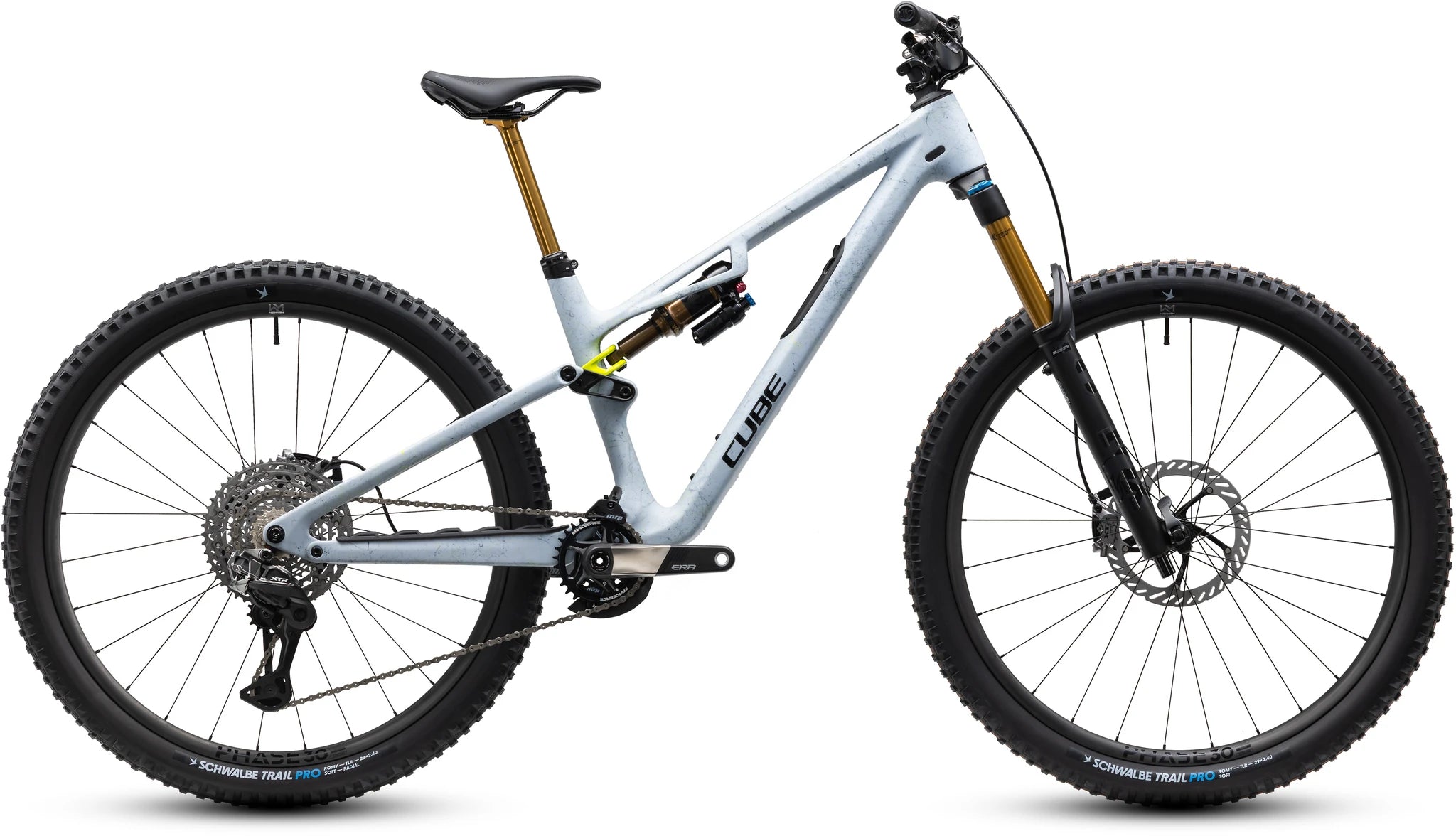
CUBE Stereo C:62
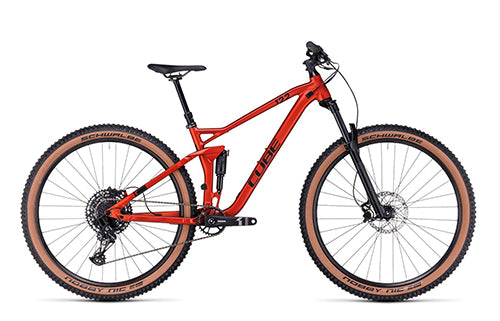
CUBE Stereo One22
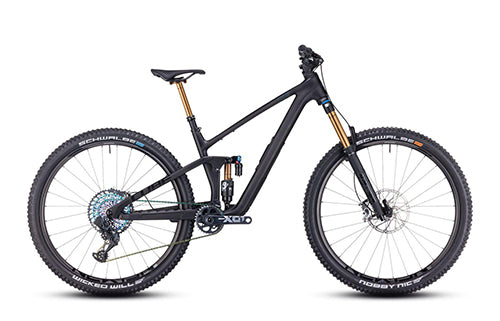
CUBE Stereo One55
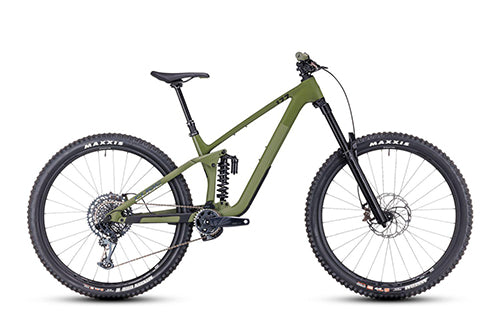
CUBE Stereo One77
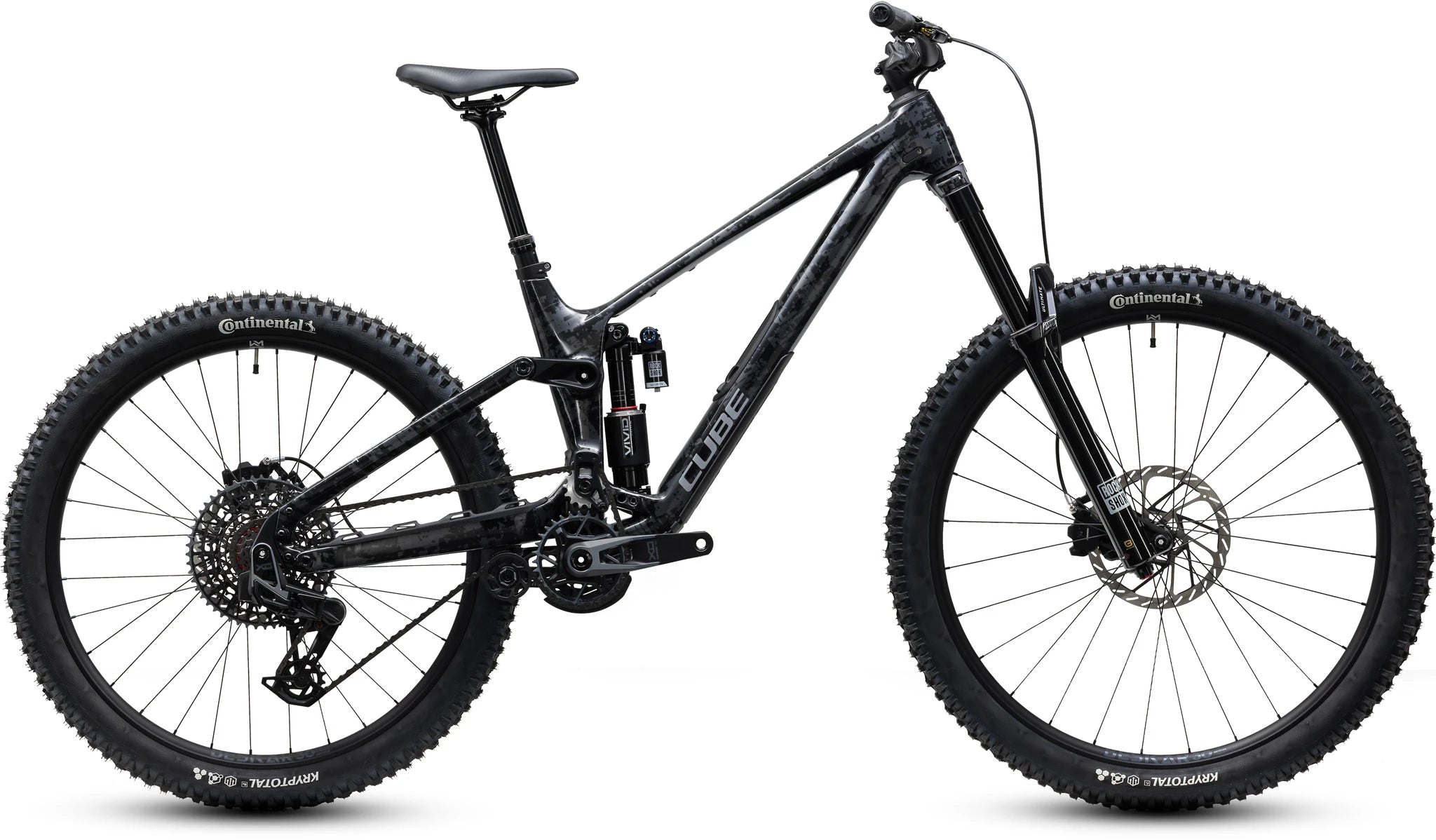
CUBE Fritzz C:62
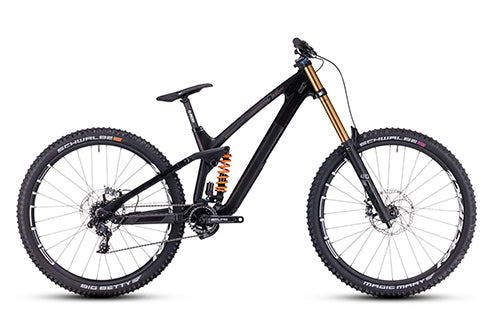
CUBE Two15
Filters
Cube AMS for cross-country and trail
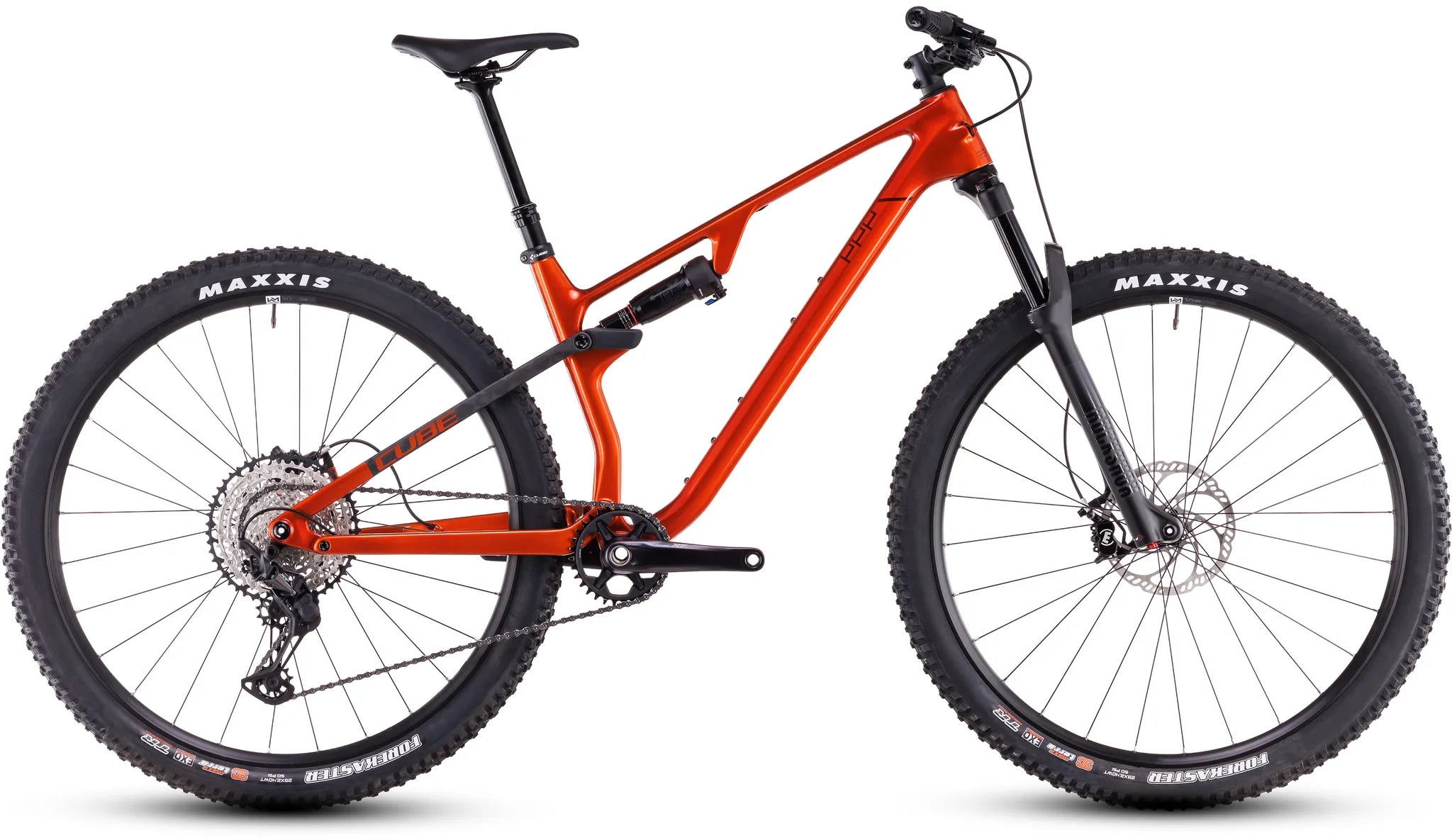
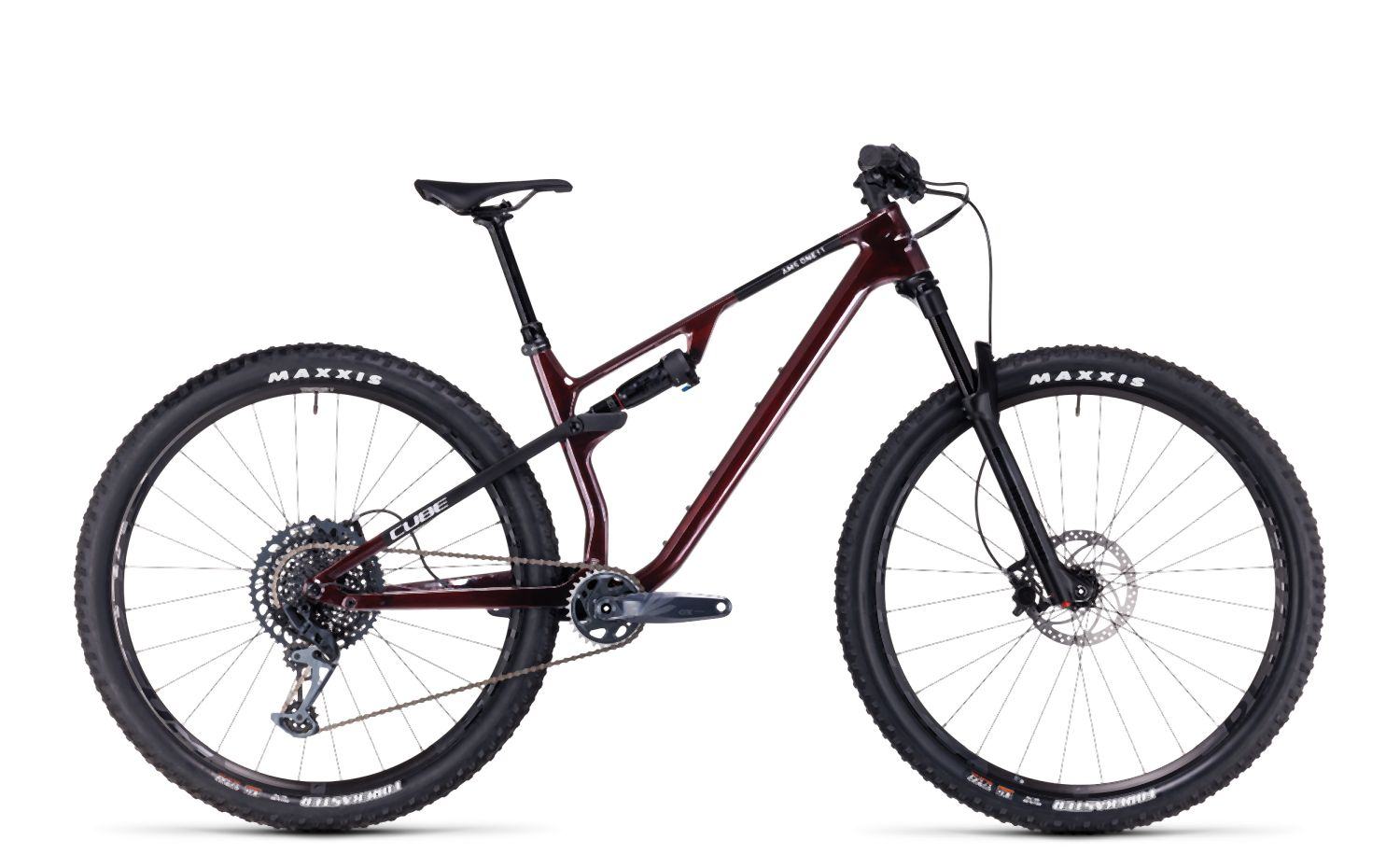
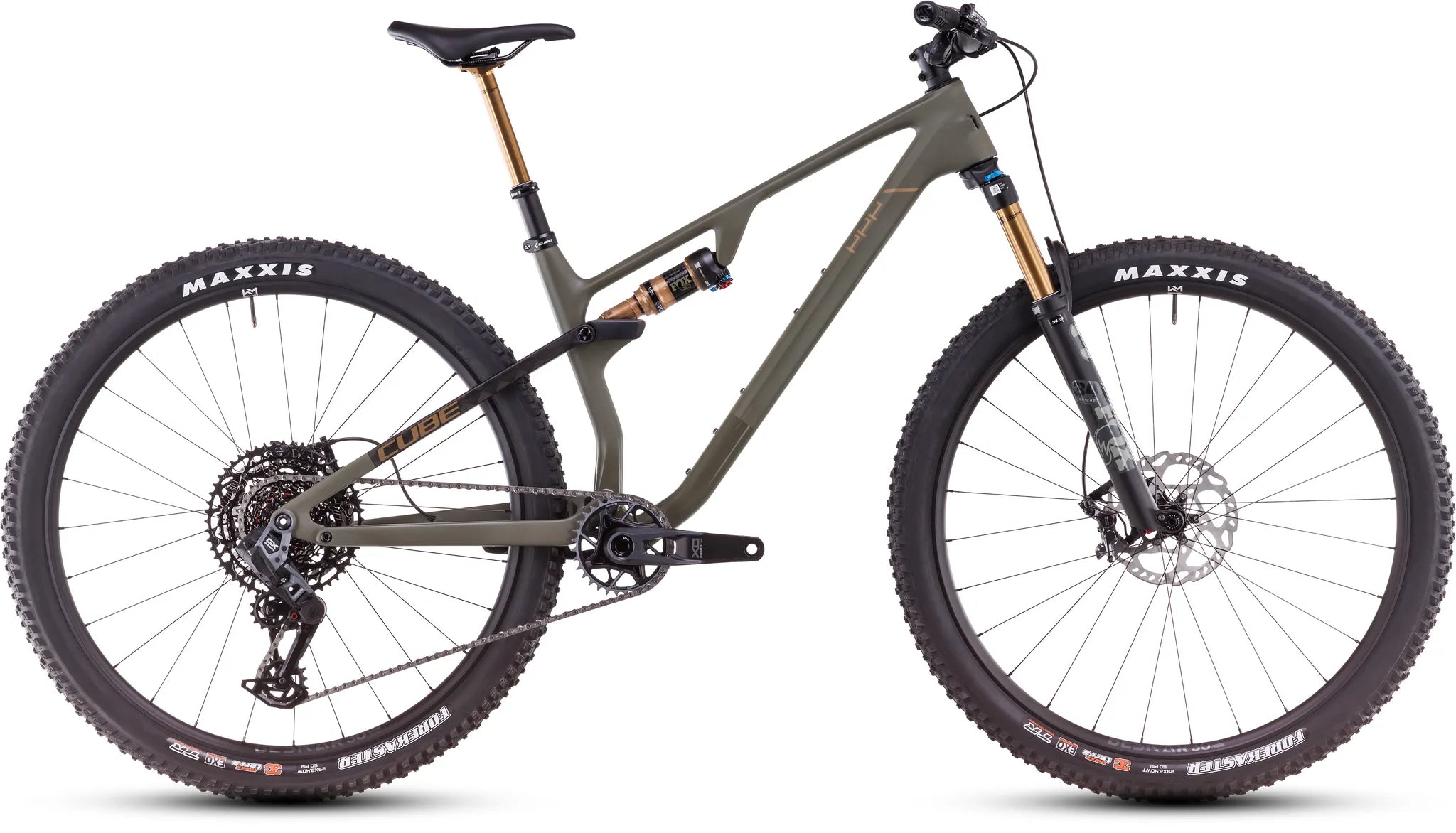
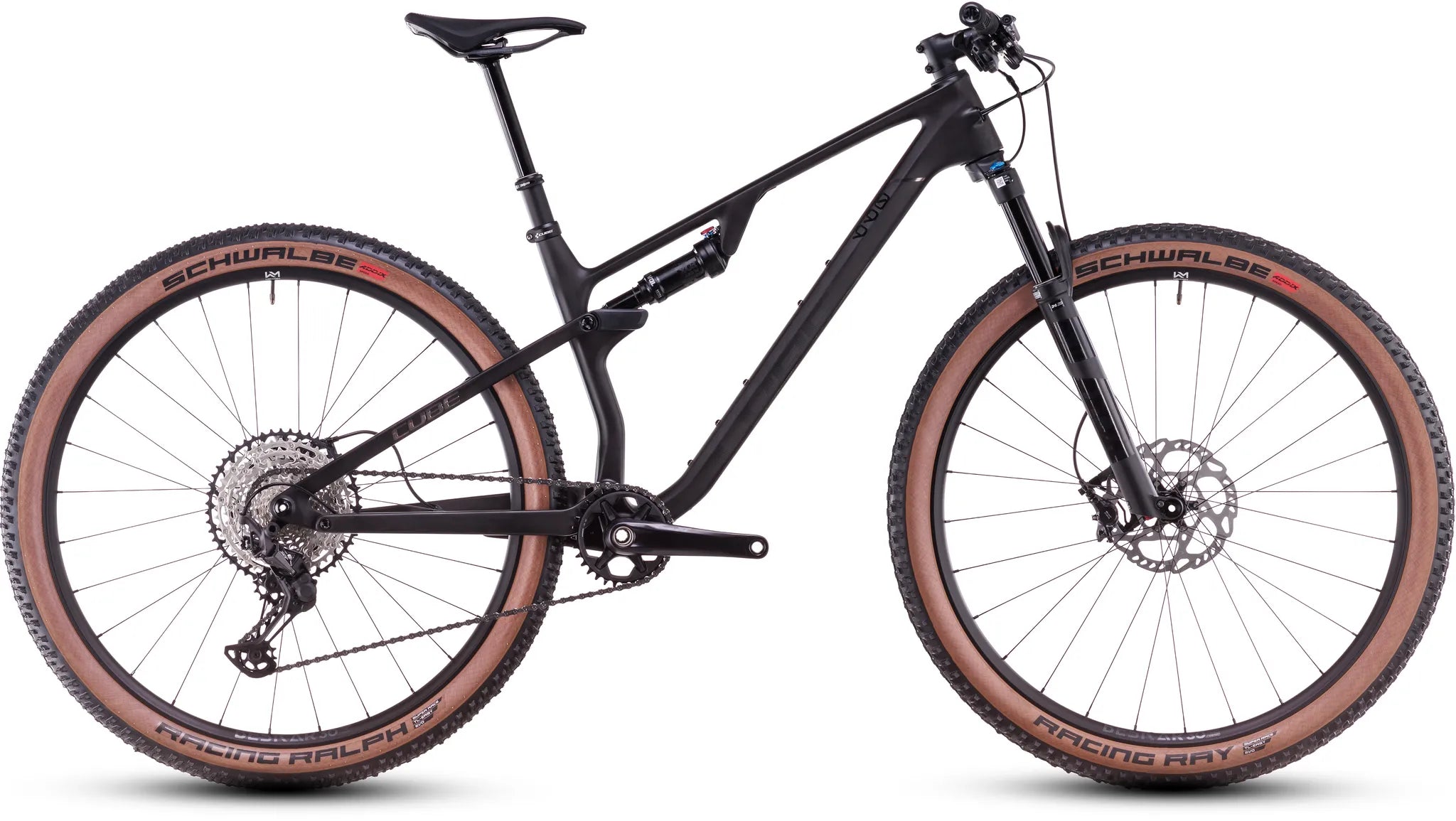
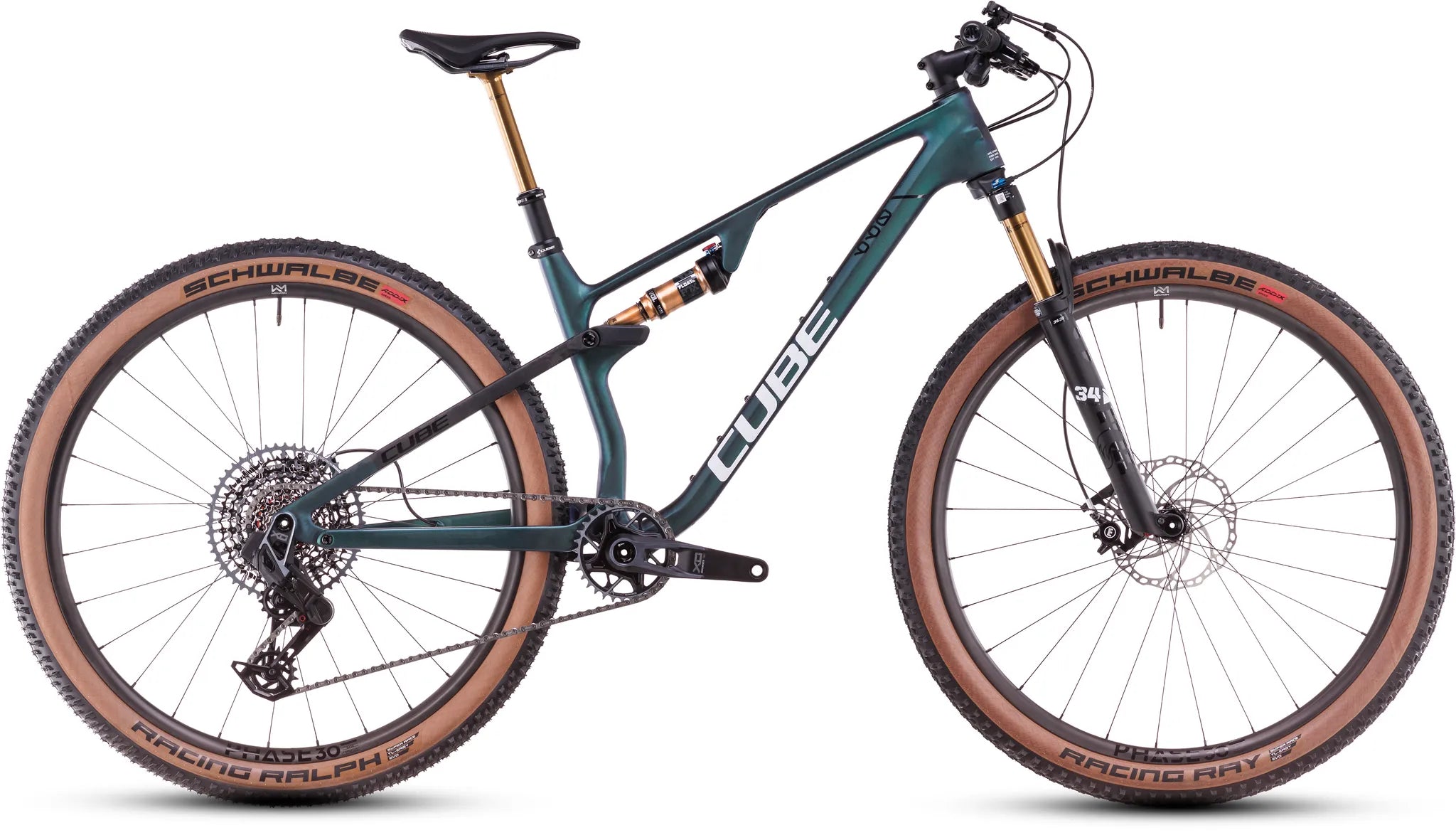
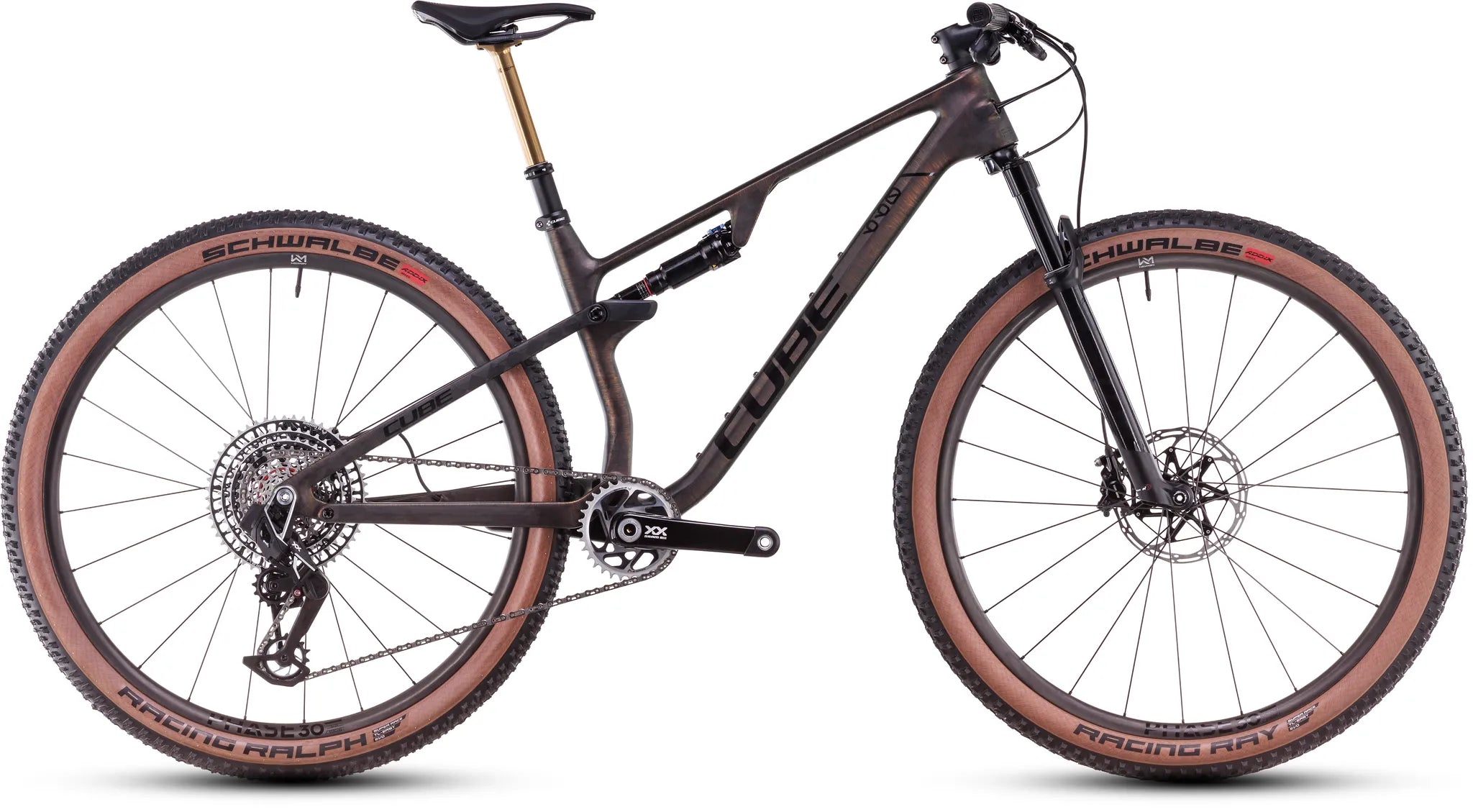
The Cube AMS is a lightweight full-suspension mountain bike for riders who want to minimize energy loss on climbs and benefit from a controlled suspension system on descents. The current model series covers two areas of use: The AMS ZERO99 is aimed at cross-country racing, fast marathons, and athletic training. The AMS ONE11 combines this efficient character with more travel and trail-oriented components.
As a result, the AMS series has evolved from a classic race full-suspension bike into a model family that also covers the down-country segment. Both variants feature 29-inch wheels and a lightweight C:68X carbon frame. However, differences in travel, tires, cockpit, and geometry significantly alter how the bikes feel on the trail. The ZERO99 reacts more directly and accelerates more easily. The ONE11 offers more stability over roots, rocks, and steeper descents.
Cube AMS ZERO99 and AMS ONE11 in comparison
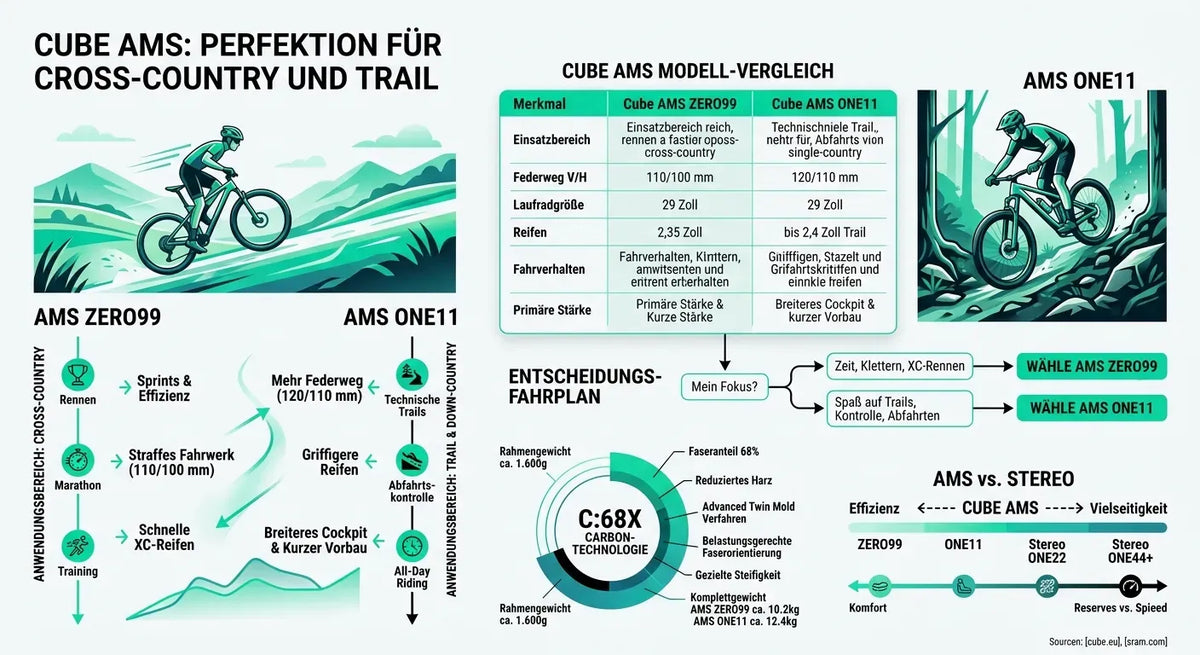
The most important decision concerns the intended use. Anyone who counts seconds, frequently accelerates uphill, and rides a large portion of their tours on fast cross-country tracks will find the AMS ZERO99 the more suitable bike. Anyone who incorporates technical trails into their laps and is looking for more safety margins on descents should check out the AMS ONE11.
| Feature | Cube AMS ZERO99 | Cube AMS ONE11 |
|---|---|---|
| Field of application | Cross-country, marathon, training and racing | Down-country, marathon and technical trails |
| Front travel | 110 mm | 120 mm |
| Rear travel | 100 mm | 110 mm |
| Wheel size | 29 inch | 29 inch |
| Tires | Fast XC profiles, usually 2.35 inches depending on the model | Grippier trail tires, up to 2.4 inches depending on the model |
| Handling | Direct, firm, and designed for rapid acceleration | Calmer, higher traction, and more forgiving |
| Cockpit | Tends towards narrower handlebars and a longer stem | Wider handlebars and a shorter stem |
| Primary strength | Acceleration and efficiency | Control in technical terrain |
The AMS ZERO99 features 100 mm of rear travel, which it combines with a 110 mm suspension fork. This setup is well-suited to modern cross-country courses, where short jumps, rock gardens, and steep descents have long been part of the standard profile. The travel remains minimal enough to ensure the bike generates little movement during sprints or when climbing out of the saddle. At the same time, the suspension relieves the rider during long races and keeps the rear wheel in better contact with the ground on uneven terrain.
With the AMS ONE11, 110 mm of travel is available at the rear and 120 mm at the fork. That sounds like a small difference, but it has a noticeable effect on the trail. The suspension can absorb impacts for longer before it sits deep in its travel.
Wider tires increase traction and dampen small bumps. A wider cockpit improves control, while a shorter stem makes steering more direct on tight trail sections.
The geometry also appeals to different types of riders. With the ZERO99, the focus is on precise handling and an efficient riding position. The ONE11 can be tuned more towards stability. Current models feature headset cups for adjusting the head tube angle. A slacker setting provides more composure on descents. The steeper position makes the bike more maneuverable on twisty trails.
Which model suits your riding style?
- Choose the AMS ZERO99 if you race cross-country, frequently train against the clock, or are looking for the lightest possible full-suspension bike for long marathon distances.
- Choose the AMS ONE11 if your tours include technical singletrack and you want more traction and control on descents.
- The ZERO99 is a better fit for riders who have mastered active line choice and prefer direct feedback from the terrain.
- The ONE11 makes sense if you want to compensate for minor riding errors with more suspension travel and grippier tires.
- For predominantly wide forest paths and simple race courses, a hardtail can be lighter and require less maintenance.
How does the AMS ZERO99 differ from the previous AMS 100?
The designation AMS 100 is found primarily on older model generations. The current AMS ZERO99 occupies a similar position within the Cube range as a lightweight cross-country full-suspension bike. Nevertheless, it should not be seen as a mere name change. Frame shape, geometry, wheel standard, and components depend on the respective model year.
Anyone switching from an older AMS 100 to a current ZERO99 will receive a more modern, finely tuned race bike. Today's frame offers clearance for wider tires, adjustable head tube geometry, and current standards such as a Boost rear hub and Universal Derailleur Hanger. With 100 mm of travel at the rear, it remains firmly rooted in the cross-country segment. The 110 mm fork provides additional reserves at the front.
What is the difference between the Cube AMS and Stereo?
The Cube AMS is designed for low weight, efficient power transfer, and sporty speed. The Stereo series covers a broader spectrum, ranging from tour and trail to enduro. Therefore, an AMS typically handles more directly and requires a cleaner line choice in rough terrain. A Stereo focuses more on comfort, traction, and reserves for longer descents.
The model designation provides an initial clue. The Stereo ONE22 is a lightweight touring and trail full-suspension bike with more comfort than a typical race bike. The Stereo ONE44 is aimed at more demanding trail and all-mountain tours. The Stereo ONE55 and ONE77 are designed for significantly rougher terrain. As travel increases, tire width, braking performance, and the stability of the suspension components usually increase as well. However, the additional material adds weight and can make the bike feel less lively on fast climbs.
Decision based on terrain and riding style
If you are planning fast laps, races, and long climbs, the AMS is the more sensible starting point. This is especially true for the ZERO99. The ONE11 serves as a middle ground if you still want to climb efficiently but ride technical trails regularly.
If touring comfort and downhill capabilities are more important than keeping weight to a minimum, a Stereo is often a better fit. The Stereo ONE22 is already designed more for extended trail rides. For steeper routes, bigger hits, and frequent excursions into alpine terrain, Stereo models with more travel are suitable options.
| Your focus | Suitable series | Justification |
|---|---|---|
| XC racing and fast marathons | AMS ZERO99 | Low weight, 100 mm rear travel and direct acceleration |
| Sporty tours with technical trails | AMS ONE11 | More reserves with a still-efficient riding position |
| Long tours with high comfort requirements | Stereo ONE22 | Tour-oriented geometry and smoother handling |
| All-Mountain and demanding descents | Stereo ONE44 or model with more travel | Sturdier design for rougher terrain |
Is the rear triangle the decisive distinguishing feature?
A detailed comparison of the frame kinematics shows the difference: the AMS uses a zero-pivot rear triangle, while the Stereo employs a four-bar linkage. The manufacturer tunes the position of the pivot points to the specific intended use. Even within the Stereo series, kinematics and tuning vary depending on the model.
For a purchasing decision, suspension travel, geometry, tires, and overall weight are therefore more informative than a simplified classification based on the number of pivot points. Two bikes with a similar rear suspension design can ride quite differently if the shock tuning, leverage ratio, and frame geometry differ from one another.
How does C:68X carbon technology save weight?
The frame has a particularly strong influence on the weight of a full-suspension race bike. For its current AMS models, Cube uses C:68X carbon and the Advanced Twin Mold process. This involves adapting the fiber type, fiber angle, and amount of material to the stress in each specific frame zone. Highly stressed areas receive a different fiber arrangement than sections exposed to lower forces.
The number 68 is derived from a high fiber content of 68 percent and a correspondingly reduced resin content. C:68X further develops this material concept. Depending on the frame area, Cube uses different types of fibers and aligns them according to the expected load. As a result, the frame does not need to be built with the same wall thicknesses and additional reinforcements everywhere.
- A high fiber content reduces the amount of comparatively heavy resin in the composite material.
- Load-oriented fiber alignment saves material in areas subject to less stress.
- The Advanced Twin Mold process keeps the carbon layers in the intended position during curing.
- Precisely manufactured transitions reduce the need for additional sleeves and reinforcement elements.
- Different fiber types allow for a targeted adjustment of stiffness and compliance.
Cube states that the current frames for the AMS ZERO99 and AMS ONE11 each weigh approximately 1,600 grams. The complete AMS ZERO99 C:68X SLT 29 weighs around 10.2 kilograms in its standard configuration. The AMS ONE11 C:68X TM 29, with its more robust suspension, wider tires, and trail-oriented components, weighs about 12.4 kilograms. These values may vary depending on size and specifications.
Why does a lightweight full-suspension bike accelerate faster?
When accelerating, the rider must set the mass of the entire bike in motion. Less weight is therefore noticeable when sprinting out of tight corners and during changes in pace. Lightweight wheels and tires have an additional impact because their rotating mass must be repeatedly accelerated.
On climbs, a low system weight reduces the work that rider and bike must perform against gravity. This advantage adds up in long races with significant elevation gain. However, a light frame alone does not make a bike fast. Riding position, tire rolling resistance, suspension setup, and physical performance also influence the result.
How big is the difference to C:62 carbon?
C:62 Carbon also uses a precise monocoque manufacturing process and is designed for lightweight, resilient frames. C:68X allows Cube to achieve an even more targeted selection of materials and fiber orientation. A universal percentage of weight savings cannot be derived from this. The actual frame weight depends on geometry, suspension travel, bearings, and safety margins.
In practice, what counts is the complete bike. A C:68X frame can lose some of its weight advantage due to heavy wheels or robust tires. Conversely, a sensibly equipped C:62 bike can be lighter than a C:68X model with more massive trail components. Therefore, always compare the specified complete weight in the appropriate frame size.
Which Cube bike is best suited for cross-country?
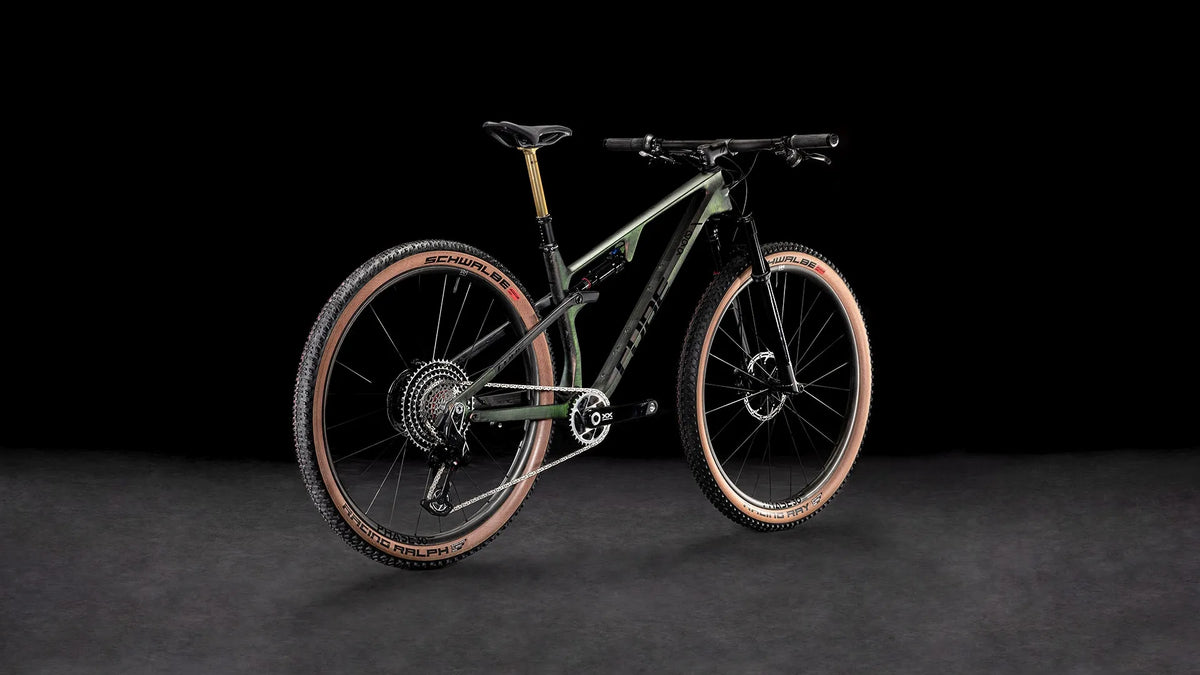
Anyone looking for a full-suspension bike for cross-country should first consider the Cube AMS ZERO99. Its short travel, lightweight frame construction, and sporty riding position are well-suited to races, fast training rides, and marathon distances. The suspension increases traction over roots and rocks without significantly diluting the direct character of a race bike.
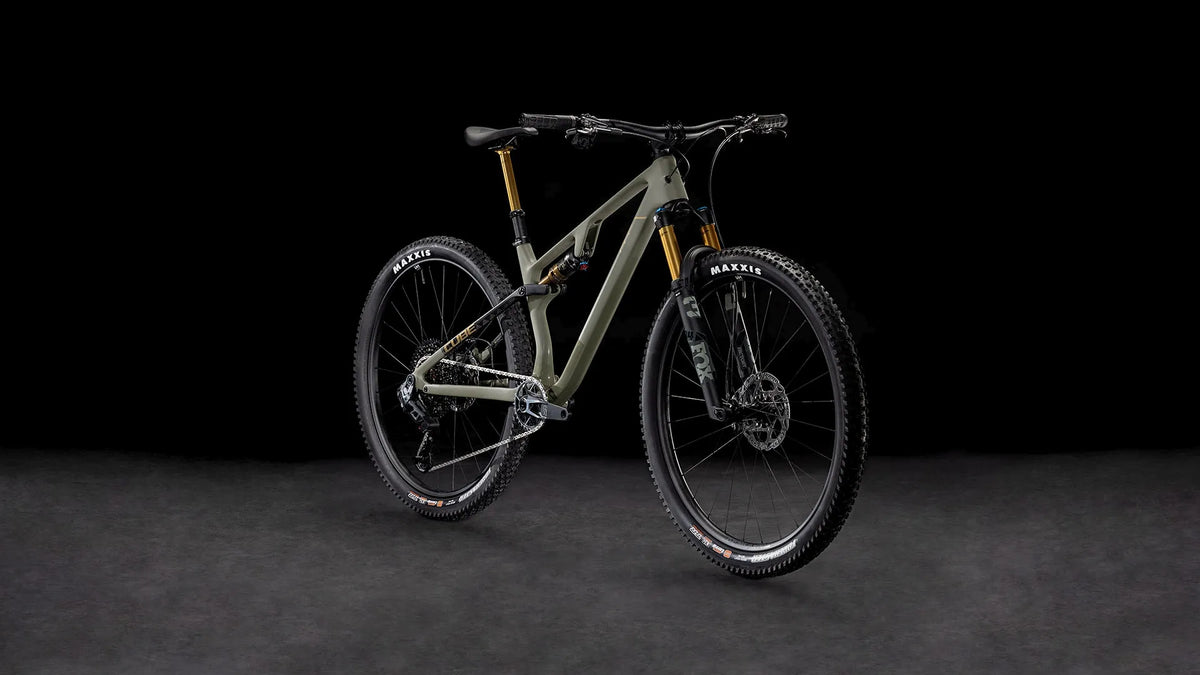
The AMS ONE11 is the better choice when the course becomes more technically demanding. It is suitable for riders who incorporate longer descents, steep sections, and rougher trails into their cross-country laps. Compared to the ZERO99, the more robust equipment adds weight but offers more control and reduces physical strain on uneven terrain.
For smooth and less technical courses, the Cube Phenix C:68X remains an alternative. As a hardtail, it dispenses with a rear shock and the bearings of the rear triangle. This saves weight and maintenance effort. On root carpets or long, rocky descents, however, a hardtail requires more riding technique and puts more strain on the rider. The AMS ZERO99 makes more sense as soon as traction and shock absorption from the rear triangle promise greater time gains.
| Route type | Recommendation |
|---|---|
| Smooth course with long climbs and few technical sections | Cube Phenix C:68X |
| Classic XC course with roots, rocks, and short descents | Cube AMS ZERO99 |
| Technical XC course with steep and rough trail sections | Cube AMS ONE11 |
| Tour-oriented use without a racing focus | Cube Stereo ONE22 |
How to set up the suspension on your Cube AMS
A proper suspension setup begins with the negative spring travel, known as SAG. It describes how far the fork and shock compress under the weight of the rider, ready to ride. Rider weight includes shoes, helmet, clothing, hydration pack, and all items you usually carry with you. Body weight alone is therefore not a sufficient basis.
The air pressure is only a starting value. Two riders with the same weight may require different settings due to their riding position and riding style. First, use the pressure recommendation from the respective suspension manufacturer. The markings on the fork or the serial number of the component help in finding the appropriate initial setting. RockShox and Fox provide model-dependent values.
Tuning the suspension in seven steps
- Check the tire pressure and place the bike on a level surface. Open the compression damping and deactivate the lockout on the fork and shock.
- Put on your full riding gear. Also take along your water bottle, tools, and backpack if you usually carry these items on tours or in races.
- Set the initial pressure recommended by the component manufacturer using a shock pump. Then, slowly cycle the fork and shock through part of their travel several times so that the positive and negative air chambers can equalize.
- Slide the O-ring on the fork down to the dust seal. On the shock, place the ring against the air canister seal.
- Carefully mount the bike and assume your normal riding position. A second person can hold the bike for you. Avoid bouncing, as this will distort the measurement.
- Dismount slowly and measure the distance between the seal and the O-ring. Compare the value with the usable travel of the respective component.
- Increase the air pressure if the sag is too large. Reduce it if the suspension barely compresses. Repeat the process until the target range is reached.
Which SAG is compatible with the AMS?
For a suspension fork, a common starting range is often between 15 and 20 percent. For a shock, approximately 20 to 30 percent is suitable, depending on the model, manufacturer specifications, and intended use. The specific manual for the installed Fox or RockShox component takes precedence. Measure the SAG at the fork's stroke or the shock's piston stroke, not at the rear wheel travel.
The ZERO99 can handle a firmer setup for racing, as long as the rear wheel does not lose traction on roots and loose ground. For the ONE11, the suspension can be more sensitive. However, too much SAG causes the bike to sit deep in its travel. This alters the geometry and can cause the suspension to bottom out too early on harder impacts.
| Application | Tuning | Handling |
|---|---|---|
| XC racing | Less sag within the approved range | Firmer, more direct and with less movement while pedaling |
| Marathon and training | Mid-range of manufacturer specifications | Balanced between efficiency and comfort |
| Technical trail tour | More SAG within the approved range | More sensitive response and increased traction |
Fine-tune rebound and compression damping
Rebound damping determines how quickly the suspension extends after an impact. If the rebound is too fast, the bike feels unstable. The rear wheel can bounce after an obstacle, and the front end feels nervous in fast corners. In this case, turn the adjuster step by step toward a slower return.
If the rebound is too slow, it prevents the suspension from fully recovering between consecutive impacts. It sinks progressively deeper on rooty sections and feels harsh, even if the correct sag has been set. In this case, open the rebound click by click. Only ever change one or two clicks at a time and ride the same short test track again.
The compression damping influences how much the suspension resists compressing. For the basic setting, it should be open or in the manufacturer's recommended middle position. Use a firm setting sparingly on smooth climbs. Before a descent, the suspension must be able to work freely again.
Note the air pressure, SAG, and number of clicks for the fork and shock. This way, you can return to your known setting after maintenance work. If the correct SAG is achieved but the suspension frequently bottoms out, volume spacers or stronger compression damping may help. Such changes should be appropriate for the specific fork or shock.
Frequently Asked Questions about the Cube AMS
How much suspension travel does the Cube AMS have?
The current Cube AMS ZERO99 features 100 mm of rear travel and 110 mm on the suspension fork. The Cube AMS ONE11 offers 110 mm at the rear and 120 mm at the front. This allows the series to cover the range from cross-country to down-country and trail. The exact specifications may vary between model years and versions.
Is the Cube AMS suitable for trails?
Yes. The AMS ZERO99 is suitable for fast cross-country trails and requires precise line choice on rough terrain. The AMS ONE11 is the trail-oriented version. It features more suspension travel than the ZERO99, wider tires, a dropper seatpost, and a cockpit designed for control. For big jumps, bike park trails, and enduro use, models with more suspension travel are recommended.
Why is the Cube AMS so light?
Thanks to the C:68X carbon frame and the Zero-Pivot rear triangle, the bike is extremely lightweight. The elimination of pivot points, load-oriented fiber orientation, and a design tailored to the intended use all help to keep the weight down. Cube specifies a weight of approximately 1,600 grams for the current AMS frames. Lightweight wheels, racing tires, and weight-optimized drivetrain components also reduce the overall weight of the higher-end ZERO99 models.
What is the difference between the Cube AMS 100 and ONE11?
Older AMS 100 models and the current AMS ZERO99 follow the classic cross-country concept with around 100 mm of rear travel. The AMS ONE11 has 110 mm at the rear and 120 mm at the front. The ONE11 offers a longer reach, a slacker head angle, and more reserves. It handles more stably on technical trails, while the race-oriented model is lighter and accelerates more directly.
Du kannst deine Einstellungen jederzeit anpassen, um den vollen Funktionsumfang unserer Website zu nutzen.
Cookie-Einstellungen bearbeitenWir helfen Dir gerne weiter!

Live-Chat
Telefon
Telefon
Telefonzeiten:
Mo. - Fr. 10:00 - 13:30 & 14:30 - 18:00 Uhr
Sa. 10:00 - 14:00 Uhr
Telefon:
+49 2961 914 886 9
Kontaktformular
Kontaktformular
Außerhalb der Chat- und Telefonzeiten kannst Du uns Dein Anliegen über das Kontaktformular mitteilen.
E-Mail
Schreib uns einfach eine E-Mail an verkauf@liquid-life.de und wir werden Dir so schnell wie möglich antworten. Bitte hab Verständnis, dass es aufgrund der chronologischen Bearbeitung zu kleinen Verzögerungen kommen kann.
Bikeberater
Bonusprogramm