


CUBE Two15
Cube Two15 2026: Total control for bike park and downhill racing
A bike designed for challenging terrain and extreme downhill adventures. If you want a bike that offers absolute top performance both in the race and in the bike park, then the CUBE TWO15 is your first choice.

Filters

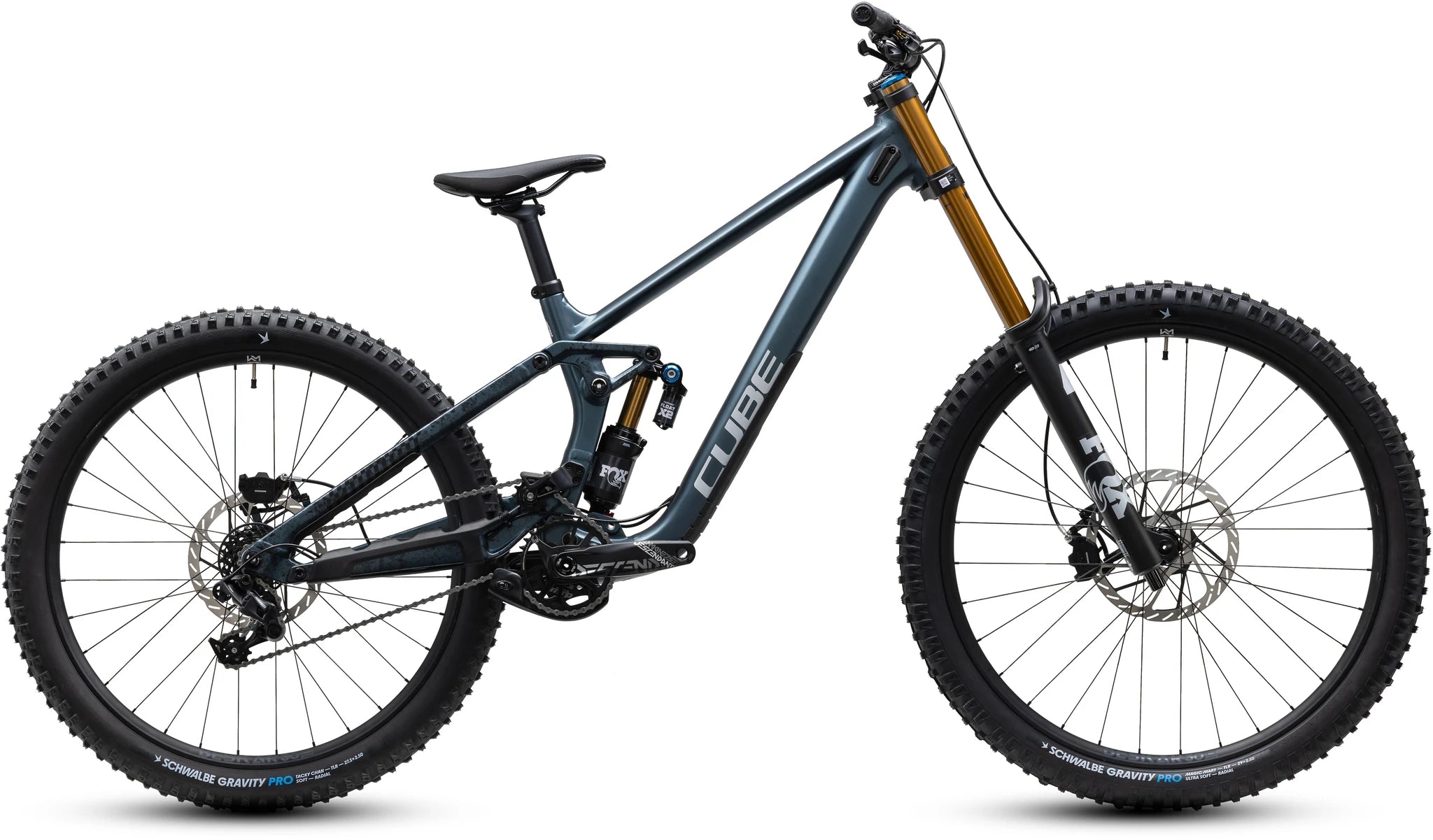


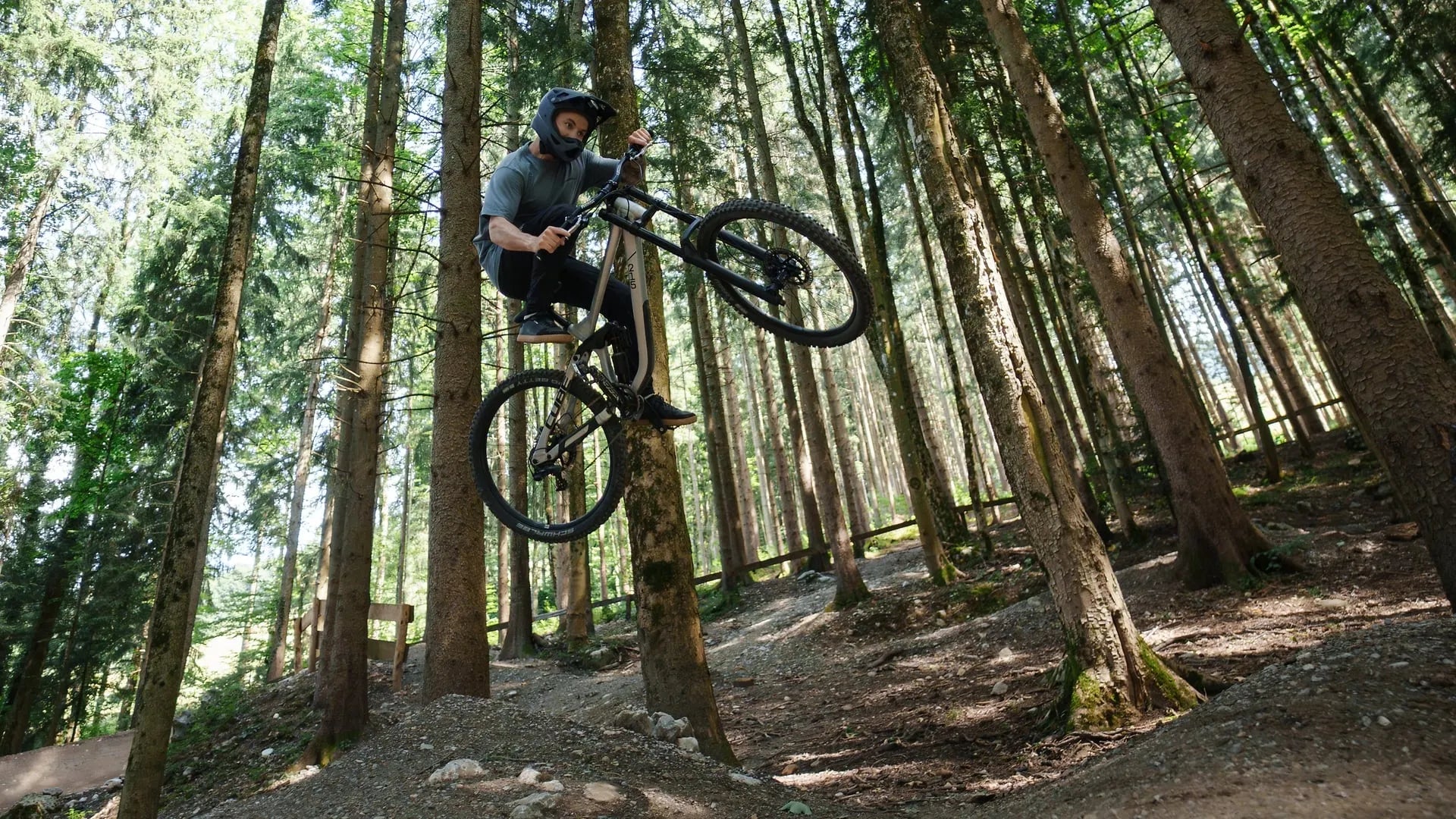
Cube Two15: Downhill bike for bike park and racing
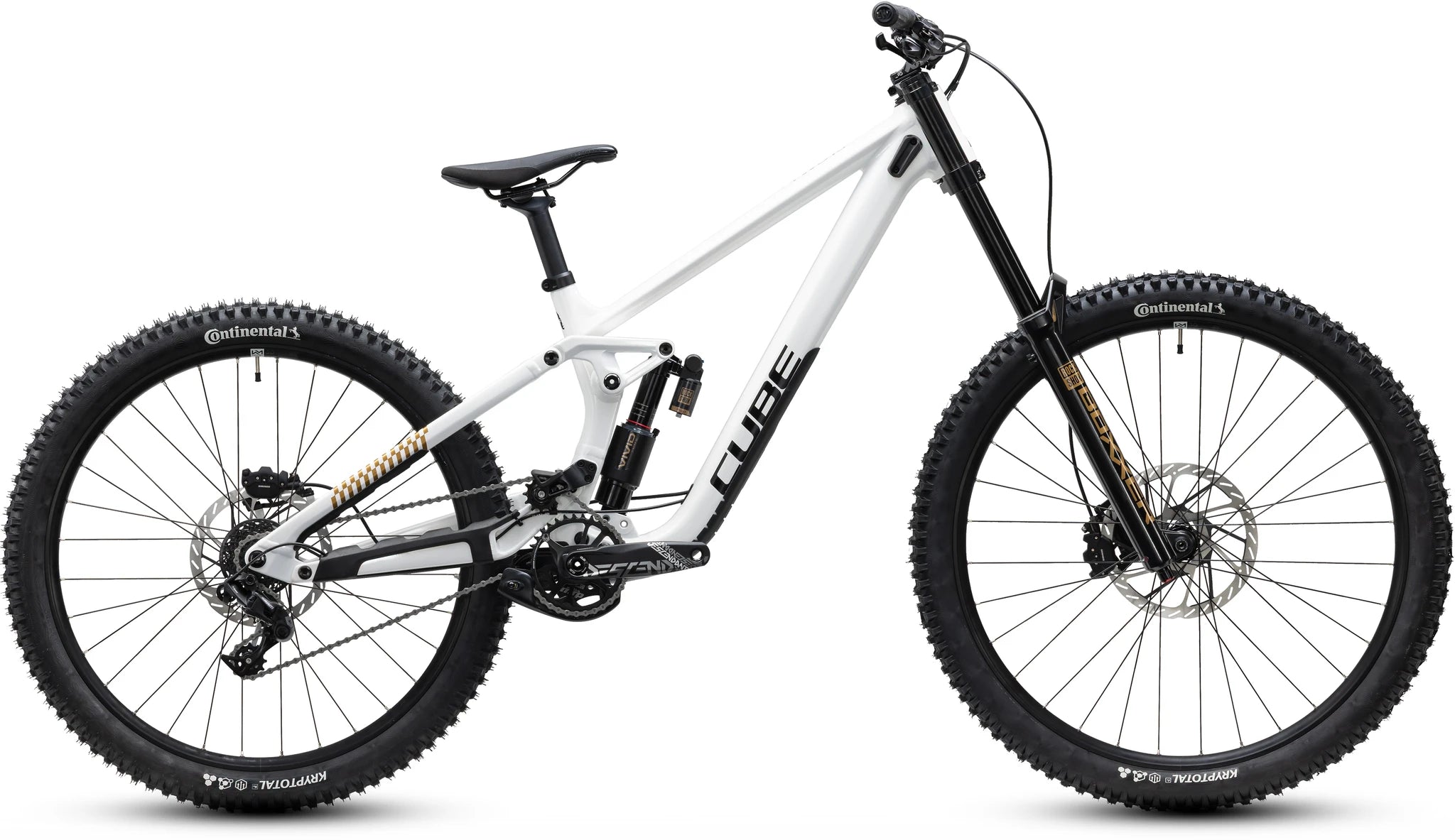
The Cube Two15 is a specialized downhill bike for fast descents, jumps, and technically demanding trails. As a gravity specialist for extreme downhill runs and World Cup racing, the Cube Two15 offers a direct link to Cube's racing heritage. Its area of use begins where a classic trail bike reaches its limits. A dual-crown fork, slack head angle, long wheelbase, and suspension with 200 millimeters of travel clearly indicate what this bike was built for: controlled speed on the way down.
Cube targets this model family at bike park riders and racers. Gravity provides the propulsion, while the suspension, brakes, and geometry are designed to keep the bike predictable. On rough root sections, it requires traction; on drops, it needs sufficient reserves; and in fast corners, it demands a stable front end. The Cube downhill bike is tuned precisely to these requirements.
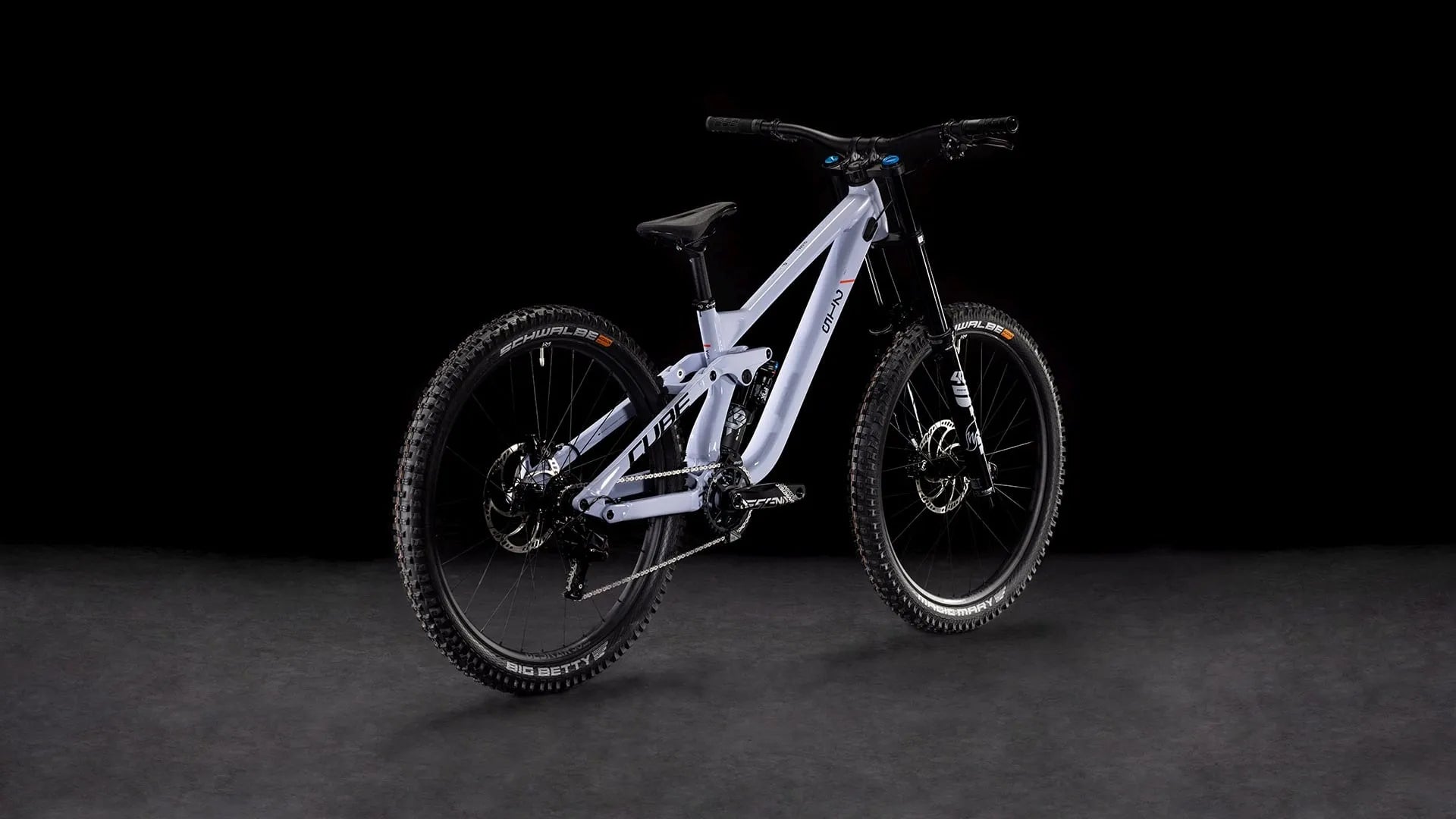
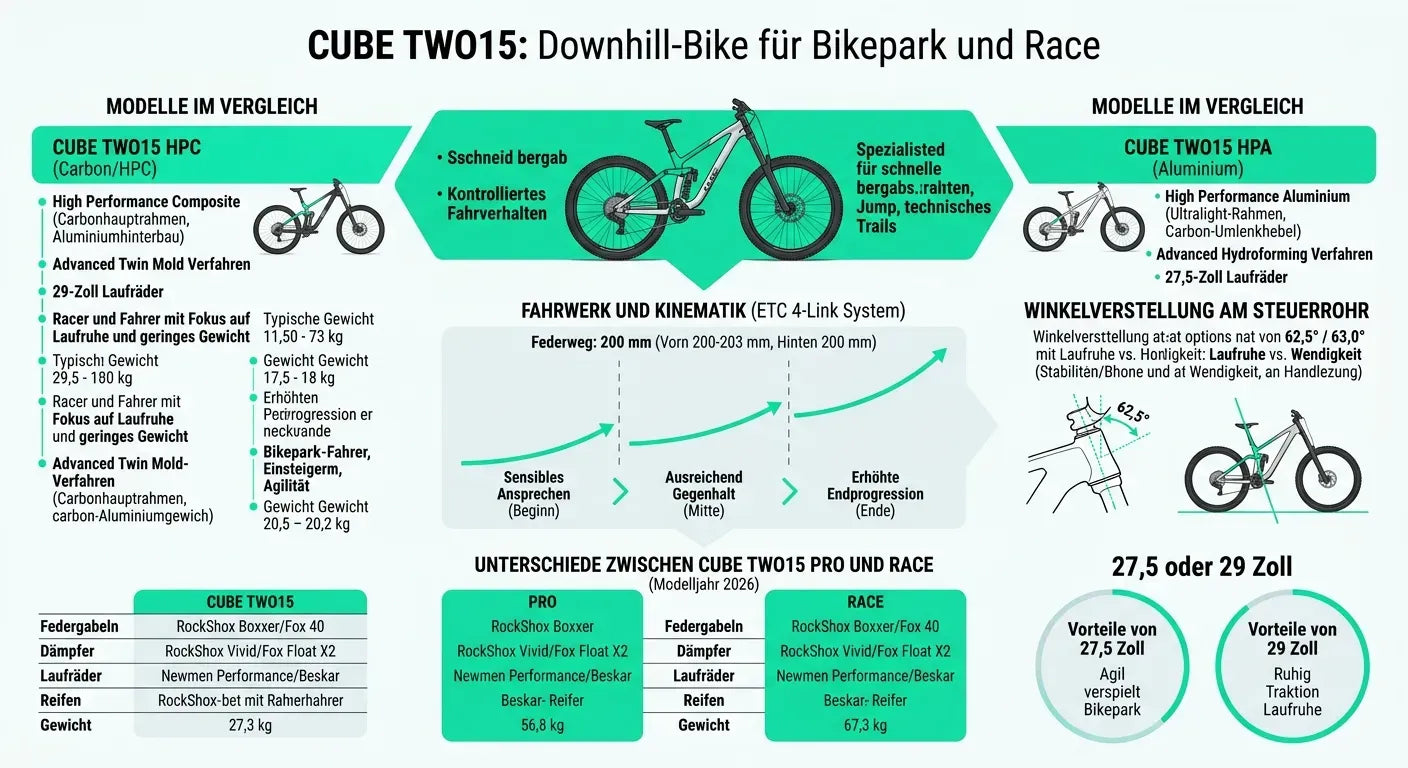
Within the Two15 series, there are different concepts. The current HPA Pro and Race models feature 27.5-inch wheels and an aluminum frame. Alongside these, you can find Cube Two15 HPC models with carbon main frames and 29-inch wheels, which, depending on the model year and availability, may come from earlier model lines. Before purchasing, it is therefore worth taking a close look at the model year, frame size, and specifications. A Two15 Pro from the 2026 model year differs significantly in its components from older Pro versions.
Carbon or aluminum for the Cube Two15
The terms HPC and HPA provide information about the frame concept. At Cube, HPC stands for High Performance Composite and refers to the carbon variants. HPA means High Performance Aluminium. Both materials are designed for high loads, but differ in weight, construction, and price.
| Feature | Cube Two15 HPC | Cube Two15 HPA |
|---|---|---|
| Frame material | Carbon monocoque main frame with aluminum rear triangle | Hydroformed aluminum frame with carbon rocker link |
| Manufacturing Processes | Advanced Twin Mold | Advanced Hydroforming |
| Typical wheel size | 29 inch | 27.5 inch |
| Ride character | Smooth, precise, and designed for high speeds | Agile, direct, and well-suited for tight bike park lines |
| Weight | Often lighter, depending on model and equipment | Slightly higher frame weight, depending on equipment |
| Cost | More complex construction and usually a higher price | More affordable entry point into the Two15 series |
| Suitable for | Racers and riders focused on smoothness and low weight | Bikepark riders, beginners and users focused on agility |
What distinguishes the Cube Two15 HPC frame?
On the Cube Two15 HPC, the main frame is made of carbon, while Cube uses 6061 T6 aluminum for the rear triangle. The carbon monocoque is created using Advanced Twin Mold technology. This allows the manufacturer to control the arrangement of the carbon fibers and the wall thicknesses during production. Material is intended to be placed precisely where high forces occur. Areas with lower stress can be made slimmer.
The technical advantage lies not only in a lower weight. A well-designed carbon frame can be engineered to be very stiff in specific zones. This supports precise line choice when the front wheel needs to be steered over rock gardens at high speed.
Older Cube Two15 HPC SLX models, for example, weighed approximately 16.7 kilograms according to the manufacturer. The high-end HPC SLT from the 2023 model year was specified at 16.1 kilograms. The actual values depend on the wheels, suspension, and components.
Carbon requires careful handling in daily use. After a hard impact, the frame should be checked for visible damage. This applies especially to the down tube, the chainstays, and the areas around the pivot points. Frame protectors reduce damage from rock strikes but do not replace regular inspections.
What are the advantages of the Cube Two15 HPA frame?
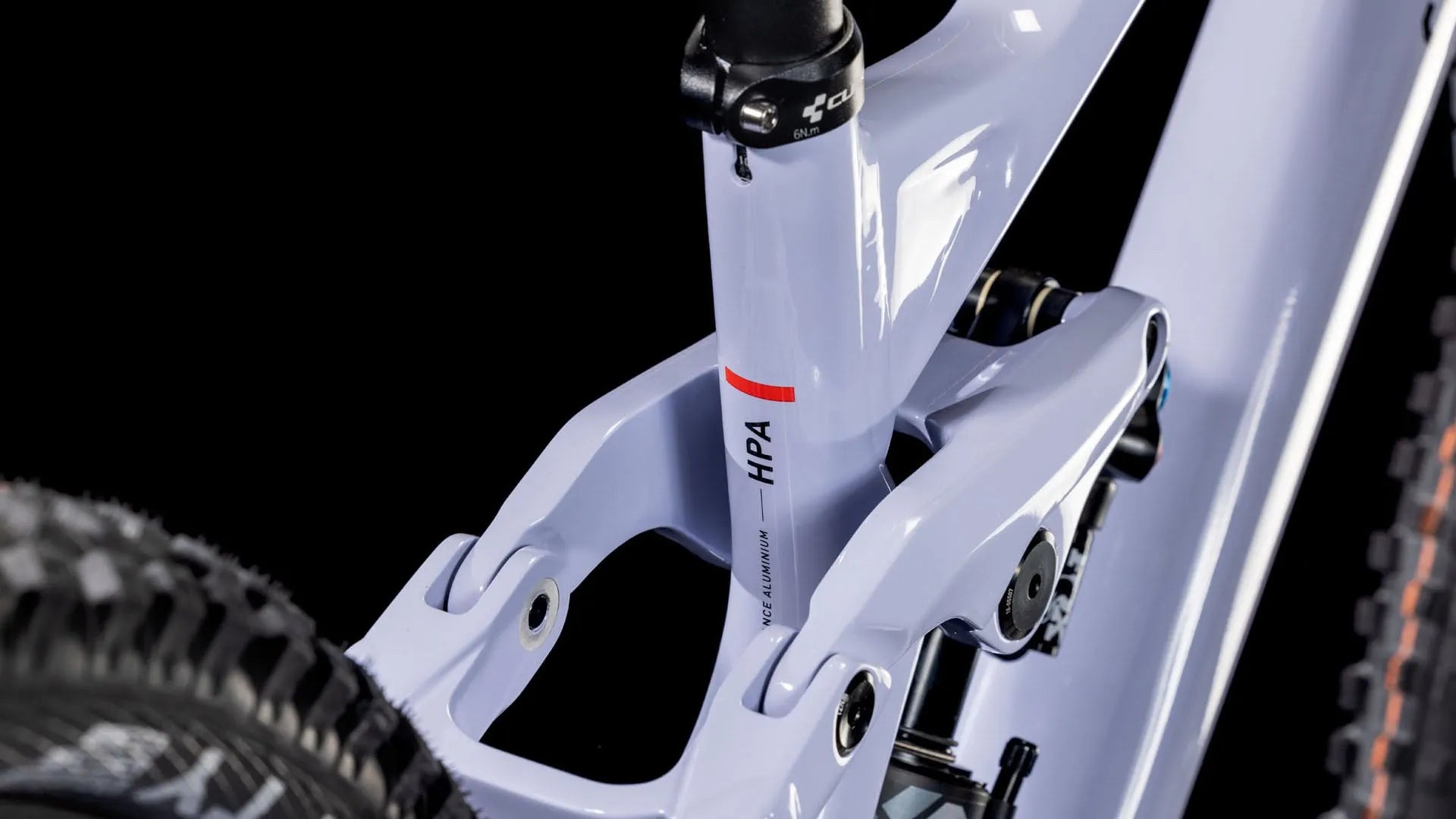
The current Two15 Pro and Race models use an HPA Ultralight frame. Cube shapes the aluminium tubes using Advanced Hydroforming. Fluid presses the tube into a predefined shape under high pressure. This allows the cross-section and wall thickness to be tailored to the stress in each specific area of the frame. Triple-butted tubes provide additional material savings in areas subject to less stress.
The HPA frame is designed for frequent bike park use. After a crash, aluminium is relatively easy to inspect for dents, cracks, and deformations. This makes the HPA version attractive to riders who spend many days in the park, transport their bike by shuttle, or are gaining their first experience with larger jumps. A carbon rocker helps to reduce weight in the rear suspension kinematics.
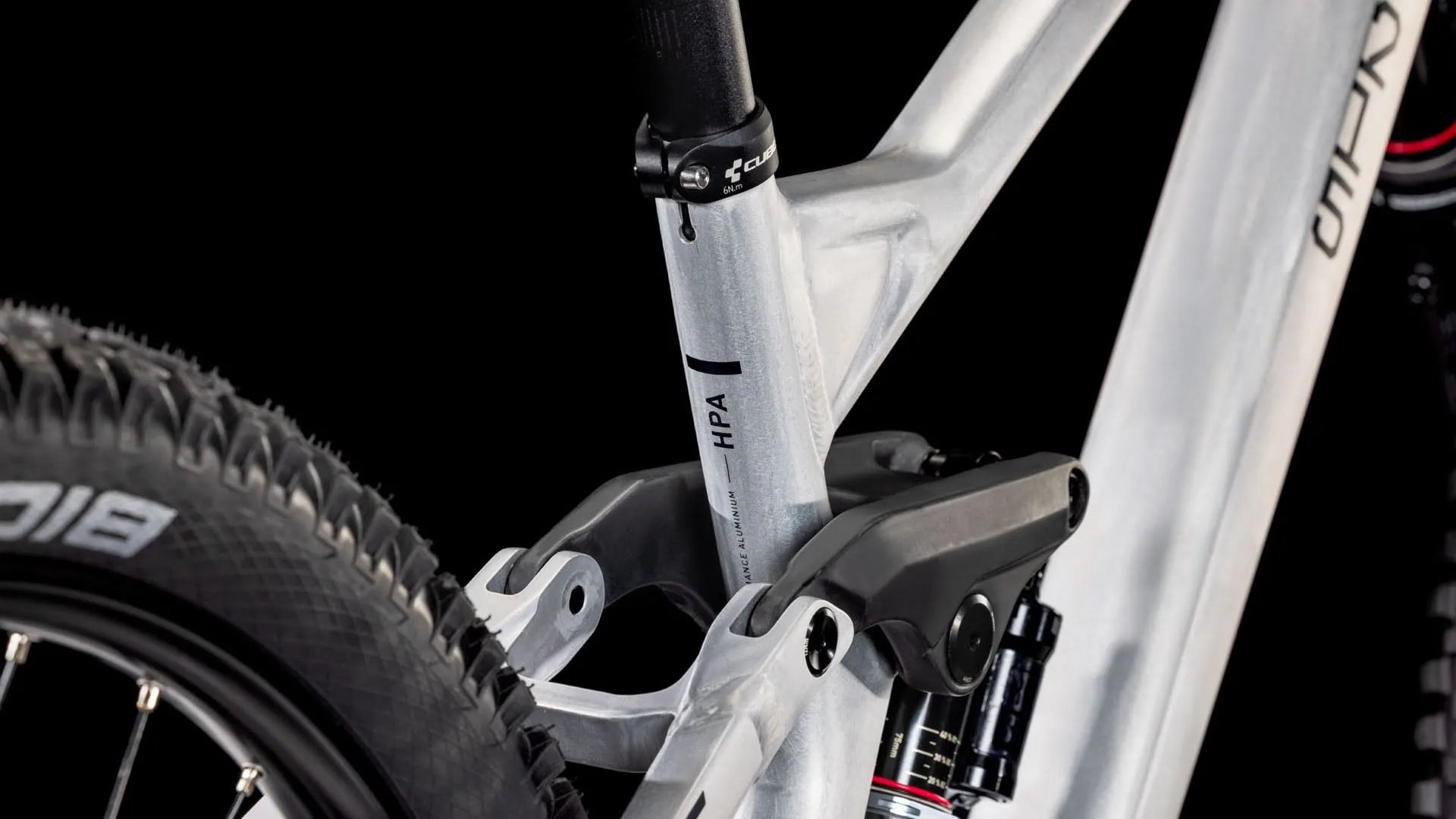
If you are looking for an agile bike park bike at a lower entry price, the HPA version is usually a better fit. If low weight, 29-inch wheels, and high stability are your priorities, the Cube Two15 HPC is an interesting option. Since HPC offers often come from older model years, spare parts availability and the specific configuration should be checked before purchasing.
Suspension and kinematics of the Cube Two15
The current Cube Two15 HPA features 200 or 203 millimeters of front travel, depending on the fork and model. The rear end provides 200 millimeters. The 2026 model year Cube Two15 Pro uses a 200-millimeter RockShox Boxxer. The Race model is equipped with a 203-millimeter Fox 40 Float. Both versions clearly fall into the downhill category.
Specifications of up to 215 millimeters at the rear frame refer to older generations of the Cube Two15. Earlier 27.5-inch frames were offered with 215 millimeters, while 29-inch versions from that time used 200 millimeters. For the current Pro and Race models of the 2026 model year, the rear travel is 200 millimeters in each case. When comparing different offers, the model year must therefore be taken into account.
How does the ETC 4-link system work?
The rear suspension is based on a four-bar linkage, which Cube calls the ETC 4-Link. Several pivot points guide the rear wheel along a defined path during compression. The tuning is intended to be sensitive at the beginning of the travel and provide sufficient support in the mid-stroke. Towards the end, the resistance increases more sharply. This progression reduces the risk of a harsh bottom-out on drops or jumps.
On root carpets and braking bumps, the rear suspension is designed to react quickly to consecutive impacts. The rear wheel can track the terrain instead of lifting off uncontrollably after a hit.
More ground contact means more usable traction when braking and in open corners. On bigger impacts, the suspension uses its travel without immediately bottoming out.
The right setup depends on rider weight, speed, and the trail. If you jump frequently or push hard into berms, you need more support and appropriate bottom-out progression. If you mainly ride natural trails with many small bumps, the suspension should be sensitive. Too much pressure or a spring that is too stiff reduces traction. A setup that is too soft causes the bike to ride deep in its travel and can lead to bottoming out on landings.
What is the effect of the head tube angle adjustment?
Using headset cups in the head tube, the head angle on current HPA models can be adjusted between 62.5 and 63 degrees. The slacker position slightly increases the wheelbase and moves the front wheel further forward. This increases stability at high speeds and on steep descents. The steeper position shortens the wheelbase slightly and makes it easier to steer on tight, twisty trails.
If you ride fast race lines, steep sections, and rough rock gardens, the slack setting offers more stability. For tight bike park trails with many direction changes, the steeper position can be useful. The differences are only half a degree, but they are noticeable on a downhill bike. After a change, the handlebar position, suspension balance, and tire pressure should be rechecked.
Differences between Cube Two15 Pro and Race
For the 2026 model year, the Pro and Race use the same HPA frame, 27.5-inch wheels, a seven-speed SRAM GX DH drivetrain, and 200 millimeters of rear travel. The main differences lie in the suspension, brakes, wheels, and tires. The Race model costs more, but offers a different suspension concept and higher-tier wheel components.
Older model comparisons often mention an X-Fusion RV-1 fork and an X-Fusion shock for the Two15 Pro. This applies to earlier model years, but not to the 2026 Pro. The latter is offered with a RockShox Boxxer DebonAir Plus and a RockShox Vivid air shock. Anyone comparing used bikes or remaining stock should therefore not rely on the model name alone.
| Component | Cube Two15 Pro 27.5 Model Year 2026 | Cube Two15 Race 27.5 Model Year 2026 |
|---|---|---|
| Frame | HPA Ultralight Aluminium, Carbon Rocker | HPA Ultralight Aluminium, Carbon Rocker |
| Suspension fork | RockShox Boxxer DebonAir Plus, Charger 3 RC, 200 mm | Fox 40 Float GRIP, 203 mm |
| Rear shock | RockShox Vivid air shock | Fox Float X2 air shock |
| Brakes | Magura MT Thirty with four pistons | Magura MT5 with four pistons |
| Brake discs | 203 mm front and rear | 203 mm front and rear |
| Drivetrain | SRAM GX DH, 7-speed | SRAM GX DH, 7-speed |
| Wheels | Newmen Performance 30 | Newmen Beskar 30 |
| Tires | Schwalbe Magic Mary and Big Betty in bike park version | Schwalbe Magic Mary and Big Betty in super gravity version |
| Manufacturer's weight specification | 17.1 kg | 16.6 kg |
The Pro is no basic recreational model. The Boxxer fork, Vivid shock, and GX DH drivetrain already form a full-fledged setup for regular days at the bike park. The shock's hydraulic bottom-out control can help utilize the final part of the travel in a more controlled manner during hard landings. The Magura MT Thirty features four pistons and 203-millimeter rotors front and rear.
The Race combines a Fox 40 Float GRIP with the Fox Float X2. The fork offers 203 millimeters of travel. The shock allows for adjustments including low-speed compression and rebound. This gives ambitious riders more scope to tune the suspension to the track and their riding style.
The Magura MT5 also uses four pistons and 203-millimeter discs. The Newmen Beskar wheelset and Super Gravity tires are designed for high loads and better puncture protection.
If you are looking for a resilient downhill bike for your first races and regular park days, the Pro offers the necessary reserves. The Race is worth it if you want to fine-tune the suspension, prefer a lower overall weight, or value tires with a reinforced casing for fast, natural trails. The additional cost mainly pays for the different equipment. The frame and basic geometry remain the same.
´
27.5 or 29 inches for the Cube Two15
The wheel size influences how easily the bike executes changes in direction and how smoothly it rolls over obstacles. With the Cube Two15, the decision is closely linked to the frame version. The current HPA Pro and Race models roll on 27.5-inch wheels. The Cube Two15 HPC models were offered as 29ers. A free choice between both sizes is not intended within a single frame.
Advantages of 27.5 inches
- The bike is easier to lean into tight corners and move more quickly from one line to another.
- Smaller wheels make active maneuvers like pulling up, repositioning, and correcting in the air easier.
- On compact bike park tracks, the handling feels direct and playful.
- Shorter riders have more freedom of movement over the rear wheel.
- Given a comparable construction, the wheels are compact and designed to withstand lateral loads during landings.
27.5 inches are right for you if you prefer jump lines, tight berms, and trails with many quick changes of direction. Beginners also often benefit from the easier turn-in. The bike reacts clearly to weight shifts and is easy to correct at moderate speeds.
Advantages of 29 inches
- The larger wheel diameter rolls more easily over roots, stone edges, and braking bumps.
- At high speeds, the bike runs more smoothly and holds the chosen line better.
- The longer tire contact patch can improve traction when braking and in open corners.
- On natural downhill tracks, the front wheel requires less active unweighting over small obstacles.
- Taller riders get a wheel size that suits long frames and a central position on the bike well.
29-inch wheels are suitable for fast and rough tracks where rollover behavior is more important than maximum agility. This applies especially to riders who want to hold their line and ride over obstacles with speed. A Cube Two15 HPC 29 requires more effort in tight corners, but in return offers more stability as soon as the track becomes open and fast.
Who is the Cube Two15 suitable for?
The Cube Two15 is designed for riders who primarily ride downhill. Typical locations are bike parks, downhill race tracks, and freeride lines with lift or shuttle access. It is not intended for long tours, technical uphills, or the daily commute. The short gear ratio, low saddle position, and slack head angle would be clear disadvantages in those scenarios.
As a first dedicated bike park bike, the Two15 is interesting because its long wheelbase and generous suspension provide a lot of stability. While this doesn't make small riding errors disappear, it prevents them from causing nervous handling as quickly. At the same time, the 27.5-inch HPA models are easier to steer into corners than many long 29er race bikes. This helps on trails where beginners still need to adjust their speed frequently.
The components are designed for the intended use. Four-piston brakes with large rotors deliver the necessary braking power for long descents. The short seven-speed cassette keeps the gear steps tight in the relevant speed range. A chain guide and robust chainstay protector prevent the chain from easily dropping or damaging the frame during impacts.
Use category 5 identifies current HPA models as bicycles for high jumps, rough terrain, and downhill use.
A suitable downhill bike is no substitute for protective gear. A full-face helmet, knee pads, gloves, and upper body protection appropriate for your riding level are part of essential bike park equipment. Before every day of riding, brake pads, brake discs, tires, thru-axles, and bearings should be checked. On a bike with 200 millimeters of travel, high forces act on screw connections and suspension bearings.
If you mainly ride trail tours with your own climbs, an enduro bike is a better fit. If your ride begins with a lift, shuttle, or starting gate and the focus is clearly on the descent, the Cube Two15 plays to its design strengths. The choice between Pro and Race is determined less by experience level than by your requirements for the suspension, tires, and wheels.
Frequently Asked Questions about the Cube Two15
How much does the Cube Two15 weigh?
The weight depends on the model year, frame material, and component package. For the 2026 model year, Cube specifies the Two15 Pro 27.5 at 17.1 kilograms and the Two15 Race 27.5 at 16.6 kilograms. Earlier HPC models with carbon main frames were also in this range or lower, depending on the equipment. The 2023 model year Two15 HPC SLX was specified at 16.7 kilograms, and the higher-equipped HPC SLT at 16.1 kilograms. Manufacturer values may be stated without pedals. Add-on parts, tubeless sealant, and tire choice will affect the ready-to-ride weight.
Can you ride the Cube Two15 uphill?
Short connecting sections and flat forest paths are possible, but longer climbs are arduous. The seven-speed DH cassette does not offer easy climbing gears. The slack head angle, low saddle position, and heavy tires also drain energy. Furthermore, a dropper seatpost is not part of the standard equipment. The Two15 is therefore not a touring bike. Anyone wanting to ride to the trail under their own power regularly should choose an enduro or freeride bike with a wider gear range.
How robust is the rear triangle for jumps?
The ETC 4-link rear triangle is designed for downhill tracks, drops, and bike park jumps. Large bearings, a short rocker link, and a progressive leverage ratio help absorb high loads. The progression increases resistance towards the end of the travel and reduces bottom-outs. Even a sturdy rear triangle requires maintenance. Bearings should be checked for play, bolts tightened to the specified torque, and the frame inspected after hard impacts. The bike's maximum approval only applies if it is in perfect technical condition.
Why is the Cube Two15 suitable for bike park beginners?
The bike offers plenty of suspension travel, a slack head angle, and a long wheelbase. This geometry provides more stability on steep descents than a short trail bike. The HPA models with 27.5-inch wheels remain agile enough for tight corners and entry-level jump lines. The Pro already comes with a full downhill setup, with no immediate need to replace the suspension, brakes, or chain guide.
For absolute mountain bike beginners, however, a downhill bike is no substitute for technical riding training. The weight, high speed, and direct braking performance require a solid basic body position. For those who can already ride confidently on easy trails and want to get started in the bike park, the Cube Two15 offers a predictable bike with reserves for increasing speeds and larger obstacles.
Du kannst deine Einstellungen jederzeit anpassen, um den vollen Funktionsumfang unserer Website zu nutzen.
Cookie-Einstellungen bearbeitenWir helfen Dir gerne weiter!

Live-Chat
Telefon
Telefon
Telefonzeiten:
Mo. - Fr. 10:00 - 13:30 & 14:30 - 18:00 Uhr
Sa. 10:00 - 14:00 Uhr
Telefon:
+49 2961 914 886 9
Kontaktformular
Kontaktformular
Außerhalb der Chat- und Telefonzeiten kannst Du uns Dein Anliegen über das Kontaktformular mitteilen.
E-Mail
Schreib uns einfach eine E-Mail an verkauf@liquid-life.de und wir werden Dir so schnell wie möglich antworten. Bitte hab Verständnis, dass es aufgrund der chronologischen Bearbeitung zu kleinen Verzögerungen kommen kann.
Bikeberater
Bonusprogramm