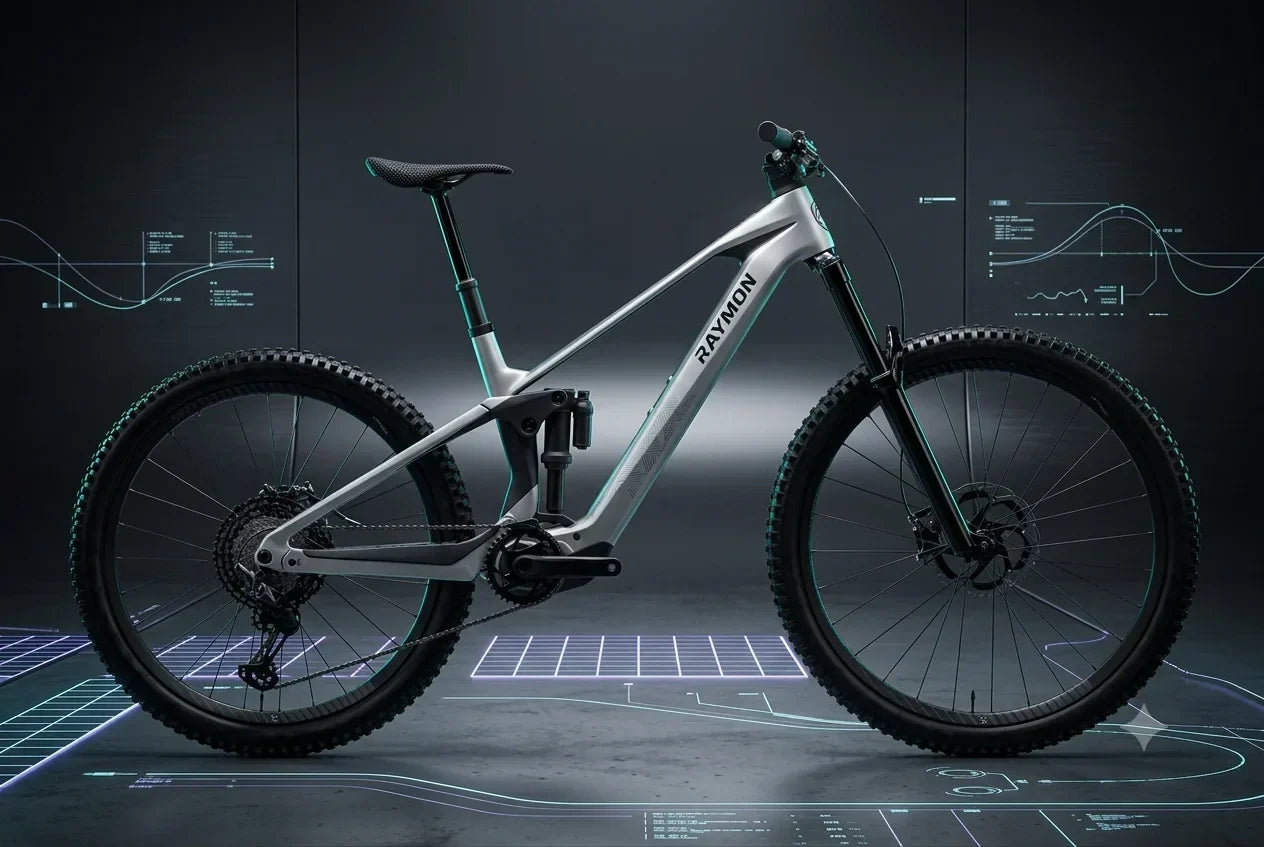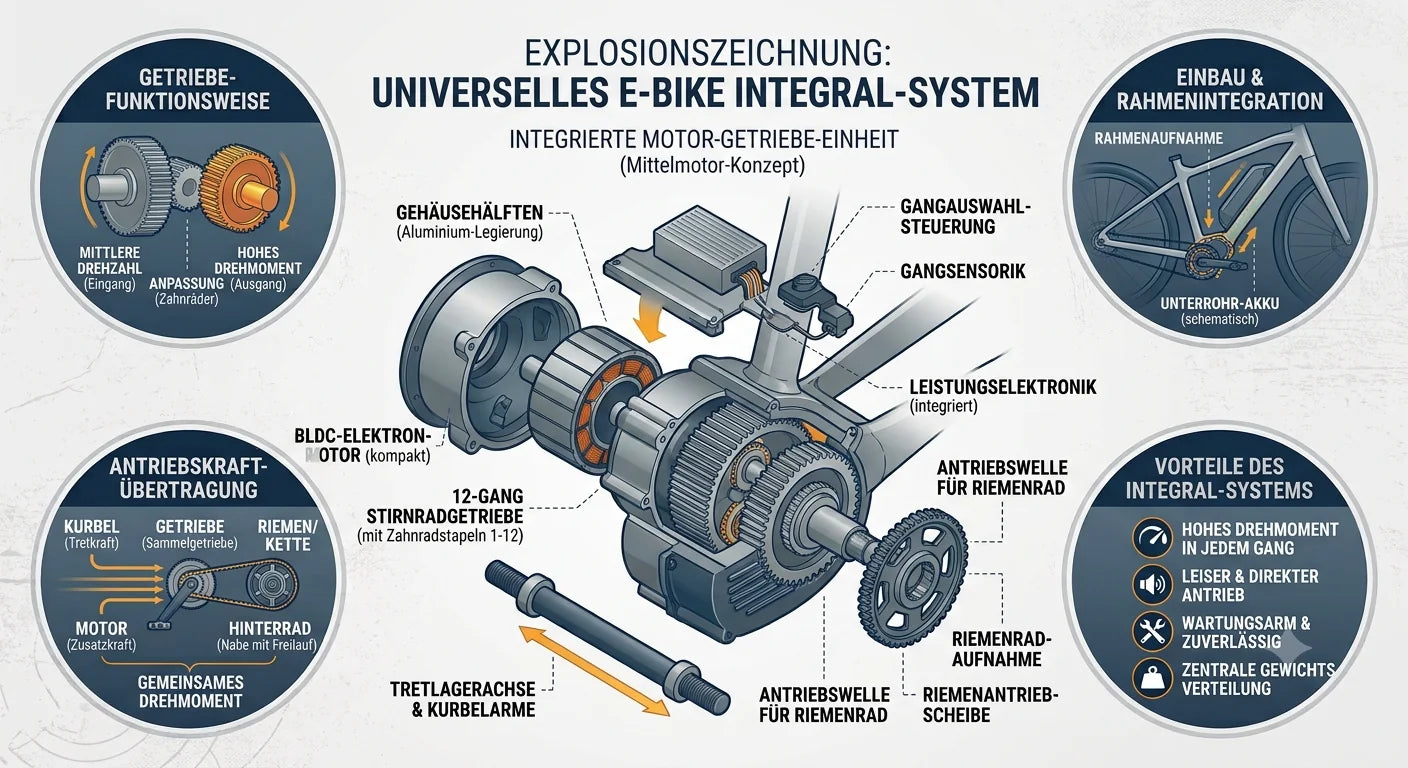
DJI Avinox MG, Gobao X1P, and Pinion MGU all pursue the same goal: to house the motor and transmission as a single integrated unit at the bottom bracket. This eliminates the need for an external derailleur and a rear cassette. Doing so reduces the number of exposed components and shifts more weight to the center of the e-MTB.
However, the systems differ significantly. The Pinion MGU combines an electric motor with a mechanical gearbox and fixed gear ratios. The Gobao X1P uses an electronically controlled, continuously variable transmission. As of July 2026, the DJI Avinox MG is a concept system that also aims to combine a motor and a continuously variable transmission into one unit. DJI Avinox unveiled the MG Concept on June 24, 2026, at Eurobike in Frankfurt.
Therefore, the highest torque figure is not the only factor in the purchasing decision. The desired shifting feel, the type of riding, the ability to modulate power on loose surfaces, and the status of each system are also important. The Pinion MGU is already available as a series-production drive system, whereas the Gobao X1P and DJI Avinox MG are still in the early stages of market launch or development.
E-CVT versus mechanical gears
The central difference in the comparison lies in how the gear ratio is generated. The Pinion MGU works with real, mechanically defined gears via a spur gear transmission. Those coming from a classic bicycle are familiar with this principle: pressing a button triggers a gear change, after which the bike continues in a clear gear step.
Gobao X1P and DJI Avinox MG, on the other hand, rely on E-CVT technology based on a planetary gear set. E-CVT stands for electronically controlled, continuously variable transmission. In the Gobao X1P, two motors control the gear ratio: the system continuously adjusts the relationship between crank movement and the rear wheel. Instead of switching between individual gears, the drive can align the gear ratio to a selected cadence, pedal load, or riding mode.

This does not mean that one has to do without a shifting interface with Gobao or DJI Avinox. Both concepts provide for manual settings and virtual gears. These simulated gears give the rider fixed shift points, even though the transmission technically operates continuously. This can be interesting for mountain bikers who want to deliberately shift before a curve or ramp on the trail.
| System | Technology | Transmission | Shifting feel | Practical advantage |
|---|---|---|---|---|
| Pinion MGU E1.9 and E1.12 | Motor with mechanical gearbox | 9 or 12 fixed gears | Distinctly defined gear steps | Familiar shifting principle with real gear increments |
| Gobao X1P | Electronically controlled E-CVT | Continuously variable, 500% range according to manufacturer | Automatic or with virtual gears | No cassette or derailleur on the rear wheel |
| DJI Avinox MG Concept | Continuously variable motor-gear unit | DJI Avinox cites a 520% gear range | Manually or automatically configurable | Gear changes under load and at a standstill intended |
The Pinion MGU E1.12 offers twelve gears with a 600 percent gear range. The E1.9 has nine gears and nearly 570 percent. The gear intervals are smaller in the 12-speed version, while the 9-speed version has coarser jumps between gear ratios. Both versions shift electronically, but the gear ratios themselves are generated by a mechanical gearbox with fixed steps.
Off-road, the mechanical principle has a clear character. A gear change is palpable and provides feedback. This can be helpful when you are preparing for technical climbs and intentionally select an easier gear before a ledge. Under high pedal load, individual shifts can be more audible or take slightly longer. For certain double-shifts on the E1.12, Pinion explicitly points to possible crank free-play.
An E-CVT system can keep the cadence significantly more consistent. On long climbs with varying gradients, the rider needs to shift less actively. In return, the familiar feel between the crank and the rear wheel changes. Those who want to consciously perceive every gear change will usually find the Pinion MGU more direct. Those who prefer a constant cadence and want to partially automate shifting will find the more suitable concept in Gobao and DJI Avinox.
The technology of the DJI Avinox MG and Gobao X1P should currently be viewed with caution. DJI Avinox explicitly describes the MG as a concept product. The Gobao X1P is also a new system whose series use in specific e-MTB models has yet to occur. Therefore, data on durability, shifting quality in wet conditions, noise levels, and workshop practice cannot yet be evaluated as reliably as with the already available Pinion MGU.
Does 150 Nm make sense for an e-MTB?
On the data sheet, the Gobao X1P leads with 150 Nm of torque. The DJI Avinox MG torque is also associated with the performance values of the Avinox M2S platform, i.e., up to 150 Nm and 1,500 watts of peak power. Pinion specifies 85 Nm for the MGU, regardless of the 9- or 12-speed version. However, these figures cannot be transferred into a ranking for practical riding without context.
In simple terms, torque describes the rotational force at the drive. A high value is particularly helpful when the e-MTB needs to accelerate strongly at low speeds on steep ramps. Especially on heavy enduro bikes, on short climbing passages, or with a high total mass of rider, equipment, and bike, a powerful motor can create reserves.
However, 150 Nm is not an automatic advantage. On roots, damp rock, loose gravel, or wet leaves, too much drive power can cause the rear wheel to spin. As soon as the tire loses grip, additional motor power provides no further propulsion. The deciding factor is how sensitively the motor reacts to pedal pressure and cadence, and whether the selected riding mode delivers power in a controlled manner.
- If you frequently ride steep, short ramps with little run-up, 150 Nm offers noticeable reserves.
- If you ride technical uphill trails on loose surfaces, finely adjustable support is more important than the maximum Nm figure.
- If you mainly ride tours, forest paths, and moderate trails, 85 Nm is sufficient in many situations.
- If you pull a trailer or use a heavy SUV e-bike, the higher torque of Gobao or DJI Avinox may make sense.
With the Gobao X1P, the continuously variable transmission complements the high torque. The drive can adjust its gear ratio so that the crank does not suddenly become too heavy when the gradient increases. This facilitates steady pedaling. At the same time, the control system must prevent the support from engaging too abruptly on slippery surfaces.
The DJI Avinox MG is also designed to shift without interrupting power delivery and enable gear changes in less than 0.1 seconds. DJI Avinox also mentions manual and automatic shifting modes. Whether the system is actually easier to modulate on winding trails with frequent changes between braking, accelerating, and short climbs compared to other e-MTB drives will only be revealed by independent long-term tests with production bikes.
The Pinion MGU rides differently. With 85 Nm, it is below the new 150 Nm concepts in terms of performance, but offers a clearly stepped transmission and predictable response behavior. Those who want to consciously control their power and motor support via real gears receive a comprehensible setup. For long alpine climbs or technically demanding tours, this is not automatically too little power. The decisive factors remain how heavy the e-MTB is, which tires are fitted, and how steep the terrain really becomes.
Why the Pinion MGU is heavier
The weight of the motor unit influences the total weight of an e-MTB, but does not say everything about the finished bike. With integrated drives, several parts are eliminated at the rear wheel: derailleur, cassette, shifter, cable or line, and in some concepts, the chain in favor of a belt. Therefore, it is not just the weight of the motor that is relevant, but the entire drive system.
- The Pinion MGU E1.9 weighs around 4.0 kilograms.
- The Pinion MGU E1.12 weighs around 4.1 kilograms.
- The Gobao X1P is stated at around 3.85 kilograms.
- There is currently no final production weight for the DJI Avinox MG Concept.
The Pinion MGU carries more mass because it houses a full-fledged mechanical gearbox with nine or twelve fixed gear ratios. The gears, shifting elements, and the construction designed for high loads require space and material. In return, the mass sits low and centrally in the frame. The rear wheel remains free of a cassette and derailleur, which can reduce the unsprung mass of a full-suspension e-MTB.
The Gobao X1P is intended to be lighter than the Pinion E1.12 despite the integrated E-CVT unit. However, its stated mass of 3.85 kilograms is only part of the equation. For range and total weight, the battery, frame, and wheels play a larger role. Gobao offers three battery variants for the X1P system: in addition to the 500 Wh and 750 Wh batteries, there is also a large 900 Wh battery. Here, battery density is crucial: a heavier motor can be compensated for by lighter batteries with high energy density, balancing out the total system weight. Whether a complete Gobao e-MTB turns out lighter than a comparable Pinion or DJI Avinox bike therefore depends on the implementation of the respective manufacturer.
For the DJI Avinox MG, a direct weight comparison is not yet possible. DJI Avinox did not release a final mass for the motor-gear unit at its Eurobike debut. This is important, as a concept drive can still be changed before the start of series production. Those who want to buy an e-MTB today should therefore not treat the DJI Avinox MG like a regularly available product, but as a glimpse into future model generations.
Furthermore, a lighter motor is not always the better choice. A heavier system can make sense if it brings a larger gear range, a particularly resilient gearbox, or a battery with more capacity. For handling, the position of the weight is often more important than a difference of a few hundred grams at the drive. A centrally installed gear motor supports neutral handling because the rear of the bike is less burdened.
Which gear motor is the right one?
The Pinion MGU is for you if you prefer fixed gears and a clearly defined shifting feel. It is the right choice for touring riders and trail riders who are looking for an established motor-gear unit and appreciate the elimination of the derailleur and cassette. The E1.12 is particularly suitable if fine gear increments are important to you. The E1.9 is an alternative if larger gear jumps are not a disadvantage for your usage.
The Gobao X1P is aimed at riders who are looking for maximum performance figures and a continuously variable transmission. Its 150 Nm and 1,500 watts of peak power are particularly interesting for steep climbs, heavy e-MTBs, and performance-oriented use. However, the system is new. Before purchasing, you should check which bicycle brands actually install the drive, what the spare parts supply looks like, and whether the software fits your riding style.
The DJI Avinox MG is interesting for you if you are looking for the combination of automatic or manual E-CVT shifting, high motor power, and system integration. As of July 2026, however, the MG remains a concept. DJI Avinox developed it with several bicycle brands, but final production models, prices, and complete technical specifications are still pending.
For an e-MTB that you want to buy soon and use on long tours, the Pinion MGU is the most reliable benchmark. For future high-end enduros, Gobao X1P and DJI Avinox MG could change the construction of the drive. Whether the continuously variable systems will permanently displace mechanical gears will not be decided by the torque figure, but by reliability, maintenance, software, and the feeling on the trail.
Frequently asked questions about gear motors
Does the Pinion MGU have mechanical gears or does it work continuously?
The Pinion MGU works with mechanical, fixed gears. The E1.9 has nine gears with around 568 percent gear range, while the E1.12 offers twelve gears with 600 percent. The shifting process is electronic, but the gear ratio itself remains mechanically stepped. There is no continuously variable E-CVT function in the Pinion MGU.
Which system offers the highest torque?
According to the currently stated data, the Gobao X1P and DJI Avinox MG (or the underlying Avinox M2S performance platform) are at up to 150 Nm. The Pinion MGU delivers 85 Nm. The DJI Avinox MG is still a concept, so final series specifications may change.
Why is the Pinion MGU heavier than the Gobao X1P?
The Pinion MGU contains a mechanical gearbox with nine or twelve real gear ratios. This construction requires gears and shifting components in the motor housing. The Gobao X1P uses an electronically controlled, continuously variable transmission and is stated at about 3.85 kilograms, while the Pinion E1.12 weighs around 4.1 kilograms. A complete system comparison must additionally take into account the battery, belt or chain, and the frame construction.
Does a torque of 150 Nm make sense for an e-MTB?
150 Nm can be helpful for very steep ascents, high bike weight, or heavy riders. On loose and slippery surfaces, however, too much power can cost traction. For many tours and normal trail climbs, 85 Nm is sufficient if the gear range is wide enough and the support responds cleanly. Therefore, the decisive factor is not just peak power, but also the control of the motor and the grip of the rear tire.