32-inch Bikes: Everything about the XXL trend for mountain bikes
32-inch bikes are the next step after the now-established 29-inch standard. The larger wheels roll more smoothly over roots and rocks and offer more traction. For a long time, the topic remained limited to prototypes and custom builds. In 2025 and 2026, this will change: the first production models, such as the Stoll P32, are entering small-batch production, and several manufacturers are showing near-production concepts. This means the previously exotic approach is on the verge of entering the regular retail market.
What is a 32-inch bicycle?
A 32-inch mountain bike refers to a bicycle with particularly large wheels, with an outer diameter including tires of approximately 81.3 cm. For comparison, a 29-inch wheel measures about 73.7 cm. According to ETRTO, the technical basis is a rim with an inner diameter of 686 mm, compared to 622 mm for 29 inches.
- Outer diameter with tires: approx. 81.3 cm
- Rim inner diameter (ETRTO): 686 mm
- Comparison 29 inches: 73.7 cm outer diameter, 622 mm rim
Wheel sizes in the mountain bike sector have increased incrementally. For a long time, 26 inches was the standard, then 27.5 inches became established until 29 inches became the current measure for most trail and race bikes. 32 inches continues this development and uses the same effect that every previous jump brought: a shallower angle at which the wheel hits obstacles.
What body height is a 32-inch bike suitable for?
32-inch bikes are primarily aimed at tall riders, but the first production models cover a wider range than one might initially assume. Stoll provides a recommendation starting from approximately 170 cm for the P32 in size M. From this height upwards, the geometry can be designed so that reach and standover height work.
The central hurdle lies with the stack. A larger wheel raises the front end, which causes the front to quickly become too high on smaller frames. Designers counter this with strongly negative stems reaching up to about -40 degrees and with adapted bottom bracket heights. For riders over 195 cm, the large wheel size plays out its strengths most clearly because the proportions can then be implemented without extreme compromises.
| Body height | Frame size | Reach (example Stoll P32) | Note |
|---|---|---|---|
| 170–184 cm | M | approx. 468 mm | potentially requires negative stem to control front height |
| 182–195 cm | L | approx. 500 mm | geometry can be designed in a balanced way |
| over 195 cm | L and larger | 500 mm upwards | greatest advantages in riding position |
32-inch vs. 29-inch: What are the advantages of XXL wheels?

The main advantage of larger wheels lies in the rollover behavior. The larger the radius, the flatter the angle at which the tire hits an obstacle. The bike runs more smoothly over root carpets and maintains more speed. Measurements from Bike-Test show a time saving of around 3 percent compared to 29 inches on such sections. In addition, there is the larger contact patch of the tire, which ensures more traction, especially on loose or alpine terrain.
The frequently mentioned disadvantage is the higher inertia. A larger wheel has a higher moment of inertia, which translates in test measurements to about 33 percent and an increased requirement of about 3 watts when accelerating. In practice, the effect is smaller than the raw number suggests: at the same speed, a larger wheel rotates more slowly, and the angular velocity decreases. This relationship almost cancels out the diameter disadvantage, so that the loss of inertia is less noticeable during riding than on paper.
| Criterion | 32-inch | 29-inch |
|---|---|---|
| Rollover behavior | Flatter angle, smoother run | Good compromise, current standard |
| Traction | Larger contact patch | Slightly smaller contact area |
| Inertia | Higher (approx. 33% more), relative during riding | Lower, more agile when starting |
| Weight | approx. 600–800 g heavier in total system | Lighter |
| Speed on roots | approx. 3% faster | Reference value |
Which brands already offer 32-inch bicycles?
The market is currently composed of boutique brands, pioneers, and initial near-production projects. So far, large manufacturers have primarily shown prototypes at trade fairs, while smaller providers have already developed concrete models.
- Stoll Bikes (P32): one of the first announced series mountain bikes with 32 inches
- Bike Ahead: specialist for carbon wheels with concepts in the large dimension
- Dirty Sixer: US brand with a focus on very tall riders
- KTM: prototype as a perspective of a large manufacturer
Are 32-inch wheels stable enough for technical terrain?
The biggest technical hurdle is stiffness. A larger diameter means longer spokes and larger leverage forces, which places higher demands on the rim, spoke tension, and frame. Carbon rims are practically mandatory here because they offer the necessary stiffness at an acceptable weight. The same applies to the fork: to limit twisting under load, very stiff designs are used, such as upside-down forks from Intend.
Also crucial is the hub standard, because it determines the spoke angle. With Boost (148 mm), a 32-inch wheel can be built, but Super-Boost (157 mm) provides a larger flange spacing and thus a more favorable spoke angle for a laterally stiffer wheel. For hard off-road use, the wider hub is therefore the more robust choice.
Frequently asked questions about 32-inch bikes
Are there 32-inch gravel bikes for racing?
In the gravel sector, there are currently primarily prototypes. Integration is technically easier here because no suspension fork is necessary. The large wheels roll better on long distances, which is why the focus is more on endurance than on agility. Brands like Stoll are planning a corresponding model with the G32.
Are there mass-produced 32-inch mountain bikes?
Yes. Stoll Bikes has announced one of the first series models for 2025 with the P32. The quantity is limited and is handled by pre-order. Race and trail variants in lightweight carbon construction with a weight under 10.5 kg are planned.
How heavy are 32-inch wheels in comparison?
A 32-inch system is about 600 to 800 grams heavier than a comparable 29-inch setup. The wheelset alone weighs about 440 grams more, and the tires are 30 to 80 grams heavier depending on the model. In addition, there is the extra weight of the frame and fork due to the longer design.
Can a 32-inch hardtail replace a 29-inch full-suspension bike?
No. Measurement data shows that a full-suspension bike filters shocks significantly better, even if the 32-inch wheel rolls over roots faster. Measurement data and practice generally show that an active suspension (full-suspension) absorbs impacts and vibrations significantly better than a hardtail, regardless of how well the 32-inch wheels roll over obstacles. The speed advantage of the 32er only shows on certain sections, while the suspension remains decisive for comfort.
What are the big manufacturers doing?
Trek: The unintentional leak
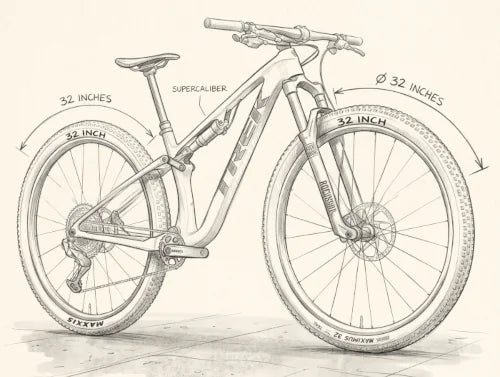
Trek is currently the furthest out of the woodwork of the three giants – albeit presumably unintentionally. In a video for the company's 50th anniversary (2026), an XC racing machine appeared in the background whose proportions unmistakably point to 32-inch wheels.

The background: Trek has been testing a completely new, nameless prototype platform off the beaten track of Supercaliber and Top Fuel in the World Cup for some time. In the rumor mill, it is considered an open secret that the Trek Factory Racing Team is validating the system for the coming seasons. If Trek joins in, it will suddenly make the topic mass-market capable.
Specialized: On the prowl
There is no official statement or visible prototype from Specialized yet, but industry insiders and leaks from the racing circuit suggest that the Californians are watching the development very closely.
Since the UCI (International Cycling Union) has officially allowed the large wheels, it is rumored that Specialized is already working on corresponding 32er platforms for the Epic (MTB) and possibly even the Crux (Gravel) so as not to be left behind in the cross-country world cup if the competition's speed advantage is confirmed.
Cube: Focus on the mass market
Cube has remained completely under the radar so far. As a classic volume manufacturer with a focus on a strong price-performance ratio, Cube almost never jumps on an extreme niche trend first.