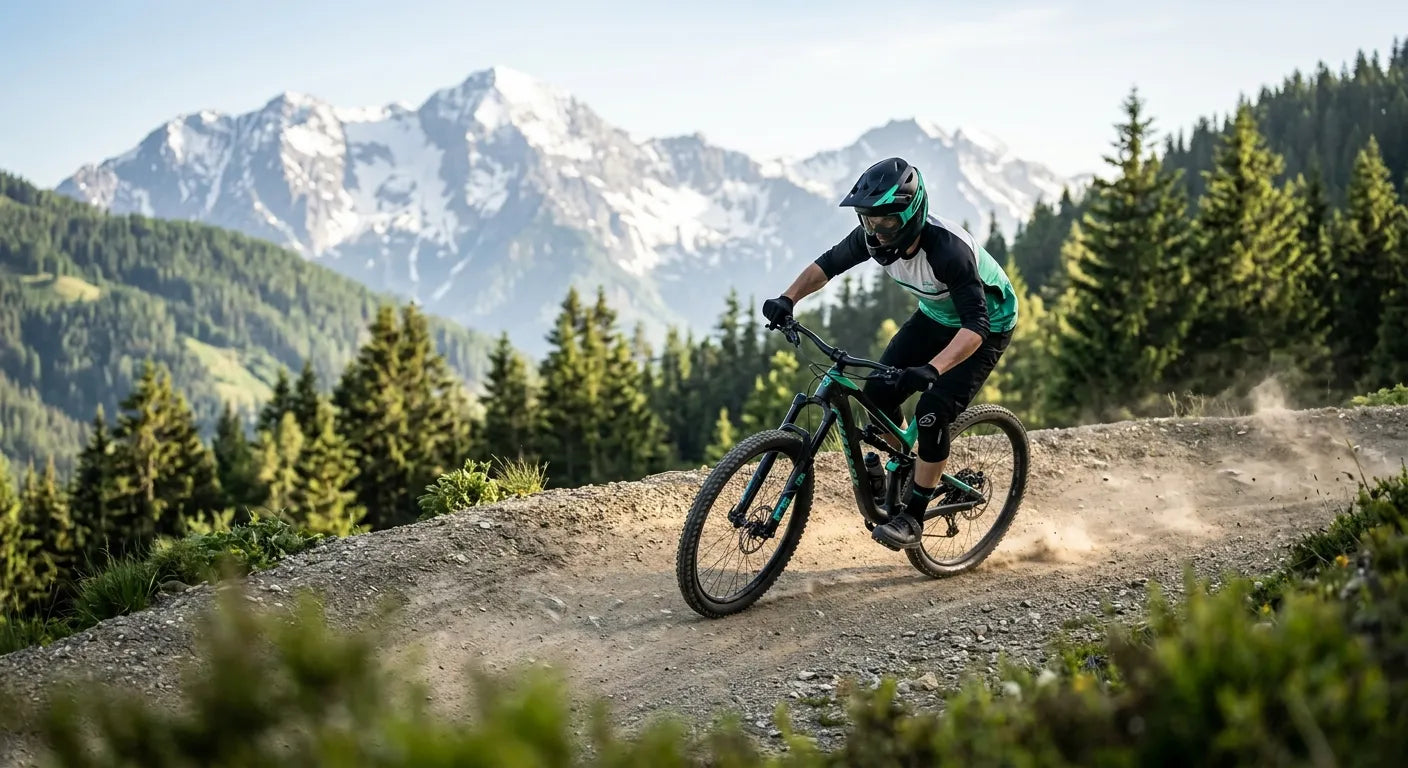
Amflow is a young e-MTB brand that develops its bikes entirely around the DJI Avinox drive system. The drone manufacturer DJI provides not only the motor, but the entire electronic package consisting of the drive unit, battery, display, and charging technology. For the 2027 model year, the range is expanding from the Enduro PX line and the Race PR series to include the PL and TL models, which target touring-oriented riders and beginners.
The series is particularly interesting for riders who previously had to choose between two camps: a lightweight e-MTB with limited torque or a full-power bike weighing well over 23 kilograms. Amflow positions its 2027 models in between. A system weight of around 20 kilograms combined with a motor that delivers triple-digit torque in boost mode was technically unachievable just a few years ago.
What is the Amflow 2027 e-bike series?
The series includes full-suspension mountain bikes with 150 to 160 millimeters of travel, designed for trail and enduro use. The shared technical core of all models is DJI's Avinox platform. Differences arise from the frame material, travel, battery concept, and equipment level.
A typical use case looks like this: You go on a day tour with 1,500 meters of climbing, want to knock out the climbs quickly, and then tackle technical descents without the bike feeling like a motorcycle. This combination is precisely the approach of the 2027 models. On the climbs, the motor provides up to 1,500 watts of peak power, while the low weight pays off in fast corners and when navigating technical terrain. For the carbon versions, the total weight is approximately 19 to 21 kilograms, depending on frame size and equipment.
The sensor system works more finely than has long been common in e-MTBs. The system measures cadence, pedal force, and incline, adjusting support continuously rather than rigidly following a fixed percentage level. In practice, this means you shift between modes less frequently because the bike automatically releases more power on a sudden steep section and dials it back on the subsequent flat. Riders who stand to pedal feel less "push" because the motor coordinates the output with pedal pressure.
Equipment on the higher-end models includes FOX suspension components, drivetrains from the SRAM Eagle Transmission family, and four-piston brakes with large rotors designed for the higher system weight and long descents. Operation is managed via a color display on the top tube, which shows remaining range, power output, and battery status, and can be connected to route data via an app.
For which type of rider is the series less suitable? Those who primarily ride on forest roads and gravel paths will barely utilize the potential of the drive and will pay for travel and suspension reserves that remain idle in daily use. A trekking or SUV e-bike is a more sensible choice there.
Who is the manufacturer behind the Amflow e-MTBs?
Amflow develops and sells the bikes as its own brand but relies on DJI's Avinox technology for the drive. DJI itself does not build complete bicycles; instead, it positions Avinox as a drive platform, similar to how Bosch or Shimano supply their systems to bicycle manufacturers. Amflow was the first customer, making it the bike on which the system publicly premiered.
The connection to DJI explains several characteristics of the drive. For drones, power density, precise motor control, and battery management are critical because every extra gram costs flight time. These exact factors determine the quality of an e-MTB in 2027: how compact a motor with high output power can be built, how cleanly the control system manages power delivery, and how much capacity fits into a battery at a given weight. Even the gallium nitride-based charger comes from an area where DJI has experience: compact power electronics.
For you as a buyer, the second point is relevant: Service and spare parts are handled through the Amflow dealer network and DJI support, not through established drive manufacturers. Anyone who values a comprehensive workshop network should clarify before purchasing which dealer in their region handles warranty claims and software updates for the drive.
How powerful is the DJI Avinox M2S in the Amflow PX Carbon?
The DJI Avinox M2S is the current generation of the drive and sits in the top models of the series, including the Amflow PX Carbon. The DJI Avinox M2S officially delivers 130 Nm in standard operation and 150 Nm in boost mode, with a peak power of 1,500 watts.
| Parameter | Standard operation | Boost mode |
|---|---|---|
| Torque | officially 130 Nm | 150 Nm |
| Power | up to 1,500 W peak | up to 1,500 W peak |
| Availability | permanent in all ride modes | 30 seconds per activation |
| Typical use | climbs, touring, trail | steep ramps, technical steps, sprints |
| Control | automatic adjustment to pedal force/incline | manual activation via display or remote |
The time-limited boost mode of the DJI Avinox is restricted to 30 seconds per activation, not 60 seconds. It then switches back to normal operation. This is not a cost-saving measure, but thermal management: the motor and battery release significantly more energy during this phase than they can handle permanently without a temperature rise. In practice, the 30 seconds are well-calculated. A root step, a concrete ramp, or a 20 percent gravel climb are covered by this. However, if you ignite the boost at the beginning of a ten-minute climb, you will waste it.
Mechanically, the M2S uses a compound planetary gear. This design offers two advantages: it transmits high forces in a small installation space and allows for helical gears. The helical gearing reduces operating noise to about 45 dBA, which is in the range of a quiet conversation. On long climbs with high cadence, this is the difference between an audible whir and a drive that remains quieter than tire and chain noise.
A practical note on automatic support adjustment: If you are used to riding with a fixed support level and dosing the power via gear selection, you will need some time to adjust. The auto mode reacts to your pedal pressure, so a powerful start immediately releases more power. Ride your first few tours with a steady cadence, and you will learn to estimate when the system provides extra boost.
What are the differences between the Amflow PL, PX, and PR?

The letter abbreviations stand for different focus areas. PX is the performance line for trail and enduro, PR is the race series designed for weight and range, while PL and TL cover touring-oriented and more affordably priced configurations. Within each line, there are several equipment variants that differ in suspension, groupset, and wheels.
| Model | Travel | Battery concept | Focus |
|---|---|---|---|
| Amflow PX Carbon | 150 to 160 mm | 700 Wh, fixed in frame | Enduro and demanding trails |
| Amflow PR | around 150 mm | removable, 600 or 800 Wh | Race and long tours with battery swap |
| Amflow PL | trail range, around 150 mm | fixed | Tour and versatile trail use |
| Amflow TL | trail range | removable | entry into the series |
The most important difference in daily use is the battery concept. In the PX, the 700 Wh unit is fixed in the down tube. This allows for a slimmer frame cross-section and a stiffer construction, but it means charging must be done on the bike. Those living on the third floor without an elevator or parking the bike in a garage without a power outlet should take this into account. The Amflow PL has a fixed battery. Removable batteries are only available from Amflow starting with models like the Amflow PR. PR and TL use removable batteries, which you can take into your home for charging and swap for a second one on long tours.
For orientation based on rider type:
- If you are primarily in the bike park, on steep root trails, and in rocky terrain, the Amflow PX Carbon is the right fit. Travel and frame stiffness are designed for rough conditions.
- If you ride marathons and long Alpine tours and want to carry a spare battery, the Amflow PR is the suitable line.
- If you are looking for a versatile trail bike for local laps and weekend tours and do not want to reach the top end of the price spectrum, the Amflow PL and Amflow TL are the obvious choices.
Regarding frame sizes, the series typically covers S to XL. Since e-MTBs with high motor torque feature a longer reach and slack head angles, a test ride in two sizes is worthwhile. Riders on the borderline between M and L choose more by riding style than by height: those who want to ride agilely and playfully should opt for the smaller size, while those seeking stability in fast descents should choose the larger one.
Battery capacities and range of the 2027 models
Amflow uses cell packs with an energy density of about 220 Wh per kilogram. An 800 Wh battery thus weighs about as much as a 600 Wh unit of an older design. This is exactly what creates the flexibility to keep a full-power bike around 20 kilograms.
- 600 Wh, removable: the light option for local laps and trail days with 800 to 1,200 meters of climbing. Sensible if you want to keep the weight as low as possible.
- 700 Wh, fixed integrated in the PX Carbon: designed for mixed day tours with around 1,500 meters of climbing, depending on rider weight, surface, and support level.
- 800 Wh, removable: for Alpine cross stages and long tours. With a second battery in your backpack, you double your reserve without needing a charging break.
Reliable range specifications in kilometers are always an estimate for e-MTBs because elevation gain, rider weight, tire pressure, temperature, and riding style have a greater effect than capacity itself. As a calculation figure, you can estimate about 8 to 12 Wh per 100 meters of climbing when riding in medium support and with luggage. An 800 Wh battery will mathematically take you over 1,500 to 2,000 meters of climbing. Those who ride permanently in the highest level and use boost frequently will end up significantly lower.
When charging, the Avinox system offers a tangible advantage. The included fast charger uses GaN technology and up to 12 amps of charging current. As a result, going from zero to 80 percent takes about 75 minutes, whereas classic 4-amp chargers require several hours for the same amount of energy. In practice, this means an extended lunch break in a mountain hut is enough to have sufficient capacity for the second half of the day. The GaN power supply is also more compact than standard chargers and fits in a backpack, which is relevant for bike vacations with multiple riders.
Regarding durability, the same applies to these cells as to other lithium-ion batteries: store them at about 50 to 70 percent charge, avoid leaving them plugged in permanently, and only charge them after cold winter rides once the battery has reached room temperature.
Prices and market launch in Germany
The series launched in Germany at the end of 2024 and became more widely available through specialist retailers starting in early 2025. The 2027 models run as the subsequent model year with the M2S drive. Recommended retail prices range from the entry-level at around 3,499 euros to the top model at 9,999 euros.
| Model | Equipment variant | RRP |
|---|---|---|
| Amflow TL | Entry-level configuration | from approx. €3,499 |
| Amflow PL | Touring and trail configuration | mid-price segment of the series |
| Amflow PR Carbon | Race configuration with removable battery | upper price segment of the series |
| Amflow PX Carbon | Standard configuration, 700 Wh | below the Pro variant |
| Amflow PX Carbon Pro | SRAM X0 Eagle Transmission, FOX Factory suspension | €9,999 |
Retailer prices differ from the RRP: lower for previous-year models and display pieces, occasionally higher due to scarce availability of individual frame sizes. Check before ordering whether the desired size and color are actually in stock, as lead times of several weeks are common for carbon models.
All models in the series are approved as pedelecs with a 25 km/h cutoff and are thus suitable for company bike leasing. Providers like JobRad cover the series provided the retailer participates in the program. For a bike around 8,000 euros, this significantly reduces the monthly burden because the leasing rate and taxable benefit are handled via payroll deduction. Clarify with the retailer in advance how software updates for the Avinox system and warranty claims on the motor are handled, as this is more important with a young drive system than the last 200 euros in price difference.
Frequently asked questions about Amflow 2027
How much torque does the DJI Avinox M2S motor have?
The DJI Avinox M2S officially delivers 130 Nm in standard operation and 150 Nm in boost mode, with a peak power of 1,500 watts. The control system regulates power based on pedal force and cadence, so that the support increases linearly with your own effort rather than kicking in abruptly.
How much does the Amflow PX Carbon Pro 2027 cost?
The top model, Amflow PX Carbon Pro, has a recommended retail price of 9,999 euros. For this, you get a SRAM X0 Eagle Transmission drivetrain, FOX Factory suspension, and the permanently integrated 700 Wh battery. Retailer offers are sometimes below the RRP, especially for remaining sizes. Through company bike leasing, the amount can be spread over monthly installments.