


Cube Phenix
Cube Phenix 2026: Maximum performance for cross-country and marathon
With the Cube Phenix, you are choosing an uncompromising XC hardtail that is consistently designed for speed and efficiency. The extremely lightweight carbon frame, sporty geometry, and high-quality components ensure direct propulsion and precise handling – ideal for fast cross-country laps, demanding marathon courses, and racing.
Filters


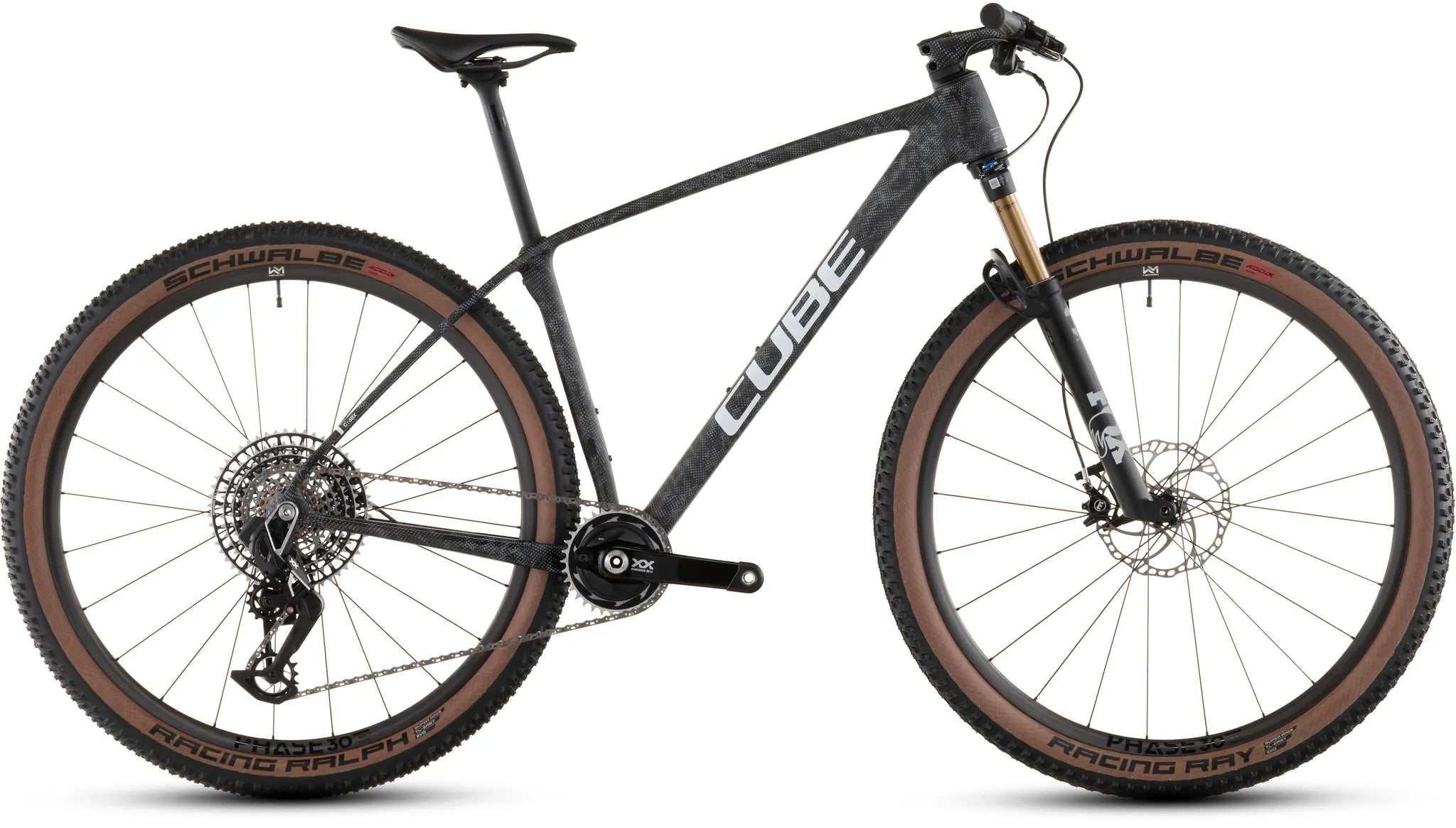

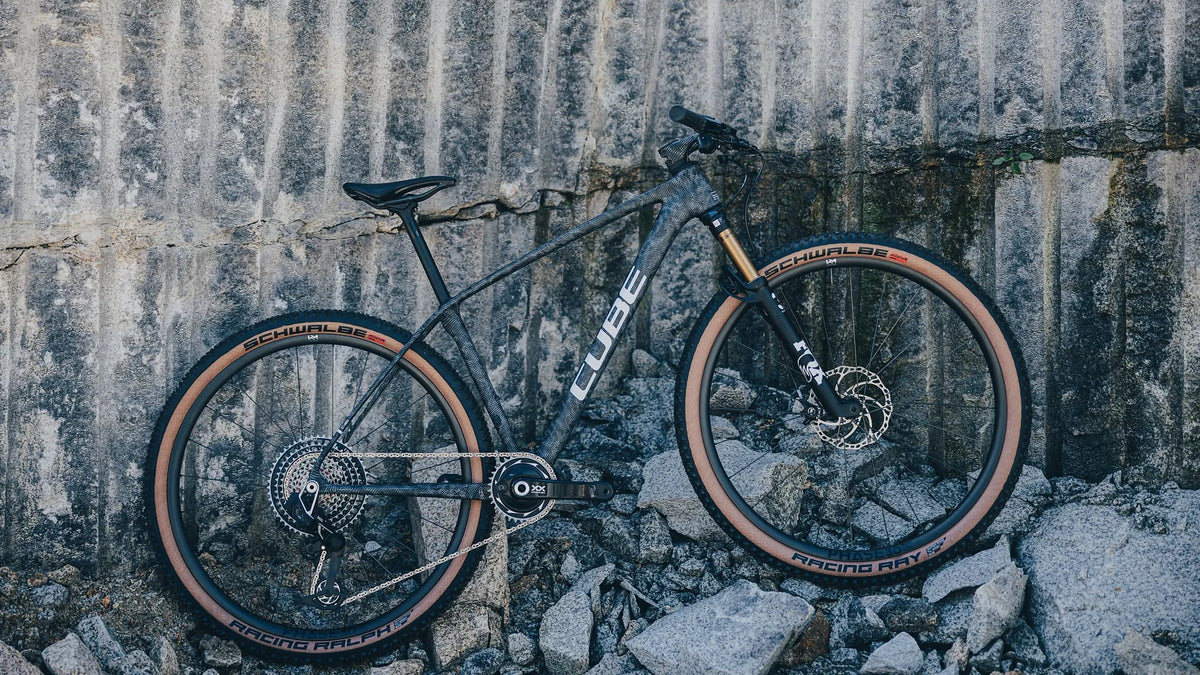
Cube Phenix as a lightweight XC hardtail for racing use
The Cube Phenix is a cross-country bike for riders who prioritize low weight, direct power transfer, and precise handling. As the successor to the Cube Elite series, it is aimed primarily at ambitious marathon riders and XC racers. The focus is clearly on speed. The lightweight carbon frame, sporty geometry, and competition-tuned components are designed to eliminate unnecessary mass on climbs and convert power directly into propulsion.
Technical cross-country courses are no longer just about long climbs on forest tracks. Steep descents, tight corners, and man-made obstacles demand much more from a modern XC hardtail. Cube therefore combines an aggressive racing position with an adjustable head tube angle, allowing the handling to be fine-tuned for fast, compact circuits or more technically demanding trails.
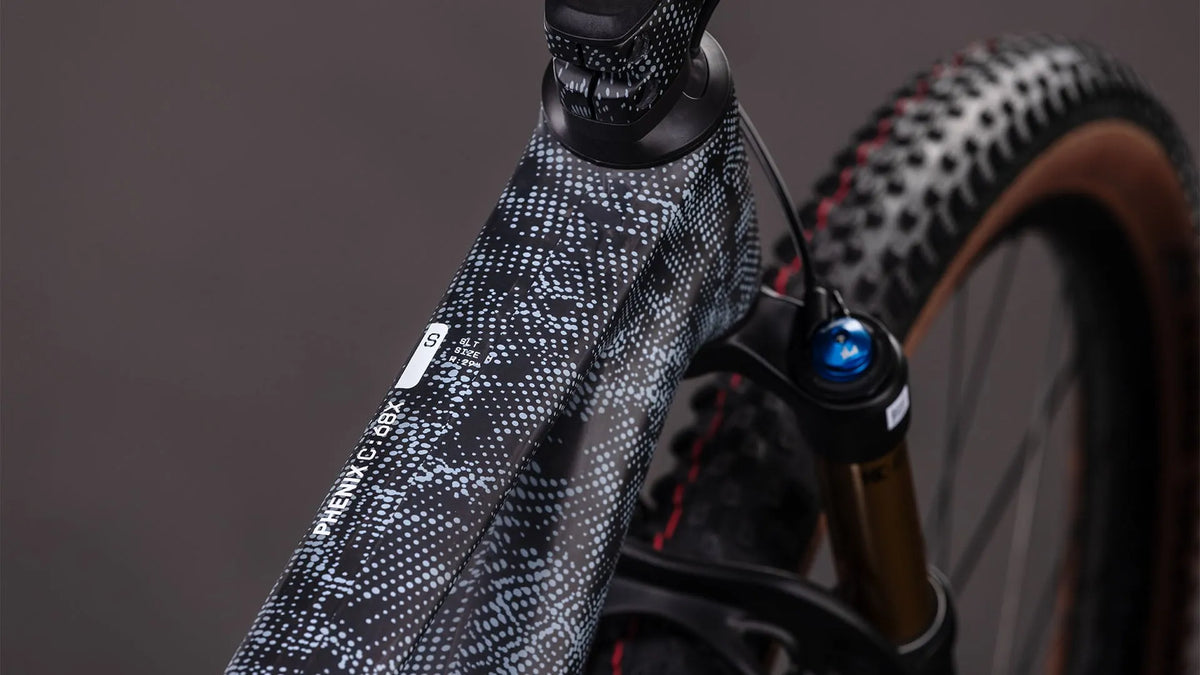
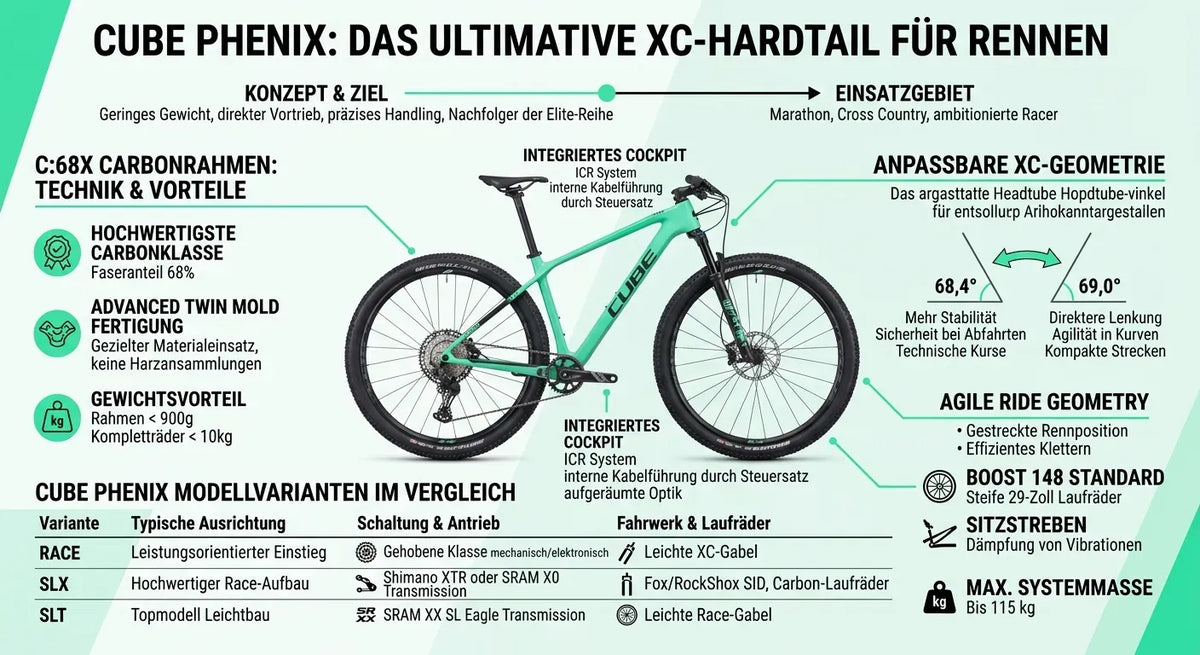
The Cube Phenix C:68X achieves its greatest weight advantage through the frame. Weighing less than 900 grams, it forms the foundation for complete bikes that, depending on the equipment variant, remain well under ten kilograms. The Race, SLX, and SLT models use the same consistent lightweight construction approach, but differ in terms of the suspension fork, drivetrain, wheels, and other components. As a result, the series ranges from a performance-oriented entry level to a race-ready top model.
The C:68X carbon frame of the Cube Phenix
The abbreviation C:68X denotes Cube's highest-grade carbon class. The manufacturer tunes fibers, resin content, and layup to achieve the lowest possible weight with high stiffness. The number 68 refers to the high fiber content in the composite material. Less resin saves mass without Cube neglecting the stability necessary for a racing bike. What is crucial here is not just the material, but also the precise orientation of the carbon layers.
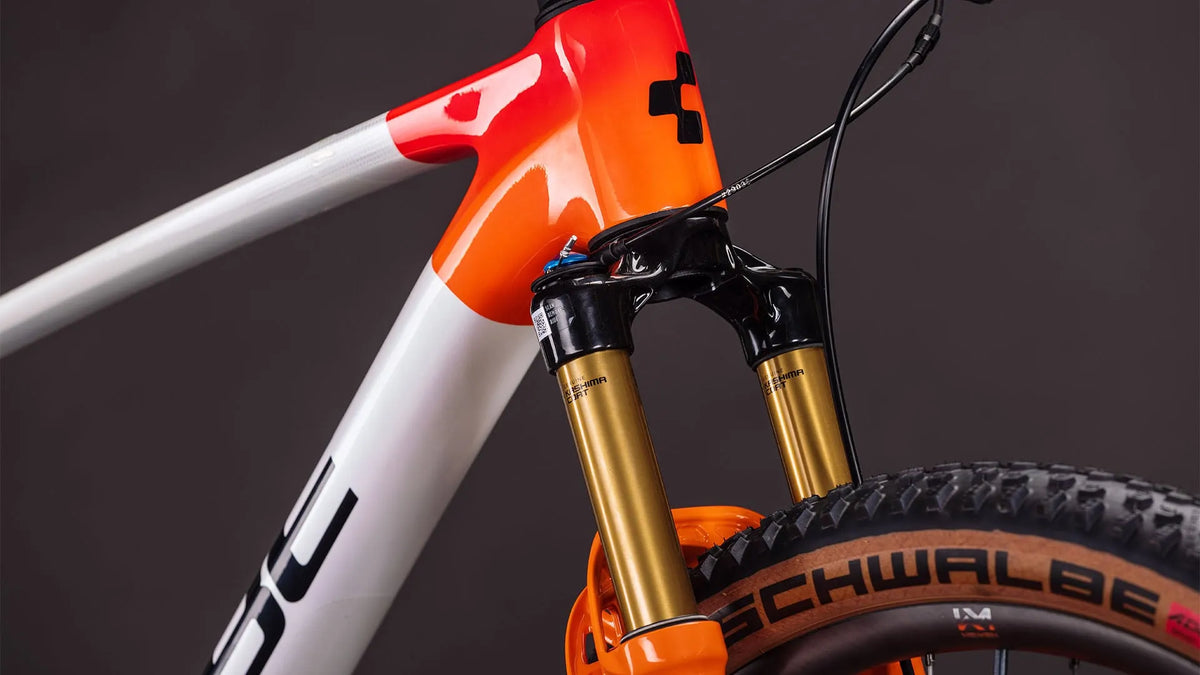
In Advanced Twin Mold manufacturing, Cube controls the shape of the frame from both the inside and outside during the laminating process. This is intended to prevent excess resin accumulation and uneven wall thicknesses. Material is placed specifically where high forces occur. This includes the area around the bottom bracket, the head tube, and the transitions to the chainstays. Lower-stress zones can be made thinner.
The result is a frame weight of under 900 grams. This puts the Cube Phenix C:68X in a weight class that is well below many production XC hardtail frames, which weigh around or over a kilogram. A difference of 100 or 150 grams might sound small at first. However, on a systematically built race bike, it has a noticeable impact on the overall weight. Especially on long climbs, every gram saved counts because both rider and bike must be repeatedly accelerated and moved against gravity.
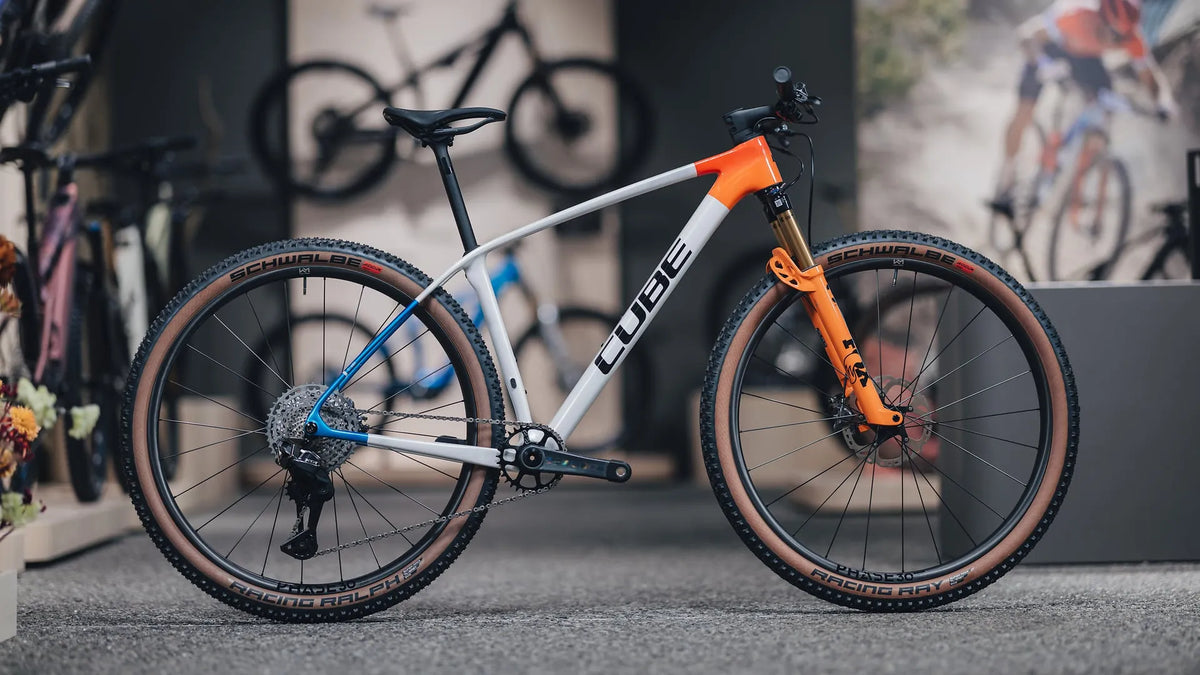
A lightweight frame must not twist uncontrollably under high pedal loads. Cube therefore designs the area around the bottom bracket for direct power transmission. When riding out of the saddle and during short sprints, as little energy as possible should be lost to lateral frame movement. At the same time, the thinner seat stays are able to absorb minor shocks and vibrations. While this does not replace rear suspension, it reduces the strain caused by rough terrain on long rides.
The Phenix uses the Boost 148 standard on the rear triangle. The wider rear hub creates a more favorable spoke angle, thereby enabling stiff 29-inch wheels. At the same time, it provides more space for tires and chainstays. This design is widely used in the sporty mountain bike sector and makes it easier to select compatible wheels.
Why XC geometry is designed for racing
The geometry of the Cube Phenix has one clear goal: the bike is intended to climb efficiently and react precisely to steering inputs on fast courses. The riding position is more stretched out than on a comfort-oriented touring hardtail, which shifts the upper body forward. On steep climbs, more pressure remains on the front wheel, while the rider can apply power to the pedals consistently.
An important feature is the adjustable head tube angle. The head tube angle is adjusted via special asymmetrical inserts (fiber inserts) in the headset that are placed into the frame. A change of just 0.6 degrees noticeably alters the character of a race bike. The setting influences the wheelbase, the trail, and the position of the front wheel in relation to the rider.
| Setting | Driving behavior | Suitable application |
|---|---|---|
| 68.4 degrees | A bit more composed at higher speeds and increased stability in steep sections | Technical XC courses, steeper descents, and rough terrain |
| 69.0 degrees | More direct steering response and quick turn-in on tight corners | Compact racetracks, marathon courses and rapid changes of direction |
The slacker 68.4-degree angle moves the front wheel slightly further forward. As a result, the bike remains more stable on fast descents and provides more control on steep steps. The steeper 69.0-degree position shortens the steering response and suits riders who prefer a very direct hardtail. For short sprints and tight corners, this setting can offer advantages.
The stem length also contributes to the typical XC character. On larger frames, a stem of up to 100 millimeters in length can be used. A longer stem stretches the riding position and keeps the front wheel on the ground during steep climbs. At the same time, the steering is less twitchy in response to small movements. Riders coming from trail bikes with short stems usually need to get used to this handling first.
The long and low position requires an appropriate frame size. A frame that is too large can restrict freedom of movement on technical descents. Conversely, a frame that is too small alters the intended weight distribution and can lead to a very cramped riding position. Stack and reach should therefore be considered in conjunction with body height, inseam, and preferred riding position.
The Agile Ride Geometry is aimed at experienced riders who actively maneuver a bike along the trail. The Phenix is not a comfortable touring bike with an upright posture. It requires strong core muscles and refined riding technique, but rewards both with immediate reactions. Those who race regularly can purposefully fine-tune the setup for each course via head angle, stem position, and cockpit height.
Cube Phenix Race, SLX, and SLT in comparison
The Race, SLX, and SLT equipment variants are based on the lightweight C:68X frame but have different focuses. The Race model provides entry to the Phenix platform. The SLX is aimed at riders with high standards for gearing, suspension, and wheels. The Cube Phenix SLT uses particularly lightweight components and is prepared for direct racing use.
Since Cube may change components between model years, color variants, and markets, the exact specifications should always be checked against the data sheet for the specific bicycle. The following classification shows the fundamental differences within the model series.
| Variant | Typical orientation | Shifting and drivetrain | Suspension and wheels | Suitable for |
|---|---|---|---|---|
| Race | Performance-oriented entry into the C:68X platform | The Race model is also equipped throughout with electronic shifting (e.g., SRAM X0 Eagle AXS Transmission). Mechanical groupsets are not used in the Cube Phenix series. | Lightweight XC suspension fork and race-ready 29-inch wheels | Marathon riders and ambitious tour riders |
| SLX | High-quality race build with reduced weight | Shimano XTR or SRAM X0 Transmission depending on the configuration | Fox Factory or RockShox SID as well as lightweight carbon wheels | Regular race participants and demanding XC riders |
| SLT | Top model with consistent lightweight construction | SRAM XX SL Eagle Transmission with electronic shifting | Lightweight race suspension fork and carbon wheelset | Competitive riders with maximum performance requirements |
The electronic SRAM Eagle Transmission shifts precisely even under high pedal loads. This is relevant in cross-country racing because gear changes often occur right at the start of a steep climb. Instead of significantly easing off the pedals before shifting, riders can better maintain their rhythm. The wireless control also reduces the number of cables at the cockpit.
Shimano XTR takes a slightly different approach and is known for its crisp, defined shifting. Which version is better suited depends on personal preferences and the desired availability of spare parts. Anyone who already owns other bikes with a specific shifting system can reduce workshop effort through standardized batteries, chargers, or wear parts.
For the suspension fork, aside from weight, the primary factors are responsiveness, adjustability, and lockout operation. Fox Factory and RockShox SID are among the typical high-end race forks. Both systems can be tuned to rider weight and the terrain. The lockout makes it possible to stiffen the suspension on smooth climbs or during sprints. Conversely, the fork should be able to operate openly on rooty sections and descents.
Carbon wheels reduce rotating mass and respond directly to acceleration. Their high lateral stiffness supports a precise line in corners. The difference is most noticeable during repeated bursts of speed. Riders should carefully adjust tire pressure, as a very stiff wheelset with too much pressure quickly loses traction on uneven terrain.
Depending on the specific model version, the Cube Phenix SLT features a power meter integrated into the SRAM XX SL crank. It measures the power generated while pedaling and transmits the data to a compatible bike computer. Racers can use this to monitor their exertion on long climbs, ride intervals based on power targets, and evaluate performance development. With this equipment, a later upgrade is not necessary.
If you already own a good wheelset or would like to replace individual components later, the Race model may make economic sense. The SLX offers a balanced ratio of low weight and high-quality standard equipment. The SLT is suitable for riders looking for the lightest possible, fully equipped race bike, including power measurement.
Integrated cockpit and internal cable routing
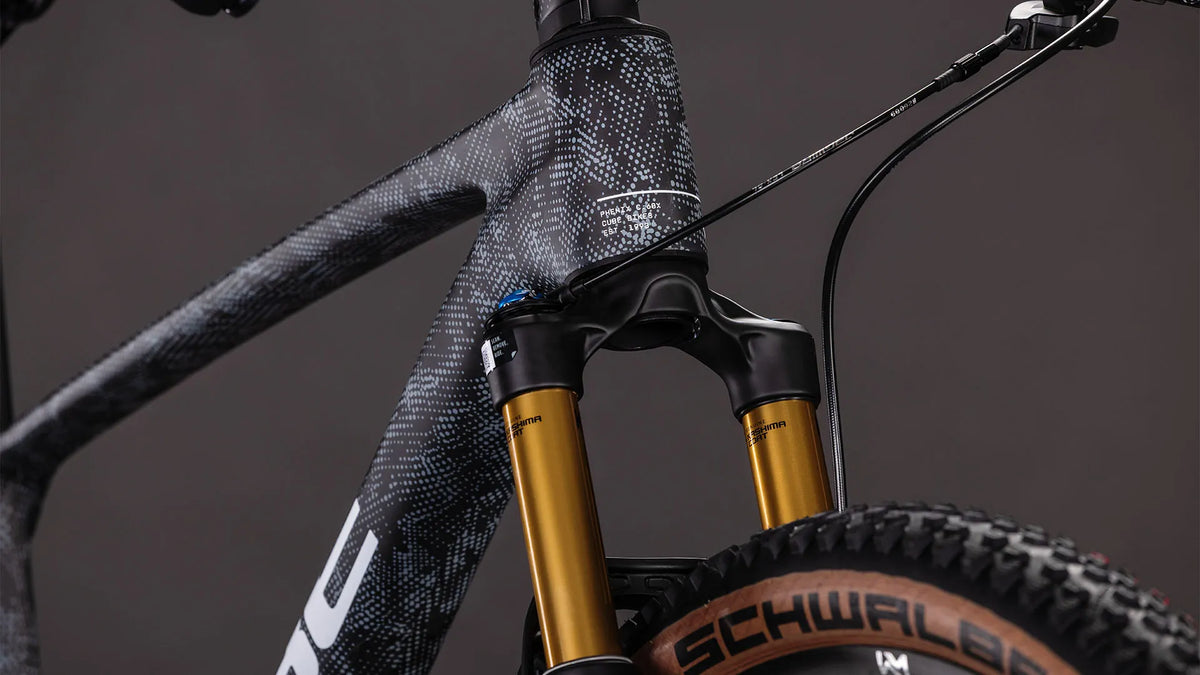
The cockpit of the Cube Phenix looks uncluttered because cables and lines are routed through the headset into the frame via the ICR system. ICR stands for Integrated Cable Routing. The lines run in the area of the ACROS headset bearings and do not enter the side of the head tube. Especially with an electronic gear system, this leaves only a few visible cables.
Internal routing better protects the lines from dirt and direct contact with branches. It also prevents gear cables from rubbing against the head tube. During assembly, the lines must be routed with suitable radii so that the brake hose and any existing cable housings are not kinked.
Despite the full integration, the system is characterized by its high ease of maintenance. The provided guides facilitate service work on lines and the headset. In addition, the clean look not only provides a tidy appearance but also brings clear aerodynamic advantages.
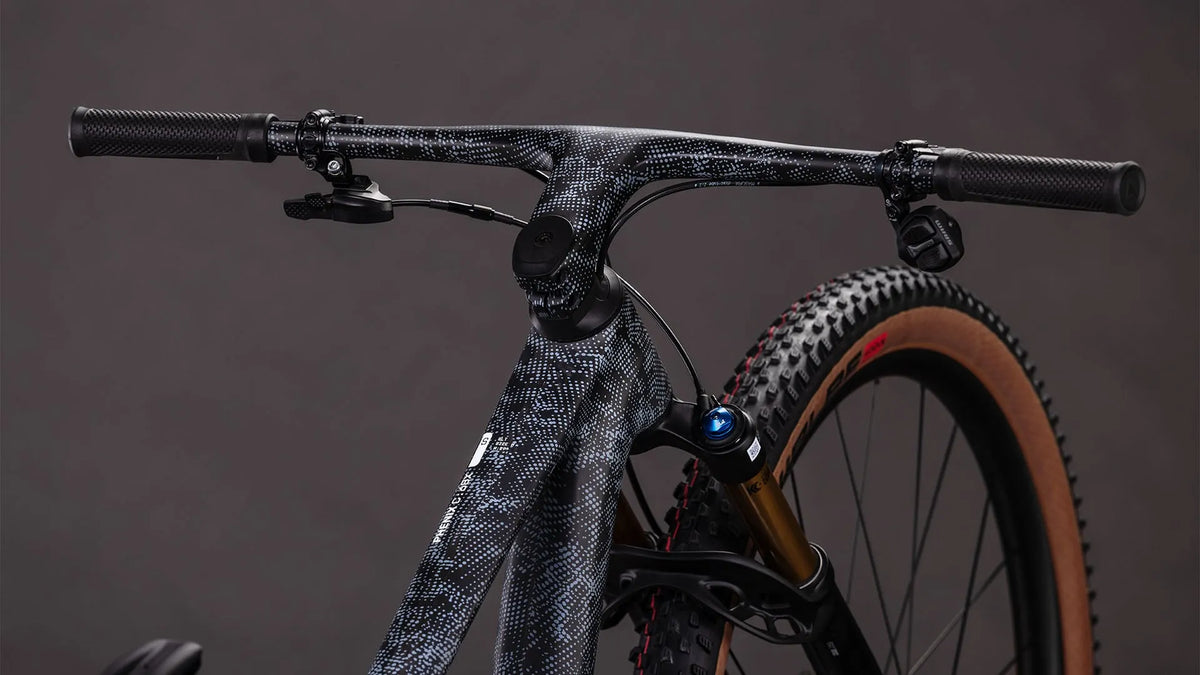
On selected equipment configurations, a carbon handlebar-stem unit complements the internal cable routing. The one-piece construction saves on connection materials and allows for a specifically tuned laminate layup. It offers direct power transfer during sprints and reduces weight compared to some two-piece combinations.
However, a one-piece unit limits subsequent adjustments. With a classic cockpit, the stem length, handlebar width, and handlebar angle can be changed separately. With an integrated component, these dimensions are fixed to one another. Therefore, reach, grip position, and desired handlebar width should be checked before purchase. An aerodynamically flat posture is of little use if the position causes discomfort on longer rides.
Who is the Cube Phenix suitable for?
The Cube Phenix suits riders who spend most of their time on XC race tracks, fast forest paths, and marathon courses. Its low weight makes long climbs and frequent changes in pace easier. The stiff construction translates pedal strokes directly, while the 100-millimeter suspension fork on the front wheel absorbs impacts and braking bumps.
On less demanding trails, a hardtail can save weight and maintenance compared to a full-suspension XC bike. It has no rear shock system, no pivot points, and no additional bearings. As a result, the drivetrain remains stable under pedaling load. On flat and rolling terrain, the Phenix feels especially fast.
On highly technical trails, a hardtail requires more active work from the rider. The rear wheel follows rough obstacles with less control than on a full-suspension bike, and impacts are felt more directly in the legs and back. Anyone who frequently rides rocky trails or needs more reserves on long descents should consider a full-suspension cross-country bike for comparison. For fast, climb-heavy courses, the low weight of the Phenix remains a clear advantage.
The choice of tires significantly influences the character of the bike. The frame is designed for tire widths of up to 2.35 inches or approximately 60 millimeters. A narrow, light tire rolls quickly on hard-packed ground. A 2.35-inch-wide model offers more contact surface on roots and loose ground and can be ridden with lower air pressure.
In doing so, rim width, the actual tire dimensions, and sufficient clearance from the frame must be taken into account.
For racing, a tubeless tire setup is recommended. Without an inner tube, tire pressure can be reduced without the constant risk of a classic snakebite during every hard impact. Tire sealant seals small punctures while riding. Tire pressure should be adjusted based on rider weight, rim width, tire model, and the course. Excessive pressure costs traction, while too little pressure increases the risk of rim strikes.
The riding position also deserves attention. Those who have previously ridden a comfortable touring bike should not choose the Phenix based solely on their height. The stretched racing geometry may require a different frame size or cockpit setup. A test ride will show whether the rider can sufficiently unweight the front wheel on steep sections while still maintaining enough pressure on the front during climbs.
The Cube Phenix is particularly worthwhile when low weight and acceleration are more important than suspension travel and reserves on rough terrain. The Race model is suitable for a gradual build. The SLX comes equipped ready to race for many ambitious riders. The Cube Phenix SLT is aimed at athletes who want to utilize electronic shifting, carbon wheels, and power meters straight from the factory.
Frequently Asked Questions about the Cube Phenix
How much does the Cube Phenix C:68X weigh?
The total weight depends on the model, frame size, and equipment. As a guideline, the Cube Phenix C:68X SLT weighs approximately 8.6 kilograms, while an SLX build can weigh around 9.0 kilograms. The frame weight is under 900 grams. Manufacturer specifications often refer to a specific frame size and may be stated without pedals. Tires, tubeless sealant, bottle cages, and bike computers increase the ready-to-ride weight. According to model specifications, the maximum permissible system weight is up to 115 kilograms. The system weight includes the bicycle, the rider, clothing, and all equipment. For instance, anyone carrying water bottles, tools, and a full backpack must factor this load in. Therefore, the low frame weight does not mean that the Phenix is only suitable for particularly lightweight riders. However, the specified system limit must be adhered to.
How much does the Cube Phenix frame weigh?
The C:68X carbon frame weighs less than 900 grams. The exact weight can vary depending on frame size, paint finish, and fitted small parts. In this weight class, the Phenix frame ranks among the lightest mass-produced XC hardtail frames. The C:68X carbon layup and Advanced Twin Mold manufacturing process enable this low mass.
Does the Cube Phenix have integrated cable routing through the headset?
Yes. The Cube Phenix uses an ICR system with internal cable routing through the headset area. The cables and brake hoses do not enter the side of the head tube. This protects them from dirt and ensures a tidy cockpit. Maintenance on cables and headset bearings may therefore require more assembly steps.
What is the maximum tire width that fits in the Cube Phenix frame?
The frame is designed for tires up to 2.35 inches or approximately 60 millimeters in width. The Boost standard provides the necessary extra clearance at the rear triangle. In its standard configuration, the bike is often equipped with a 2.25/2.35 Schwalbe combination. The actual size of a tire also depends on the inner rim width, air pressure, and manufacturer. A nominally 2.35-inch wide tire can measure larger on a wide rim. After installation, therefore, sufficient clearance must remain between the chainstays and seatstays.
Does the Cube Phenix SLT have an integrated power meter?
Depending on the specific version, the Cube Phenix C:68X SLT is offered with an SRAM XX SL Eagle Transmission power meter. The power measurement is integrated into the crank and transmits data to a compatible bike computer. This allows riders to manage training sessions based on wattage, monitor effort during races, and document their performance progress. Before purchasing, the specifications for the specific model year should be checked.
How much does the Cube Phenix frameset weigh compared to other XC bikes?
At less than 900 grams, the Phenix C:68X frame is below the one-kilogram mark that many lightweight XC hardtail frames aim for. Compared to a 1,000-gram frame, this already results in a saving of more than 100 grams. However, it is the complete bike that counts for riding performance. Wheels, tires, suspension forks, and drivetrain can either increase the frame's weight advantage or partially offset it.
Why is the geometry suitable for cross-country racing?
The stretched seating position supports efficient power transfer and keeps the front wheel weighted on steep climbs. The adjustable head tube angle allows for tuning between direct steering and increased stability. At 68.4 degrees, the bike handles more calmly in technical sections. The 69.0-degree setting reacts more quickly to steering inputs and is well-suited for tight, fast XC courses.
Du kannst deine Einstellungen jederzeit anpassen, um den vollen Funktionsumfang unserer Website zu nutzen.
Cookie-Einstellungen bearbeitenWir helfen Dir gerne weiter!

Live-Chat
Telefon
Telefon
Telefonzeiten:
Mo. - Fr. 10:00 - 13:30 & 14:30 - 18:00 Uhr
Sa. 10:00 - 14:00 Uhr
Telefon:
+49 2961 914 886 9
Kontaktformular
Kontaktformular
Außerhalb der Chat- und Telefonzeiten kannst Du uns Dein Anliegen über das Kontaktformular mitteilen.
E-Mail
Schreib uns einfach eine E-Mail an verkauf@liquid-life.de und wir werden Dir so schnell wie möglich antworten. Bitte hab Verständnis, dass es aufgrund der chronologischen Bearbeitung zu kleinen Verzögerungen kommen kann.
Bikeberater
Bonusprogramm