


Cube Flying Circus
Cube Flying Circus 2027: Ready for airtime, tricks and fast lines
Pump track, dirt line, or the next jump: The Cube Flying Circus 2027 is built for riders who actively move their bikes and are constantly working on new tricks. The compact geometry, 26-inch wheels, and direct single-speed drivetrain ensure playful handling, quick responsiveness, and maximum freedom of movement. In short: a bike for anyone who doesn't just ride, but turns every line into their own playground.
Filters


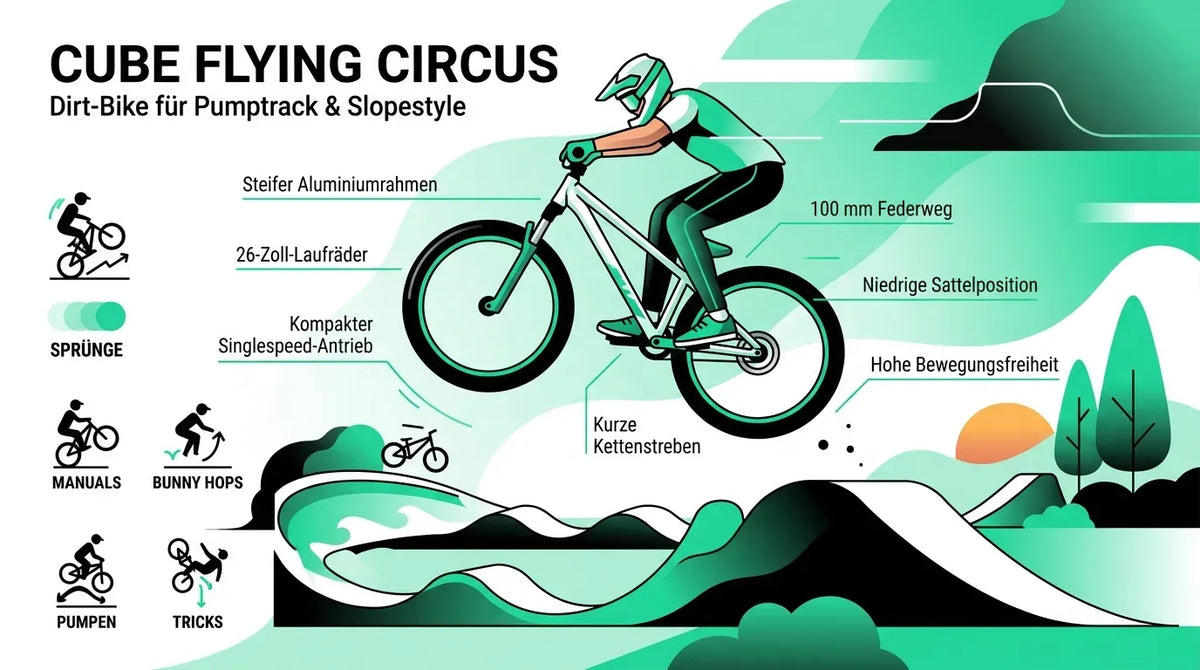
Cube Flying Circus: Dirt Bike for Pump Track and Slopestyle
The Cube Flying Circus is a specialized dirt jump bike for jumps, tricks, and fast laps on the pump track. Its stiff aluminum frame, compact 26-inch wheels, and simple single-speed drivetrain are designed for direct control. Short chainstays make manuals and actively lifting the rear wheel easier. The robust suspension fork and hydraulic disc brakes are designed to function reliably even during hard landings.
This clearly distinguishes the Flying Circus from a classic mountain bike for touring and trails. It deliberately foregoes multiple gears, a long seat post, and a comfort-oriented riding position. Instead, the design focuses on short, intense runs where acceleration, freedom of movement, and predictable handling in the air are essential.
What kind of bike is the Cube Flying Circus?
The Cube Flying Circus belongs to the dirt bike category. Such a bike has a compact frame, small wheels, and a low saddle position. During a run, riders stand on the pedals most of the time and actively move the bike under their bodies. The seating position is therefore not a criterion for choosing this bike.
The Cube dirt bike uses an aluminum Lite frame with geometry designed for dirt jumps and pump tracks. The current setup combines 26-inch wheels with 100 millimeters of travel and a single-speed drivetrain. This reduces the number of moving parts and keeps the drivetrain simple during jumps. A derailleur, which could be damaged during a landing, is not included in the standard setup.
As a single-speed mountain bike, the Flying Circus is suitable for riders who want to accelerate powerfully in a fixed gear and maintain their speed through pumping movements. This gearing is less suitable for longer climbs, tours, or varied terrain. The bike can be ridden on the way to the local pump track, but its real purpose begins on the track.
Typical features of the Cube Flying Circus are:
- a stiff aluminum frame for direct steering and pedaling input
- 26-inch wheels for a compact and agile ride
- short chainstays for manuals, bunny hops, and quick direction changes
- a suspension fork with 100 millimeters of travel
- a low-maintenance single-speed drivetrain
- adjustable dropouts for chain tension adjustment
- a low seat position with plenty of freedom of movement over the bike
The Flying Circus is therefore not a scaled-down trail bike. The frame, geometry, and components meet the demands of dirt jumping and pump track riding. Those who mainly want to ride forest trails or longer distances are better served by a classic hardtail. Those who want to learn jumps, ride pump track laps, or work on tricks will find a more suitable design here.
Where does the Cube Flying Circus excel?
The Flying Circus is at home on compact courses with rollers, berms, and jumps. Its range of use extends from paved pump tracks to groomed dirt lines. It can also be used on slopestyle courses with suitable track layouts. However, it was not designed for rough natural trails, long descents, and steep climbs.
- On the pump track, you accelerate the bike by pumping through rollers and turns. The compact geometry responds quickly to these pumping motions. The stiff frame transfers the momentum directly, while the short chainstays make it easier to actively unweight the rear wheel.
- On dirt jumps, the low design supports free movement over the bike. You can pull the bike up at the lip, adjust it in the air, and absorb the landing with your arms and legs.
- On slopestyle tracks, the Flying Circus is suitable for jumps, drops, and tricks, provided the course and obstacles match the rider's skill level. On large or very rough courses, a full-suspension slopestyle bike offers more margin.
- The bike can also be ridden on skatepark features. The tires, gearing, and geometry are suited for short starts, ramps, and controlled jumps. Before use, you should check whether bicycles are allowed in the respective park.
A pump track bike does not need to build speed through pedaling alone. When so-called pumping, you load the bike on downhill sections and unweight it before the next wave. A compact bike follows these movements more easily than a long touring bike. This makes the Flying Circus easy to pump quickly through successive waves.
On dirt lines, however, a consistent jump is important. A long suspension travel would absorb some of the pressure and change the timing. The dirt suspension fork with 100 millimeters of travel offers a middle ground: it dampens landings and bumps, but remains sufficiently direct when starting up a ramp.
The Flying Circus is not intended for road use in its sporty basic configuration. Depending on the model and delivery condition, lighting, reflectors, and other required components are missing. The low seating position and single gear are also impractical for longer everyday commutes. Short transfers are possible, but the focus is clearly on sports surfaces.
How do the frame and geometry affect handling?
The frame is made from heat-treated 6061 aluminium alloy. This material allows for stiff tube shapes while keeping the weight manageable. This means the bike responds instantly to tension and compression when you take off. On landing, the frame is designed to absorb the forces without feeling sloppy.
The chainstays on the Flying Circus are 388 millimetres long. The short distance between the bottom bracket and rear axle makes it easier to lift the front wheel. If you want to practice manuals, bunny hops or quick changes of direction, this compact rear-end geometry will help. It makes the bike responsive, but at high speeds, it requires precise body positioning.
The 69-degree head angle keeps the front end agile without making it overly nervous when approaching a jump. The stack height is 564 millimetres in both frame sizes. This means riders stand at a similar height over the front end. The main difference between the M and L is length: the top tube and reach each increase by 20 millimetres in size L.
If you want to move the bike close under your body and initiate rotations as easily as possible, the shorter frame is often a better fit. If you prefer more space between the handlebars and your hips during fast starts and big jumps, the longer frame can feel more stable. The decision therefore depends not only on body size, but also on riding style and experience.
Another detail is the BSA bottom bracket. In this case, the bottom bracket is seated in a threaded hole in the frame. The common standard makes maintenance and parts selection easier, provided that the axle diameter, shell width, crankset, and chainline match. If you want to install a different crankset later, there are many options available for BSA shells. A lightweight crankset can affect handling, while a robust setup offers more headroom during hard landings.
The tapered head tube accepts a tapered fork. The larger lower diameter increases the contact area in the crown area of the fork. High forces occur there during landings and hard braking maneuvers. An integrated headset eliminates additional external bearing cups and ensures a clean setup.
What frame size do you need for the Cube Flying Circus?
The Cube Flying Circus with 26-inch wheels is available in sizes M and L. Both versions have the same seat tube length, stack, and chainstay length. Size L is 20 millimeters longer, however. This changes the space in the cockpit, the wheelbase, and the response to weight shifts.
| Measurement or characteristic | Size M | Size L |
|---|---|---|
| Horizontal top tube | 570 mm | 590 mm |
| Reach | 392 mm | 412 mm |
| Stack | 564 mm | 564 mm |
| Wheelbase | 1031 mm | 1051 mm |
| Chainstays | 388 mm | 388 mm |
| Seat tube | 310 mm | 310 mm |
| Typical driving experience | compact and easier to maneuver | more space and a slightly smoother ride |
| Proper weight distribution | Tricks, manuals and rotations | quick starts and bigger jumps |
Size M makes sense if you are looking for playful handling or want to keep the bike close to your body when performing tricks. Riders who fall between the two sizes and prefer quick rotations also frequently choose the more compact option.
Size L offers more room between the seat area and the handlebars. This can be comfortable for taller riders as well as at high speeds. At a height of around 180 centimeters, L is often worth a look. This information is for guidance only, as arm length, leg length, and riding style significantly affect perception.
When it comes to a dirt jump bike, you can't directly compare the sizing to that of a touring mountain bike. An upright seat test doesn't tell you much, because the saddle sits low during the ride. What matters is the position when standing. You should be able to reach the handlebars without fully extending your arms or feeling like you're hanging over the front.
If you're torn between M and L, a simple rule helps: Choose M for a bike that's as maneuverable as possible, and L for more room and a longer wheelbase. A test ride on a pump track will give you more information than just a stationary seat test.
What features are installed for jumps and pump tracks?
The exact specifications may vary depending on the model year. Therefore, you should always check the components of the bicycle being offered before purchasing. The current setup includes an RST Dirt-15 suspension fork, hydraulic Shimano disc brakes, a Race Face Aeffect DH crankset, and Schwalbe Billy Bonkers tires as key components. The stated bicycle weight is 12.6 kilograms.
For a paved pump track, slightly higher tire pressure can reduce rolling resistance. On a dirt line with firm but not perfectly level ground, lower pressure often improves damping and ground contact. The pressure must always be within the specifications of the tires and rims. After hard landings, you should regularly check the tires, rims, and spoke tension.
The suspension fork is no substitute for proper landing technique. Your arms and legs still absorb a large part of the impact. A setting that is too soft can absorb energy when jumping. On the other hand, a very stiff setting transfers more stress to your hands and shoulders. The right setup depends on the rider's weight, the track, and their riding style.
- The RST Dirt-15 has 100 millimeters of travel and is designed for 26-inch wheels. A dirt fork is intended to absorb landings while providing sufficient grip when taking off.
- The hydraulic Shimano BR-MT200 disc brakes operate with brake discs on both wheels. They can be modulated with little hand force and are helpful during short, powerful braking maneuvers.
- The Race Face Aeffect DH crankset features a 28-tooth chainring and 170-millimeter crank arms. The compact gearing is suitable for short sprints and controlled acceleration.
- The ACID Pro 23 wheelset uses 32 spokes per wheel. The rear thru-axle holds the wheel securely in the adjustable dropouts.
- The Schwalbe Billy Bonkers tires are 2.25 inches wide. Their flat tread rolls easily on asphalt, concrete, and hard-packed soil. On deep mud or very loose ground, knobby trail tires offer more grip.
- The 720-millimeter-wide handlebar provides control without extending unnecessarily wide during barspins and other movements. The right width also depends on shoulder width and riding style.
Why does the Flying Circus only have one gear?
The single-speed drivetrain does away with a cassette, shifter, and derailleur. This reduces the number of components and lowers maintenance requirements. There’s no risk of shifting out of control when landing jumps, and the chain runs in a straight line. For short sprints on a pump track or before a dirt jump, a fixed gear ratio is all you need.
However, having only one gear means you can’t adjust the gearing for longer climbs or fast road sections. That’s why the Flying Circus is no substitute for a touring bike. If you regularly have to ride several kilometers with significant elevation changes to get to the spot, the ride there can be exhausting.
The frame is designed as "Rear Derailleur Ready". Gear shifting can generally be retrofitted, but the conversion is not limited to bolting on a derailleur. Depending on the desired system, a compatible rear wheel or a suitable freehub body, a cassette, a derailleur, a shifter, a suitable chain and cable routing are required. Chainline, gear range and clearance must also be correct.
Those who continue to use the bike mainly for dirt jumps usually benefit more from the simple single-speed setup. A retrofitted gear system expands the range of use, but adds weight and additional sensitive parts to the bike. Before a conversion, a workshop should check which components are compatible with the respective model year.
How do you adjust the chain tension?
The Flying Circus uses adjustable dropouts. This allows you to adjust the position of the rear wheel to tension the chain without a separate chain tensioner. Work in small increments and always check the alignment of the wheel.
- Secure the bike and first check the chain. Heavily worn, stiff, or damaged links must be replaced before making adjustments.
- Turn the crank slowly and check the chain tension over a full revolution. Chainrings and cogs are not always perfectly round. Set the tension at the tightest point.
- Loosen the rear wheel axle mounting on both sides only enough to allow the wheel to move in the dropouts.
- Adjust both sides evenly. Small increments prevent the rear wheel from sitting crookedly in the frame. Check the distance from the tire to both chainstays.
5. Check the position of the brake disc within the brake caliper. The wheel must spin freely without the disc constantly rubbing against the pads.
6. Adjust the chain so that it does not sag but still has a slight amount of play. A chain that is too tight puts strain on the bearings, chain, sprocket, and chainring. It can also become difficult to pedal.
7. Tighten the rear wheel axle alternately on both sides to the torque specified for the installed parts.
8. Turn the crank and rear wheel again. Check the chain tension, run-out, wheel position, and braking function before riding the bike.
After the first few rides, a new chain may stretch slightly. Check the tension again. If the wheel cannot be centered properly, the brake disc rubs, or you do not know the correct torque, have a bike shop perform the adjustment.
Frequently Asked Questions about Cube Flying Circus
How much does the Cube Flying Circus weigh?
The weight depends on the model year and equipment. Depending on the version, it is approximately between 11.8 and 12.6 kilograms. For the current model with the RST Dirt-15 fork, a weight of 12.6 kilograms is specified. Aftermarket pedals, tires, tubes, or other components can change the actual value.
Is the Cube Flying Circus suitable for beginners?
Yes, if beginners want to specifically learn pump track or dirt jump. The simple single-speed drivetrain requires almost no operation, and the compact geometry supports basic movements such as pumping and bunny hops. However, jumps should be practiced gradually on small, well-visible obstacles. A helmet and appropriate protective gear are essential for every training session.
Does the Cube Flying Circus have gears?
No, the stock Flying Circus has a single-speed drivetrain with a fixed gear. This setup is lightweight, low-maintenance, and more resistant to impacts. It is well-suited for short sprints before jumps and for pump tracks, where a large portion of the speed is generated through body movement.
Can a gear shift be retrofitted to the Cube Flying Circus?
The frame is prepared for the installation of a derailleur. However, several matching parts are required for the conversion. These may include the rear wheel or freehub, cassette, derailleur, shifter, chain, and cable routing. The retrofit should be planned based on the specific model year.
Is the Cube Flying Circus suitable for pump tracks?
Yes, pump tracks are one of the Flying Circus's main areas of use. The short chainstays, stiff frame, and 26-inch wheels respond directly to pumping motions. The bike can be quickly accelerated out of rollers and controlled in tight berms.
What is the difference between size M and L?
Size L has a 20-millimeter longer top tube, 20 millimeters more reach, and a 20-millimeter longer wheelbase. M feels more compact and makes tricks and rotations easier for many riders. L offers more room and can feel more stable at high speeds. Stack, seat tube, and chainstays are the same for both sizes.
What wheel size does the Flying Circus have?
The standard Flying Circus in sizes M and L features 26-inch wheels. This size combines quick handling with sufficient stability. Depending on the product range, a smaller Flying Circus model with 24-inch wheels may also be available, designed for younger or smaller riders.
Is the Cube Flying Circus suitable for regular mountain bike trails?
It can be used to a limited extent on short, smooth sections. However, on longer or more technically demanding trails, it lacks variable gearing, ample suspension travel, and an upright riding position. The bike is designed for manicured jumps, pump tracks, and compact park lines.
How often should the chain tension be checked?
Check the chain regularly and additionally after hard landings, work on the rear wheel, or the installation of a new chain. It should neither sag significantly nor be under high tension. Uneven tension during a crank rotation should also be checked.
What frame size is suitable for a height of 180 centimeters or more?
From around 180 centimeters, size L is often a good option because it offers more room in the cockpit. However, riders who prefer a compact, easily maneuverable bike can still choose size M. Body proportions and riding style are more important than a rigid classification based solely on height when it comes to dirt bikes.
Du kannst deine Einstellungen jederzeit anpassen, um den vollen Funktionsumfang unserer Website zu nutzen.
Cookie-Einstellungen bearbeitenWir helfen Dir gerne weiter!

Live-Chat
Telefon
Telefon
Telefonzeiten:
Mo. - Fr. 10:00 - 13:30 & 14:30 - 18:00 Uhr
Sa. 10:00 - 14:00 Uhr
Telefon:
+49 2961 914 886 9
Kontaktformular
Kontaktformular
Außerhalb der Chat- und Telefonzeiten kannst Du uns Dein Anliegen über das Kontaktformular mitteilen.
E-Mail
Schreib uns einfach eine E-Mail an verkauf@liquid-life.de und wir werden Dir so schnell wie möglich antworten. Bitte hab Verständnis, dass es aufgrund der chronologischen Bearbeitung zu kleinen Verzögerungen kommen kann.
Bikeberater
Bonusprogramm