


Gazelle Chamonix
Gazelle Chamonix 2027: Comfort meets sporty versatility
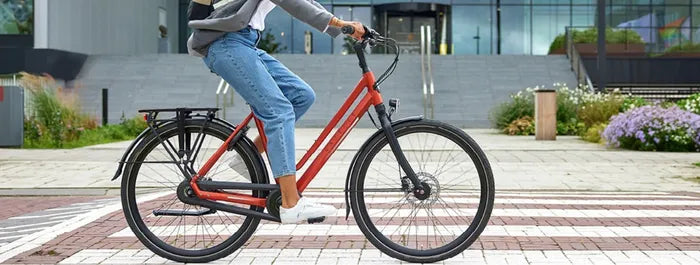
Ready for everyday life, your daily commute, and your next long-distance tour: The Gazelle Chamonix 2027 combines comfortable riding with a pleasantly active feel. This versatile model range feels just as at home in the city as it does on extended weekend tours, offering you the perfect balance of comfort, control, and dynamics.
Filters

Gazelle Chamonix: The sporty all-rounder for city and touring
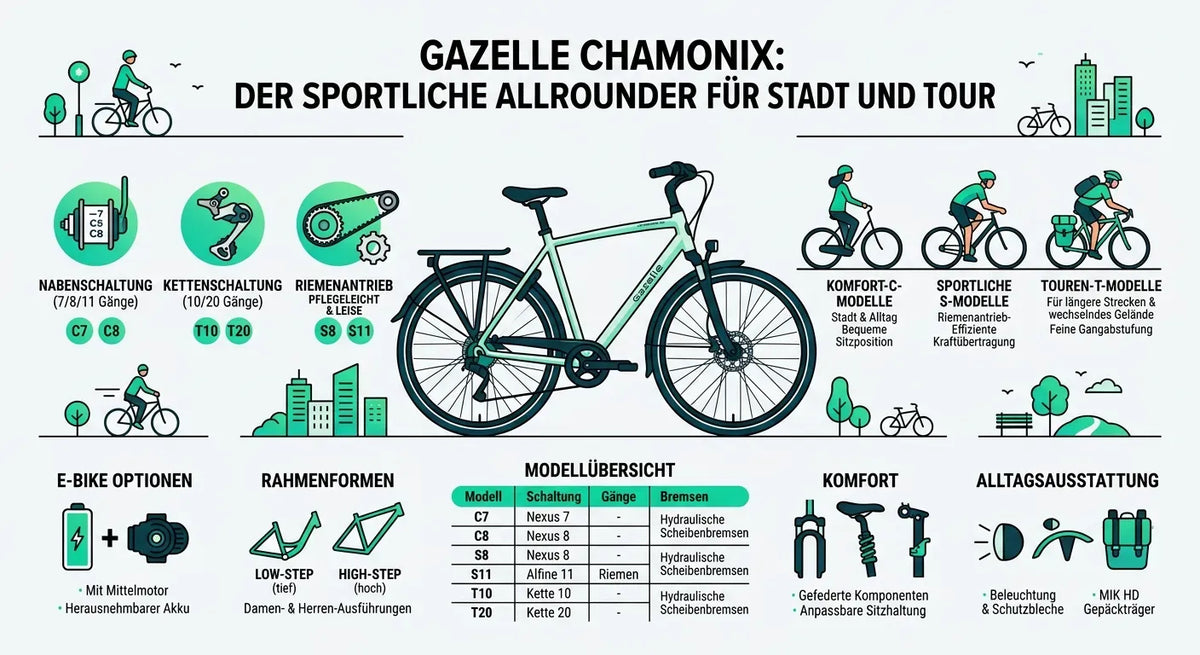
The Gazelle Chamonix combines the comfort of a city bike with the more active riding style of a trekking bike. This model series is aimed at people looking for a bicycle for their daily commute, running errands, and longer recreational rides. Depending on the version, there is a choice between hub gears, derailleur gears, and a belt drive. Some models are also available as Gazelle Chamonix e-bikes with a mid-mounted motor.
The right version depends primarily on the terrain and the desired level of maintenance. For predominantly flat routes and city traffic, models with hub gears are usually sufficient. Those who regularly ride on inclines, carry heavy luggage, or plan longer tours will benefit more from the finer gear ratios of a derailleur system. A Chamonix with a belt drive is suitable for riders who want to spend as little time as possible on drivetrain maintenance.
Designations and equipment details may vary depending on the model year and market. Therefore, the technical specifications of the specific bike should be checked before purchasing. This applies in particular to the gear system, braking system, battery, suspension, and maximum permissible total weight.
Which Gazelle Chamonix models are available?
Gazelle Chamonix models can be roughly divided into comfort-oriented C-models, sport-tuned S-models, and touring-oriented T-models. The number in the model name often indicates the number of gears. For example, the T20 has 20 gears available. Gazelle may change individual components or designations when models are updated.
| Model | Gear type | Gears | Brakes | Special features |
|---|---|---|---|---|
| Chamonix C7 | Shimano Nexus internal gear hub | 7 | Hydraulic disc brakes or rim brakes, depending on the model | Comfort-oriented riding position for city and everyday use |
| Chamonix C8 | Shimano Nexus hub gear | 8 | Hydraulic disc brakes | Slightly wider gear range than the C7 |
| Chamonix S8 | Shimano Nexus internal gear hub | 8 | Hydraulic disc brakes | Sportier configuration, with belt drive depending on the version |
| Chamonix S11 | Shimano Alfine internal gear hub | 11 | Hydraulic disc brakes | Gates belt drive and wide gear range |
| Chamonix T10 | Shimano derailleur gears, from the Cues series depending on the model | 10 | Hydraulic disc brakes | For varied terrain and longer tours |
| Chamonix T20 | Shimano derailleur gears | 20 | Hydraulic disc brakes | Fine gear spacing for inclines and touring luggage |
The Chamonix C7 is suitable for short to medium everyday trips on flat terrain. The hub gear is easy to operate and can be shifted while stationary. This is practical in city traffic when the bike frequently has to stop at traffic lights or intersections.
The C8 offers an additional gear. This makes it easier to adjust the gear ratio for bridges, slight inclines, or headwinds. Those who mainly ride in the city but also cover longer distances on the weekend will find the C8 a useful middle ground.
The S-models are aimed at riders who prefer a smooth-running and low-maintenance drivetrain. In particular, the S11 with its Shimano Alfine hub gear offers a wider gear range than simple city bike gears. The belt replaces the classic bicycle chain and does not need to be oiled or regularly degreased.
The T10 and T20 are designed for a more active riding style. Their derailleur gears react directly and offer suitable gear ratios for varied terrain. The T10 is sufficient for many day trips and commutes. The T20 is an interesting choice if you frequently encounter steeper gradients, longer distances, or trips with luggage.
Does the Gazelle Chamonix T10 have hub gears or derailleur gears?
The Gazelle Chamonix T10 features a derailleur gear system. Depending on the model year and version, Shimano components are used, including shifters from the Cues series. The ten gears allow for finer adjustment to speed and gradient than a simple hub gear system with seven or eight gears.
A derailleur gear system is suitable for riders who travel on varied terrain. The efficiency is high, the weight remains comparatively low, and worn individual parts can be replaced. However, the open design requires regular maintenance. The chain, cassette, and rear derailleur are exposed to dirt and moisture. After rides in the rain or on dusty paths, the chain should be cleaned and re-lubricated as needed.
In contrast, the C-models and many S-models use an internal gear hub. The gearbox is housed securely within the rear hub. This type of shifting requires less maintenance in daily use and can be operated while at a standstill. Under high load, the rider should briefly reduce pressure on the pedals to ensure the gear engages cleanly.
If you primarily ride in city traffic and are looking for simple operation, an internal gear hub is usually a better fit. If you regularly tackle hills, want to ride more sportily, or require a wide gear range, the derailleur system of the T10 or T20 makes more sense.
How maintenance-intensive is the belt drive on the Chamonix S11?
The belt drive of the Chamonix S11 requires less ongoing maintenance than a bicycle chain. It does not need to be oiled and therefore hardly picks up any road dirt. Grease stains on trousers or hands also do not occur during normal use. For daily commutes in changing weather, this is a practical advantage.
Nevertheless, a belt is not maintenance-free. Its tension and the alignment of the pulleys should be checked during an inspection. Small stones or stuck dirt must be removed. A damaged belt must not be kinked or mounted with unsuitable tools. With correct adjustment, however, the daily maintenance effort is significantly lower than with a chain.
The belt is combined with an internal gear hub because it cannot shift laterally between multiple sprockets. On the S11, an eleven-speed Shimano Alfine internal gear hub handles the gear selection. This combination is suitable for riders who want to combine a quiet drivetrain and low maintenance with a gear range suitable for touring.
Is the Gazelle Chamonix a trekking bike or a city bike?
The Gazelle Chamonix sits between a city bike and a trekking bike. On the city bike side, it features everyday equipment, a comfortable riding position, mudguards, lights, and a luggage carrier. From the trekking bike, the series adopts its more active frame geometry, sturdier design, and suitability for longer distances.
The C-models promote an upright to slightly active riding posture. The upper body remains well-upright without the riding experience being as relaxed as that of a classic Dutch bike. This posture improves visibility in traffic and relieves strain on the hands. It is suitable for daily commutes, errands, and leisurely recreational tours.
With the T-models, the seating position is oriented more towards the front. This makes it possible to apply more pressure to the pedals. The weight distribution supports controlled handling at higher speeds and over longer distances. Anyone who has previously ridden a trekking bike will usually find their way around a Chamonix T10 or T20 faster than on a comfort-oriented city bike.
The Chamonix is only intended to a limited extent for unpaved forest paths. Well-maintained gravel paths are possible with suitable tires. However, on rough ground, steep trails, or deep terrain, the suspension travel and off-road tires of a mountain bike are missing. The appropriate area of use ranges from asphalt and cycle paths to firm park paths and farm tracks.
How comfortable is the Gazelle Chamonix on long bike rides?
The Gazelle Chamonix is suitable for longer bike rides, provided the frame size, saddle height, and handlebar position are correctly adjusted. The combination of a stable aluminum frame, a suspended front end, and an adjustable seating position reduces strain on varying surfaces. The specific suspension system installed depends on the individual model.
- A telescopic suspension fork absorbs shocks from curbs, potholes, and poorly maintained bike paths.
- Suspension integrated into the fork steerer tube operates more discreetly and preserves the clean look of the front end.
- A suspension seat post can keep sharp, jarring shocks away from the back.
- An adjustable stem allows for the customization of handlebar height and reach to the saddle.
- Ergonomically shaped grips distribute pressure over a larger area of the hand.
- A sturdy luggage rack accommodates panniers and keeps the weight low on the bike.
The suspension is primarily intended to soften short impacts. It does not replace a correct seating position. If you experience pain in your neck, wrists, or knees after only a few kilometers, the bike's adjustment should be checked first. Often, the saddle is set too low, the handlebars are too far away, or the brake levers are at an unfavorable angle.
For day trips, a balanced weight distribution is important. Heavy items should be placed at the bottom of the panniers. A MIK HD luggage carrier makes it easier to securely attach compatible bags, baskets, or child seats, depending on the configuration. Whether a particular accessory may be used depends on the manufacturer's approval and the maximum permissible total weight.
The rigid frame construction supports stable handling when carrying luggage. At the same time, the chosen gearing should match the terrain profile. For flat riverside paths, an internal gear hub is often sufficient. On long inclines, a derailleur system offers more options for maintaining a joint-friendly pedaling cadence.
A Gazelle Chamonix test ride should therefore not just consist of a short loop on flat asphalt. It is useful to go for a test ride that includes an incline, several stops, and a section on rough ground. This allows you to check whether the gear ratio is sufficient, the brakes are easy to modulate, and the riding position remains comfortable even after a longer period of time.
How to choose the right Gazelle Chamonix for men or women
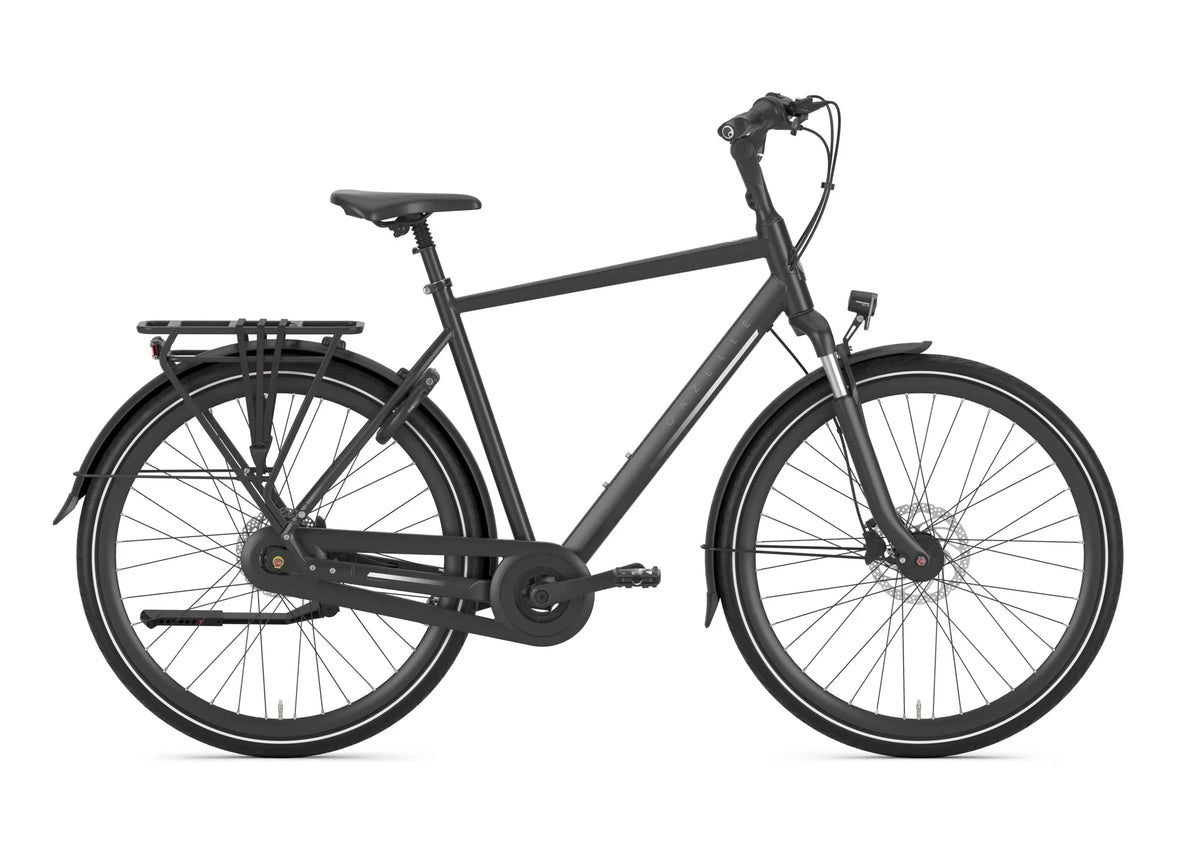
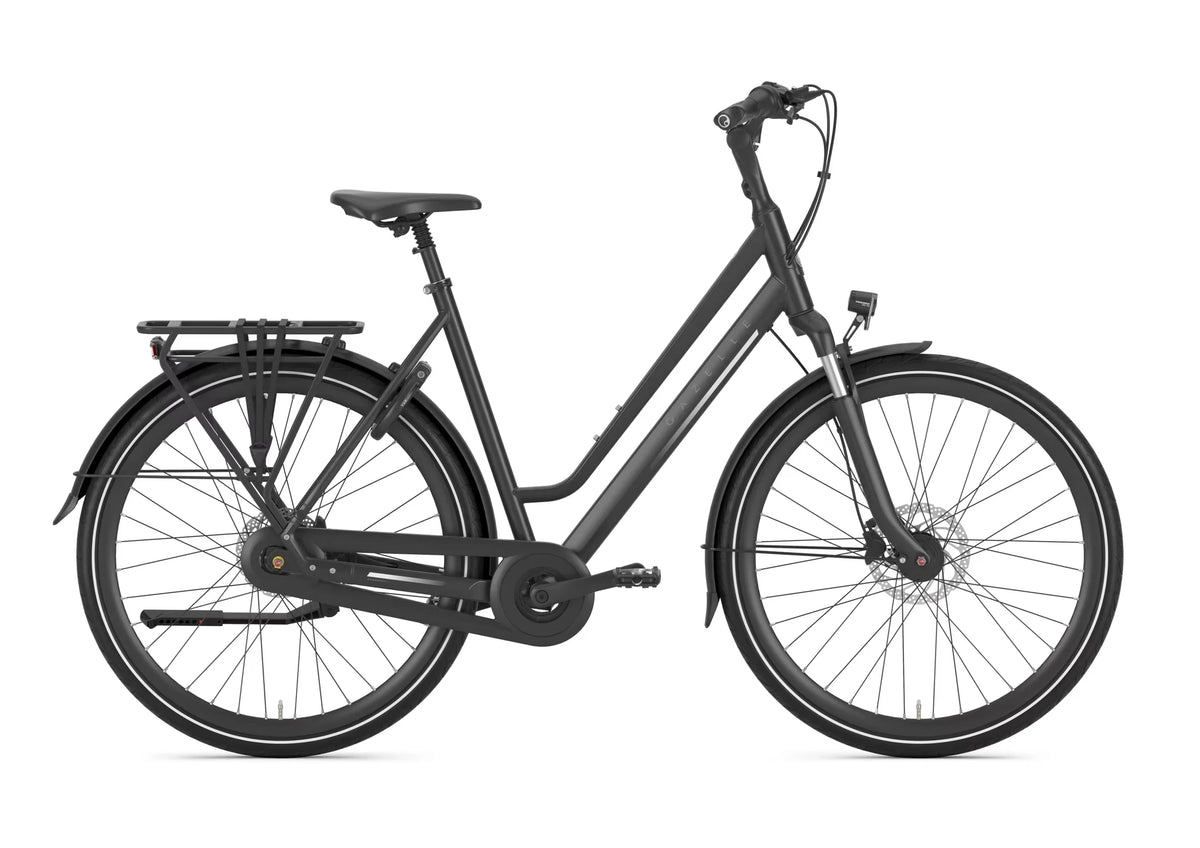
Gazelle Chamonix women's and Gazelle Chamonix men's models differ primarily in their frame shape. The terms women's bike and men's bike serve only as a rough classification. The decisive factors are a safe mount, appropriate geometry, and sufficient stability. Any frame shape can be chosen regardless of gender.
A low-step frame has a low step-through. It makes mounting easier in city traffic, on inclines, or with luggage on the rear carrier. This frame shape is also practical for those with limited mobility. The frame is structurally reinforced so that it remains stable despite the missing top tube.
A high-step frame has a high or almost horizontal top tube. This design offers high frame rigidity and suits a sportier riding position. Those who frequently ride longer distances or accelerate forcefully may prefer the direct riding feel. The prerequisite is that mounting and dismounting can be done safely.
The frame size should not be chosen based on body height alone. Inside leg length, torso length, and the desired riding position also influence the selection. For Chamonix models, sizes ranging from approximately 49 to 65 centimeters are available, depending on the frame shape. The selection may be limited depending on the model.
During a test ride, there should be sufficient clearance between the crotch and the top tube. At the lowest pedal position, the knee should not be fully extended. At the same time, the handlebars must be reachable without pulling the shoulders forward. An adjustable stem can compensate for minor differences, but cannot correct a frame that is significantly too large or too small.
If two sizes are an option, the smaller frame usually offers more agile handling and greater freedom of movement. The larger frame can provide a smoother ride if the top tube length is appropriate. Professional measurement at a specialist retailer is particularly useful for long daily stages, as a few millimeters in saddle position and stem adjustment can change the strain on the knees, back, and hands.
Frequently Asked Questions about the Gazelle Chamonix
Can you remove the battery from the Gazelle Chamonix for charging?
For the electric Chamonix models, the battery integrated into the down tube can generally be removed. A lock secures it to the bicycle. Depending on the design, the battery is removed from the frame either upwards or to the side. The corresponding key is required to unlock it.
The battery can also be charged while installed, provided the bicycle is within reach of a power outlet. The e-bike should be switched off before removal. When inserting, the battery must audibly click into place and then be checked for a secure fit. The exact handling depends on the installed battery system.
What is the range of the Gazelle Chamonix e-bikes?
The range of a Gazelle Chamonix e-bike depends on battery capacity, assistance level, terrain, temperature, and rider weight. Tire pressure, headwinds, and cargo also affect energy consumption. With a large 630-watt-hour battery, ranges of up to approximately 145 kilometers can be possible under favorable conditions.
In everyday use, it is best to plan with a reserve. Frequent starting, high levels of assistance, and long inclines reduce the range. Those who ride mainly in Eco mode on flat paths will travel significantly further than a rider who constantly uses the highest level of assistance. At low temperatures, less battery power is temporarily available.
What does a Gazelle Chamonix e-bike weigh?
A Chamonix e-bike weighs approximately 25 to 27 kilograms, depending on the frame, motor, battery, and equipment. Bicycles without a motor are lighter. A Chamonix T20, for example, can weigh around 18.3 kilograms, though specific values depend on the frame size and model year.
Weight is relevant if the bicycle is to be carried up stairs regularly or transported on a rear rack. By removing the battery, an e-bike can be made several kilograms lighter when carrying it. For transport by car, the load capacity of the bicycle rack and the permissible nose weight of the vehicle must be taken into account.
Which frame size do I need for a Gazelle Chamonix?
Depending on the model, frame sizes from approximately 49 to 65 centimeters are available. These roughly cover heights from around 1.60 to 2.05 meters. These values serve only as a guide, as people of the same height can have different inseam lengths.
For a more precise selection, the inseam length is measured first. To do this, the person stands straight against a wall without shoes and holds a book horizontally between their legs. The distance from the floor to the top edge of the book is the inseam length. Subsequently, the appropriate frame size can be determined using the size chart for the specific Chamonix model.
Which Gazelle Chamonix model has a belt drive?
The Chamonix S11 is one of the models with a Gates belt drive. Depending on the model year, other S versions, such as an S8, may also be offered with a belt. Before purchasing, you should check whether the specific variant actually has a belt or a classic chain.
Is the Gazelle Chamonix suitable for daily commuting?
The Chamonix is suitable for daily commutes because its lighting, mudguards, luggage rack, and everyday riding position are already tailored to this purpose. For short city trips, a C-model with hub gears is practical. For longer or hilly routes, a T-model with derailleur gears offers more gear range. Those who want to keep maintenance to a minimum can choose an S-model with a belt drive.
Du kannst deine Einstellungen jederzeit anpassen, um den vollen Funktionsumfang unserer Website zu nutzen.
Cookie-Einstellungen bearbeitenWir helfen Dir gerne weiter!

Live-Chat
Telefon
Telefon
Telefonzeiten:
Mo. - Fr. 10:00 - 13:30 & 14:30 - 18:00 Uhr
Sa. 10:00 - 14:00 Uhr
Telefon:
+49 2961 914 886 9
Kontaktformular
Kontaktformular
Außerhalb der Chat- und Telefonzeiten kannst Du uns Dein Anliegen über das Kontaktformular mitteilen.
E-Mail
Schreib uns einfach eine E-Mail an verkauf@liquid-life.de und wir werden Dir so schnell wie möglich antworten. Bitte hab Verständnis, dass es aufgrund der chronologischen Bearbeitung zu kleinen Verzögerungen kommen kann.
Bikeberater
Bonusprogramm