

Raymon Scorena 2027: Your introduction to road cycling. Your freedom on two wheels.
The wind in your face. The road ahead. And that feeling of wanting to keep riding forever. Your road cycling passion begins with the new Raymon Scorena 2027! The sporty aluminum frame, comfortable carbon fork, and 35 mm wide tires make every ride a pleasure – even when the asphalt gets rough. Whether it's your first road bike ride, your next training session, or an extended weekend tour: The Scorena combines speed, comfort, and pure riding pleasure. Hop on, get going, and experience the road anew.
Filtros
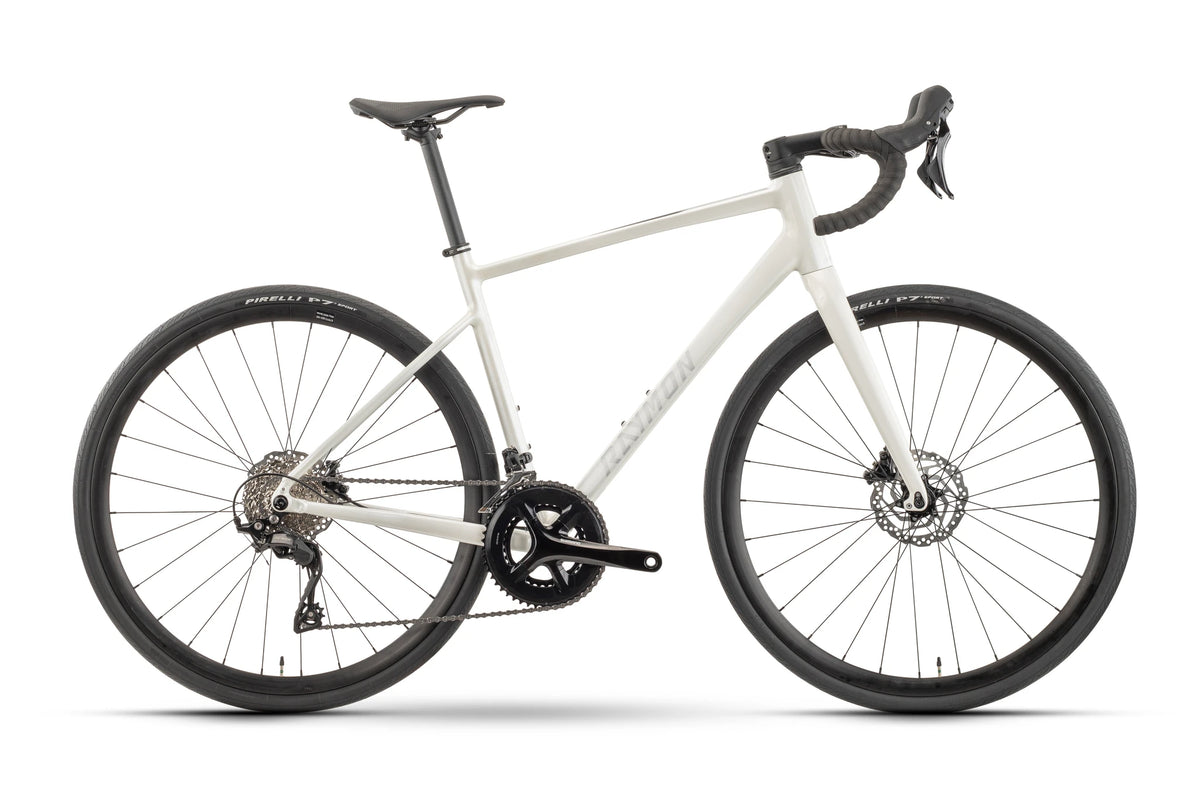

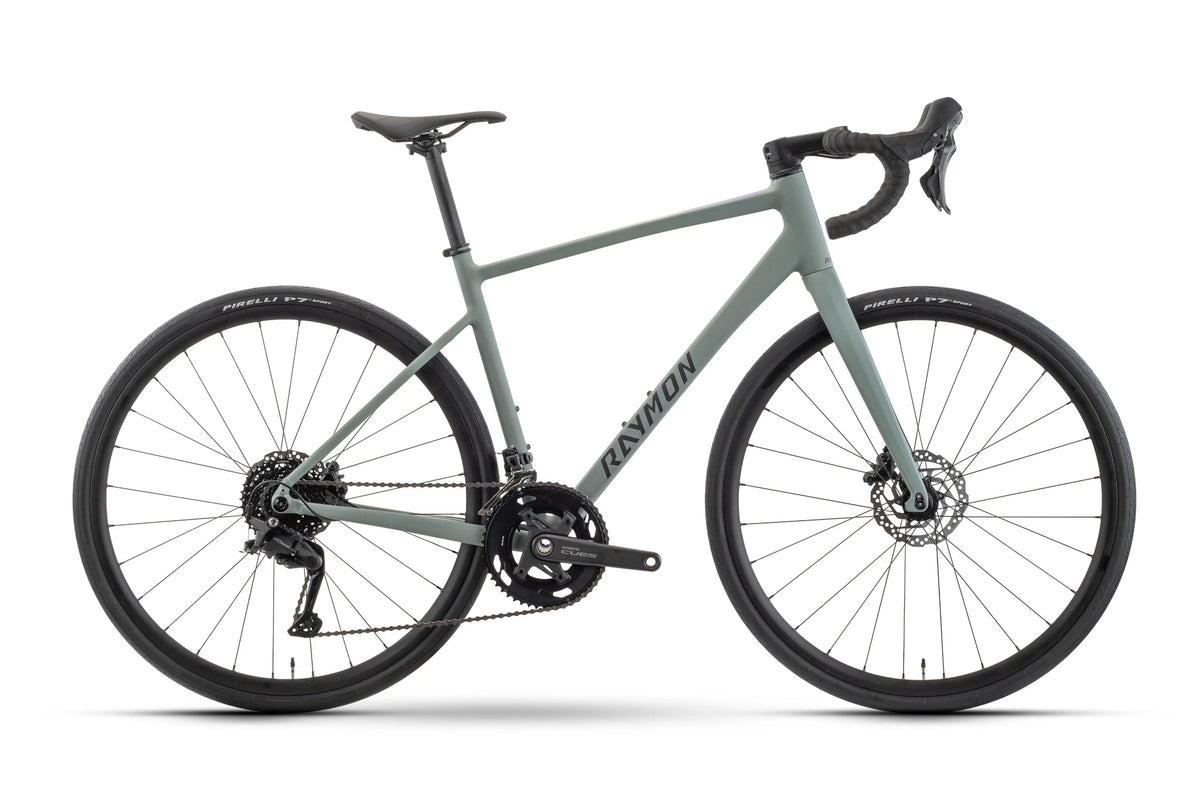
Raymon Scorena as a versatile aluminum road bike for beginners
The Raymon Scorena is a sporty aluminum road bike for getting started, regular training rides, and longer tours on varying road surfaces. Its AL61-T6 aluminum frame is combined with a carbon fork and 35-millimeter-wide tires. This keeps the bike clearly recognizable as a road bike while offering more comfort and headroom than many traditionally built road bikes with narrow tires.
Raymon is introducing the Scorena in the 2027 model year as a new road sport platform. The Scorena Pro with mechanical Shimano 105 and the more simply equipped Raymon Scorena Comp with Shimano Cues are available to choose from. Both versions roll on 28-inch wheels and are available in six frame sizes from 48 to 60 centimeters.
The Scorena is for riders looking for a predictable road bike that isn't limited to smooth asphalt. The 35-622 tires handle rough side roads, bike paths, and paved gravel sections better than narrow road bike tires. However, the bike is not intended for technically demanding forest trails or loose surfaces.
Who is the Raymon Scorena suitable for?
The Raymon Scorena is primarily aimed at road bike beginners and sporty everyday riders. Those who have previously ridden a trekking bike, fitness bike, or mountain bike will find an accessible introduction to the world of drop handlebars. The riding position is sporty, but less uncompromising than on an aero road bike designed for racing.
If you are mainly planning fast after-work rides and weekend tours on asphalt, the Scorena is well suited for this purpose. The road bike gearing allows for brisk speeds on flat stretches. At the same time, easy gears are available for climbs. The wider tires absorb some of the harshness of rough asphalt and increase control on dirty or uneven roads.
The concept is also interesting for longer distances. The aluminum frame ensures direct power transfer, while the carbon fork and wide tires reduce vibrations at the front. On multi-hour tours, this means that hands, shoulders, and the neck are less stressed by small bumps. Choosing the right frame size and properly adjusting the seat height, handlebar position, and grip width remain crucial for this.
Commuters can also use the Scorena if they are looking for a fast bike for predominantly paved roads. For riding in the dark or in bad weather, lighting, mudguards and other accessories must be selected to suit the respective frame and the desired mounting method.
The Scorena is less suitable for riders who frequently ride on rough forest roads, deep gravel or technical trails. It lacks the pronounced tire tread, wide gravel gearing and higher tire clearance of a classic gravel bike. For riders with a clear focus on aerodynamics and road racing, a lighter race or aero road bike is the more suitable choice.
Is the Raymon Scorena a road bike or a gravel bike?
The Scorena is a road bike with all-road capabilities. Its road bike geometry, drop handlebars and road-speed-oriented drivetrain distinguish it from a gravel bike. Its 35-millimeter-wide Pirelli P7 Sport tires expand the range of rideable terrain without turning the Scorena into a gravel bike.
| Feature | Raymon Scorena | Classic Road Bike | Gravel Bike |
|---|---|---|---|
| Basic Concept | Road sport bike with all-road capability | Road bike for mostly smooth asphalt | Bike for asphalt, gravel, and unpaved roads |
| Tires | 35-622 with road tread | Often about 25 to 32 millimeters | Often about 38 to 50 millimeters |
| Ride feel | Sporty, stable and relatively comfortable | Direct, fast and, depending on geometry, very agile | Smooth, trail-oriented and designed for traction |
| Suitable terrain | Asphalt, bike paths, rough roads and fine gravel | Predominantly asphalt | Asphalt, gravel, farm tracks and light forest trails |
| Riding position | Sporty with a touring-friendly orientation | Depending on the model, from comfortable to very stretched out | Mostly control-oriented and slightly more upright |
| Typical Use | Training, touring, active everyday riding | Road training, long distances and races | Bikepacking, gravel tours and mixed terrain |
If your routes are mostly paved and only occasionally take you over well-maintained gravel roads, the Scorena is a suitable solution. If you regularly ride on loose surfaces or want to mount bags for multi-day tours, a gravel bike usually offers greater versatility.
Why do beginners benefit from the Raymon Scorena?
Switching to drop handlebars changes your riding position, hand position, and steering. The Scorena combines this sporty design with components that make getting started more manageable.
- The 35-millimeter-wide tires offer more air volume than narrow road bike tires. This improves comfort and increases the contact patch on rough or wet surfaces.
- The endurance-oriented geometry reduces pressure on the neck and back compared to a very low race position.
- The carbon fork dampens fine vibrations at the front while maintaining precise steering.
- Hydraulic disc brakes provide precise modulation and require relatively little hand force for powerful braking.
- Six frame sizes make it easier to choose a suitable riding position. This is more important for comfort and safe handling than keeping the bike weight as low as possible.
- The widely geared drivetrains provide easy ratios for climbs. This means beginners do not have to stick exclusively to flat terrain.
Raymon Scorena Pro and Raymon Scorena Comp Compared
The Raymon Scorena Pro and the Raymon Scorena Comp use the same basic concept. Both models feature an aluminum frame, a carbon fork, 28-inch wheels, and a sporty design for road and all-road touring. The most important difference lies in the groupset.
The Scorena Pro is equipped with a mechanical Shimano 105 with 24 gears. The 2-speed crankset and the 12-speed cassette provide closer gear ratios. This makes it easier to maintain a steady cadence when the pace changes. This benefits sporty riders who frequently ride in groups, train systematically, or tackle longer climbs with frequent changes in pace.
The Raymon Scorena Comp features an 18-speed Shimano Cues drivetrain. It combines two chainrings with a 9-speed cassette. The larger jumps between gears are more noticeable at higher speeds, but are sufficient for leisure rides and getting started. Cues is designed for robust, all-purpose use and is suitable for riders who value simple functionality and durability over particularly fine gear spacing.
| Feature | Raymon Scorena Pro | Raymon Scorena Comp |
|---|---|---|
| Model Year | 2027 | 2027 |
| Frame | AL61-T6 aluminum | AL61-T6 aluminum |
| Fork | MLC-Carbon | MLC-Carbon |
| Drivetrain | Mechanical Shimano 105 | Shimano Cues |
| Number of gears | 24-speed, 2 x 12 | 18-speed, 2 x 9 |
| Shift character | Closer ratio for sporty riding | Robust all-round ratio |
| Weight | Approximately 10.7 kilograms | Approximately 10.8 kilograms |
| Wheel size | 28 inches | 28 inches |
| Frame sizes | 48, 52, 54, 56, 58 and 60 centimeters | 48, 52, 54, 56, 58 and 60 centimeters |
| Color | Regular training and sport rides | Road bike entry and leisure rides |
Choose the Scorena Pro if you already know that you want to train regularly and increase your pace. The finer 12-speed gearing can be used more precisely during fast road rides. The Scorena Comp is a good choice if you are looking for a Raymon aluminum road bike for your first rides and can do without the extra gears of the 105.
The two versions differ by only around 100 grams in weight. This difference is barely noticeable in practice. Shifting, fit, and intended use should therefore carry more weight in the decision than the weight alone.
What is the difference between Shimano 105 and Shimano CUES?
The mechanical Shimano 105 on the Scorena Pro is a road bike groupset. Its 2 x 12-speed drivetrain uses two chainrings and twelve cogs. The Scorena Pro combines a 50/34-tooth crankset with an 11-34-tooth cassette. The large chainring supports high speeds on flat roads. The combination of 34 teeth in the front and 34 teeth in the back also makes it possible to tackle longer climbs with a well-controllable cadence.
With twelve cogs, the individual gear ratios are closer together. The cadence changes less when shifting up. This is particularly helpful during group rides, in headwinds, and on fast courses. The 105 is aimed at riders who expect a classic road bike shifting feel and precise gear selection.
Shimano Cues on the Scorena Comp is positioned as a broader all-round group. The 2 x 9 configuration has fewer cogs and thus larger gear jumps. For beginners, everyday rides, and rides without fixed training plans, this is usually unproblematic. The Cues components are designed for durability and reliable shifting.
The choice can therefore be easily narrowed down: For sporting ambitions and finely tuned riding, the Shimano 105 is the right fit. For the simplest possible start, Shimano Cues is a practical alternative.
Aluminum frame with MLC carbon fork
The Scorena frame is made of AL61-T6 aluminum. This heat-treated aluminum alloy enables sturdy tube shapes at a reasonable weight. Aluminum responds directly to steering and pedal inputs and is therefore well suited for a sporty road bike that should also remain suitable for everyday use.
Raymon uses a process known as seamless welding for the welded areas. In this process, the visible transitions at the tube junctions are smoothed. This gives the frame a clean finish reminiscent of a carbon frame. However, tube shapes, wall thicknesses, and geometry remain decisive for handling. The smoothed transitions are primarily a feature of the finish and appearance.
The maximum system weight is 120 kilograms. The system weight includes the bicycle, the rider, clothing, as well as carried accessories and luggage. With a bicycle weighing around 10.7 to 10.8 kilograms, this leaves a calculated payload of approximately 109 kilograms. Accessories, water bottles, and bags must be included in this calculation.
At the front is an MLC carbon fork. Carbon can be specifically tuned for stiffness and damping by orienting its fiber layers. The fork is intended to transmit steering forces precisely while filtering out small vibrations. On rough roads, it thus complements the comfort benefits of the wide tires.
What are the advantages of a carbon fork on a road bike?
- Carbon can dampen high-frequency vibrations from rough asphalt more effectively than a very stiff aluminum fork. This reduces strain on the hands and forearms over long distances.
- A carbon fork reduces weight at the front of the bike. This can make steering feel lighter and more direct.
- The fiber orientation provides high lateral stiffness. This supports precise steering and controlled braking.
- The combination of materials pairs a durable aluminum frame with added comfort at the front. It is an attractive option for beginners who do not need a full carbon frame.
However, the fork alone does not make a road bike comfortable. Tire width, tire pressure, handlebar position, and grip also have a significant impact. Riders who use 35-millimeter tires inflated to a pressure suited to their body weight and the terrain will make better use of the Scorena's comfort than those who use unnecessarily high tire pressure.
Wheel size, tire width and brakes
The Raymon Scorena features 28-inch wheels with Raymon A325D aluminum rims, Shimano hubs, and 12-millimeter-diameter thru-axles. Thru-axles secure the wheels precisely in the frame and fork. This is particularly useful with disc brakes, as the brake rotor remains reliably aligned in the brake caliper after the wheel is inserted.
Pirelli P7 Sport tires in size 35-622 are fitted from the factory. The number 35 indicates the nominal tire width in millimeters. 622 millimeters represents the rim seating diameter of the widely used 28-inch standard. The actual width may vary slightly depending on the rim, tire pressure, and manufacturing tolerances.
Compared to a 25-millimeter-wide road bike tire, a 35-millimeter tire has more air volume. It can be ridden at lower pressure and adapts better to bumps. This increases comfort and keeps the tire in quieter contact with the ground on rough asphalt. In wet conditions, on loose gravel, or on poor-quality bike paths, the larger contact patch provides additional control.
The Pirelli P7 Sport tire is designed for road use. It rolls more easily on asphalt than a knobby gravel tire. It offers sufficient grip on fine, hard-packed gravel. However, it lacks deep tread for mud, loose forest soil, or large rocks.
The Scorena Pro uses hydraulic Shimano 105 BR-R7170 disc brakes with two pistons. The Scorena Comp uses hydraulic Shimano BR-RS405 disc brakes, also with two pistons. Hydraulic actuation allows for smooth modulation and powerful braking with minimal hand effort. This helps beginners, as the braking power can be applied gradually and controlled.
In the rain, disc brakes are generally more predictable than rim brakes because the braking surface is not located on the rim. This also provides confidence on wet descents.
| Component | Specification | Practical Benefit |
|---|---|---|
| Wheel size | 28 inches | Common road bike standard with good spare parts availability |
| Wheels | Raymon A325D, aluminum | Designed for 35-millimeter tires and road sports use |
| Axles | 12 mm thru-axles | Precise wheel positioning and high rigidity |
| Tires | Pirelli P7 Sport, 35-622 | More comfort and control on rough asphalt |
| Brake on the Scorena Pro | Shimano 105 BR-R7170, hydraulic | Well-modulated braking power with low hand force |
| Brake on the Scorena Comp | Shimano BR-RS405, hydraulic | Well-modulated braking power for training and tours |
Frequently Asked Questions about Raymon Scorena
How much does the Raymon Scorena weigh?
The Scorena Pro weighs approximately 10.7 kilograms, while the Scorena Comp weighs approximately 10.8 kilograms. The actual weight may vary depending on frame size, manufacturing tolerances, pedals, and retrofitted accessories. The maximum system weight for both models is 120 kilograms.
What does MLC-Carbon mean at Raymon?
MLC is the name Raymon uses for the Scorena's carbon fork. By carefully controlling the orientation and combination of the carbon layers, the fork can be precisely tuned for stiffness and vibration damping. It is designed to provide precise handling while reducing minor road vibrations.
What does the 2-degree flare on the road bike handlebar mean?
Flare describes the outward angle of the lower handlebars. On the Scorena, the lower handlebar ends are angled two degrees outward. This slight flare creates a little more room for the forearms and wrists without significantly widening the cockpit. In the lower handlebar position, it can help maintain control when braking and riding descents.
Can mudguards or accessories be fitted to the Raymon Scorena?
Depending on the mounting type and frame size, lights, saddlebags, bottle cages and other accessories can be added. For mudguards and a stand, you should check before purchase which mounting points are available on the specific model. Alternatively, clip-on mudguards can be used, provided there is sufficient tire clearance and the frame shape is suitable.
What frame sizes are available?
The Raymon Scorena Pro and Scorena Comp are available in frame sizes 48, 52, 54, 56, 58, and 60 centimeters. The right size does not depend on height alone. Inseam length, upper body length, flexibility, and desired riding position should also be taken into account. When choosing between two possible sizes, the smaller frame usually offers a more compact and sporty ride, while the larger frame creates a more stretched-out riding position.
What tire width does the Raymon Scorena have?
The Scorena is equipped with 35-622 tires. Its nominal width is therefore 35 millimeters. These tires offer more comfort and traction than typical narrow road bike tires while still being designed for efficient rolling on asphalt.
Is the Raymon Scorena suitable for long tours?
Yes, the combination of touring-capable road sport geometry, a carbon fork, and 35-millimeter tires is suitable for longer day trips. For maximum comfort, the frame size, saddle position, and handlebar reach must suit the rider. Anyone planning to carry a lot of luggage or go on multi-day tours should check the required mounting options in advance.
Which Scorena is better for beginners?
The Scorena Comp is the obvious choice for riders looking for a functional road bike for initial training rides and leisure tours. The Scorena Pro is a better fit if regular training, longer distances, or sporty group rides are already planned. Its Shimano 105 offers more gears and closer ratios, while the weight difference compared to the Comp is practically irrelevant.
You can change your settings at any time to use all features of our website.
Edit cookie settingsWir helfen Dir gerne weiter!

Live-Chat
Telefon
Telefon
Telefonzeiten:
Mo. - Fr. 10:00 - 13:30 & 14:30 - 18:00 Uhr
Sa. 10:00 - 14:00 Uhr
Telefon:
+49 2961 914 886 9
Kontaktformular
Kontaktformular
Outside our chat and phone hours, you can send us your request via the contact form.
E-Mail
Simply send us an email at verkauf@liquid-life.de and we will reply as quickly as possible. As we handle requests in the order received, there may be slight delays.
Bikeberater
Bonusprogramm