

Raymon Korak 2027: Every climb a promise. Every descent an experience.
Time to clock off? Get on your bike! The Raymon Korak 2027 turns spontaneous trail rides into real adventures and long tours into unforgettable moments. With the powerful Bosch Performance Line CX, a long-range 800 Wh battery and 140 mm of travel, you’re ready for whatever awaits on forest tracks, steep climbs and flowing singletrack trails. Whether the Korak Comp or Pro, this full-suspension e-all-mountain bike combines comfort, control and pure riding pleasure. For anyone who prefers to ride where the asphalt ends.
Filtros


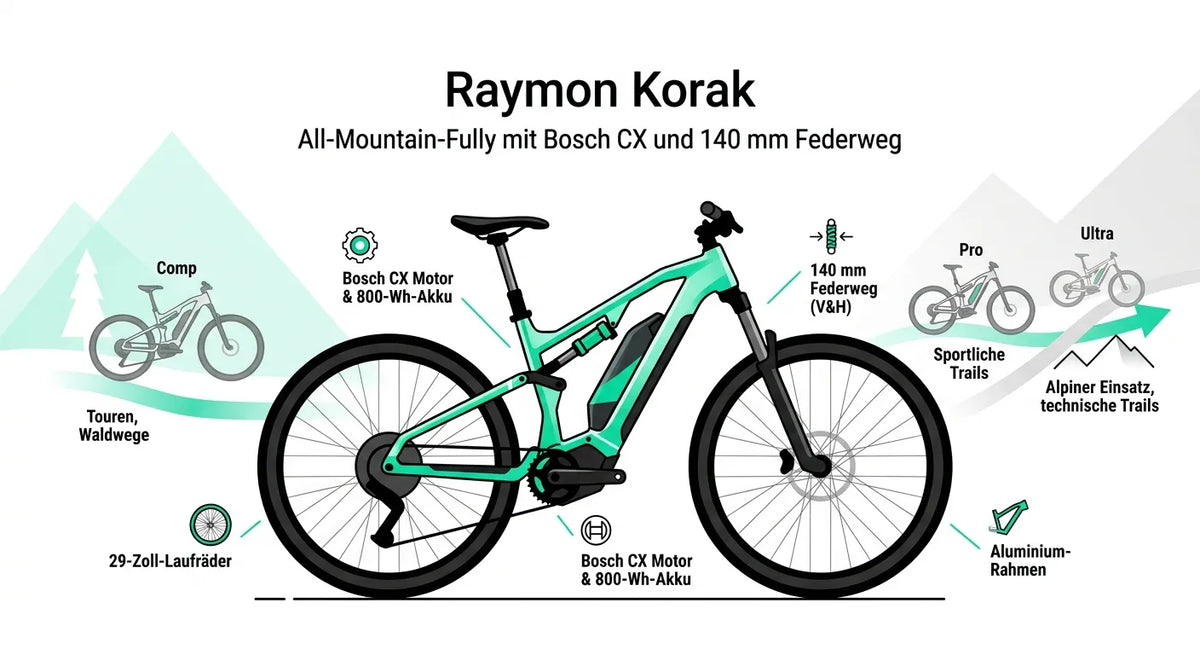
Raymon Korak: All-Mountain Full-Suspension Bike with Bosch CX and 140 mm Travel
Mornings commuting to work over asphalt and gravel paths, evenings climbing 600 vertical meters up the local mountain and back down via singletrack: the Raymon Korak is designed for exactly this kind of riding. It is a fully suspended all-mountain e-mountain bike with 140 mm of travel at the front and rear, 29-inch wheels, a Bosch Performance Line CX motor in the bottom bracket, and an 800 Wh battery in the downtube. All variants feature an aluminium frame, the battery is removable, and the maximum permitted system weight is 130 kg.
Two versions are available: the Korak Comp and the Korak Pro. Both share the same frame, suspension travel, motor and battery. They differ in suspension, gears, brakes, tyres, display and weight.
What are the differences between Raymon Korak Comp and Pro?
The differences mainly concern the suspension elements, the shifting system and the brakes. The weight decreases by 300 grams from the Comp to the Pro, and the shifting system changes from Shimano Cues with ten gears to Shimano Deore with twelve gears.
| Model | Suspension fork | Shock absorber | Drivetrain | Brakes | Weight | Compatible with |
|---|---|---|---|---|---|---|
| Korak Comp | SR Suntour XCR36X R Air, 140 mm | SR Suntour EdgeX R | Shimano Cues, 10-speed, 11–48T | Tektro Gemini SL, 4-piston | 26.0 kg | Touring, forest roads, moderate trails |
| Korak Pro | RockShox Psylo Silver RC air, 140 mm | RockShox Deluxe Select | Shimano Deore, 12-speed, 10–51T | Magura Luise Elite, 4-piston | 25.7 kg | sporty all-mountain riders |
Two clear examples can help you choose. If you mainly ride forest roads, gravel, and occasional trails and a solid basic setup is enough for you, the Comp is the right choice. If you regularly ride off-road and value finely tuned suspension components, twelve gears, and more braking power, the Pro is the more sensible option.The Comp is available in greige/taupe and steel blue/taupe, while the Pro comes in pipe grey/black and white/copper. Both models are available in frame sizes S to XL.
Raymon Korak Comp with Shimano Cues
The Comp is the entry-level model in the range and, compared to the Pro, omits features only in the suspension, gears and brakes, not in the drivetrain. At the front is an SR Suntour XCR36X R air suspension fork with 140 mm of travel, while the rear features an SR Suntour EdgeX R air shock with a 205x60 mm mounting size. Braking is provided by Tektro Gemini SL four-piston brakes, which have plenty of reserve power on long descents even with the rider and luggage. The Bosch Purion 200 serves as the display.
The gears are particularly interesting: Shimano CUES uses Linkglide technology with thicker, flatter-profiled teeth on the cassette. Shimano states that this offers significantly higher wear resistance compared to conventional Hyperglide cassettes. On an e-MTB, where the motor applies additional torque to the chain with every gear change, this pays off: longer cassette service intervals and less readjustment. Ten gears with 11–48T cover even steep ramps thanks to motor assistance. The range advantage of the 12-speed groupset only becomes apparent when you want to conserve the battery and climb at a low cadence in Eco mode.
Raymon Korak Pro with RockShox suspension and Shimano Deore
In the Pro, the added value lies almost entirely in the suspension and braking system. The RockShox Psylo Silver RC with 140 mm of travel and external compression and rebound adjustment responds more sensitively in the first third of its travel than the Suntour fork on the Comp, which noticeably improves traction and steering precision on rooty sections. At the rear is a RockShox Deluxe Select air shock, which harmonizes well with the drivetrain-neutral rear triangle and exhibits little pedal bob when walking.
Added to this is the Shimano Deore 12-speed with a 10–51T cassette, which offers one more finely graded gear on steep ramps than the 10-speed group. The Magura Luise Elite with four pistons requires less hand force than the Tektro system, which makes a difference on long descents. The Bosch Purion 400 is mounted on the handlebars. At 25.7 kg, the Pro weighs around 300 grams less than the Comp. For riders who move their Korak off-road several times a week, the Pro is the more balanced version.
Which motor is installed in the Raymon Korak and how much torque does it deliver?
In both Korak models, the fifth-generation Bosch Performance Line CX (BDU38) operates within the Bosch Smart System. The nominal power is 250 W, with peak power of 750 W. The control unit varies depending on the model: the Korak Comp uses the Bosch Purion 200, while the Korak Pro uses the Bosch Purion 400. Riding modes and settings are managed via the Bosch eBike Flow app.
In practice, two situations are crucial. If you have a long, consistently steep gravel climb ahead of you, constant power over time is what matters most: here, Turbo mode provides full assistance continuously but consumes the most energy. On the other hand, if you are riding a technical trail section with drops, switchbacks, and varying cadence, eMTB mode is the better choice. It automatically adjusts the assistance up and down based on pedal pressure, so you are less likely to spin out the rear wheel during sudden peaks in load.
The Korak comes pre-equipped for the Bosch Performance Upgrade 2.0. It is unlocked as software via the eBike Flow app and increases the maximum torque to up to 120 Nm, as well as the maximum assistance to up to 600 percent of your own pedaling power. You can then adjust the riding modes in the app using sliders, for example, towards more acceleration or a more economical setup.
Compared to the fourth generation, the noise level is particularly noticeable in everyday use. Bosch has eliminated the rattling of the freehub when struck off-road, and the motor runs more quietly under load. The higher-resolution torque and cadence sensors also ensure that the assistance engages more smoothly on slippery surfaces.
What kind of trails is the suspension with 140 mm of travel suitable for?
140 mm front and rear on 29-inch wheels is the classic all-mountain setup. The rear suspension is neutrally tuned to pedaling and is highly sensitive, while the large wheel diameter rolls over roots and steps more easily than 27.5 inches. This defines clear limits of use:
- Gravel paths and forest roads: significantly more comfort than a hardtail; on long climbs, it is worth closing the compression damping or using the lockout.
- Flow trails with berms and flat jumps: the Korak's preferred terrain, with the suspension travel remaining within its operating range during landings.
- Technical singletrack trails of difficulty S0 to S2: manageable, with the Pro benefiting especially from the RockShox suspension and more powerful Magura brakes.
- Bike parks, large drops, and continuous downhill riding: not intended. It lacks the suspension travel, tire volume, and suspension reserves for this.
The tires support this setup. The Korak Comp rolls on a 2.40-inch Schwalbe Nobby Nic, while the Pro uses a 2.35-inch Schwalbe Hans Dampf. If you mainly ride tours with a high proportion of asphalt and gravel, the Nobby Nic is the more efficient choice. If you prioritize descents, the Hans Dampf is the more suitable tread, and it can also be fitted to the Comp.
How much does the Raymon Korak weigh, and what frame size is right for me?
The frame is made of 6061 aluminum with the Boost standard. The Bosch PowerTube 800 is fully enclosed in the down tube and can be removed. The Comp weighs 26.0 kg, the Pro 25.7 kg. The maximum total weight is 130 kg. With a curb weight of 26 kg, this leaves around 104 kg for the rider, clothing, backpack, and accessories. Anyone using bikepacking bags should double-check this beforehand.
The following table lists body heights as guidelines. You can find the full geometry on the respective product page.
| Frame size | Rider height (guide) | Wheel size | Character |
|---|---|---|---|
| S | 160 to 170 cm | 29 inches | short reach, very agile on narrow trails |
| M | 170 to 178 cm | 29 inches | balanced between touring and trail riding |
| L | 178 to 188 cm | 29 inches | extended position, stable at speed |
| XL | 188 to 198 cm | 29 inches | maximum stability, needs space in tight corners |
When choosing between sizes, the intended use is the deciding factor. If you mainly ride fast, open descents and long tours, go for the larger frame: the extra reach provides more stability at speed. If your home trails are tight and twisty and you need to move around a lot, choose the smaller frame and level out your riding position with a longer stem. A dropper post is included with all models, so saddle height for descents is not a factor when choosing a size. The RAYMON Care program applies to the frame: with RAYMON Care, Raymon offers a lifetime warranty on the frame if registered online within 90 days of purchase. Raymon’s warranty terms and conditions apply.
Frequently Asked Questions about Raymon Korak
Can the battery be removed from the Raymon Korak for charging?
Yes. The Bosch PowerTube 800 is built into the down tube and can be removed, for example to charge it indoors or for winter storage. A lock secures it to the frame against theft. You can choose to charge it via the charging port on the bike or separately.
Can lights, mudguards, and a kickstand be retrofitted to the Raymon Korak?
The Korak Comp and Korak Pro come from the factory without lights or mudguards. A suitable kickstand can be mounted using the IC44 mount on the frame. You can add lights and mudguards separately; for road use, an approved lighting system must be retrofitted.
What distinguishes the Bosch CX Gen 5 from the previous Gen 4 motor?
The fifth generation runs more quietly and no longer rattles downhill because Bosch has eliminated play in the freehub. The cadence and torque sensors offer finer resolution, resulting in smoother assistance on slippery surfaces. On the software side, the Performance Upgrade 2.0 has been added, which unlocks up to 120 Nm of torque and 600 percent assistance.
How far can an e-mountain bike with an 800 Wh battery go?
A fixed mileage figure is of little significance for an e-mountain bike. The biggest impact on range is the assistance level, elevation profile, rider weight, outside temperature, and the tire pressure of the knobby tires. On flat gravel and asphalt routes in Eco mode, you will get significantly further than on steep climbs in eMTB or Turbo mode. In winter at temperatures around freezing, you should expect noticeably less capacity.
You can change your settings at any time to use all features of our website.
Edit cookie settingsWir helfen Dir gerne weiter!

Live-Chat
Telefon
Telefon
Telefonzeiten:
Mon - Fri 10:00 - 13:30 & 14:30 - 18:00
Sat 10:00 - 14:00
Telefon:
+49 2961 914 886 9
Kontaktformular
Kontaktformular
Outside our chat and phone hours, you can send us your request via the contact form.
E-Mail
Simply send us an email at verkauf@liquid-life.de and we will reply as quickly as possible. As we handle requests in the order received, there may be slight delays.
Bikeberater
Bonusprogramm